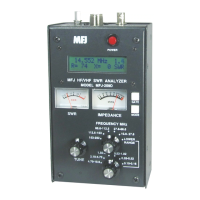
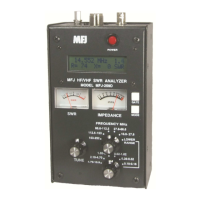
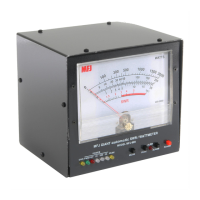
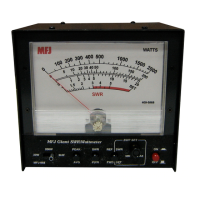
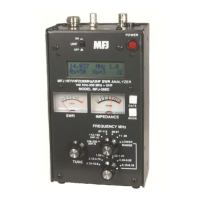
MFJ-269D Instruction Manual LF/HF/VHF/UHF SWR Analyzer
17
When a reactance is present, voltage and current are no longer in phase (or exactly out-of-phase) and so
the phase angle increases from 0 degrees to a maximum angle of 90 degrees. The angle becomes 90
degrees when the load is a pure reactance, and zero degrees when the load is a pure resistance.
This analyzer will determine the angle in degrees, but it will not describe the load reactance specifically
as either capacitive or inductive. It is a simple matter to determine the direction by adding a small
amount of reactance in series with the load and watching the angle change. If the angle decreases, the
load reactance is opposite to the sign or type of test reactance. If the angle increases, the load reactance
is the same sign as the added reactance.
5.4.1.2 Series Equivalent Impedance
The Advanced-1 display sub-mode is reached by pressing the Gate button once while in the Magnitude
and Phase of Load Impedance mode. This mode displays the series-equivalent impedance of the load.
It is the most common form used to describe antenna system impedance. In this mode, the load
impedance is described as a resistance in series with a reactance. In order to cancel the reactance
without changing the resistance, a reactance of the opposite type and value must be connected in series
with the load at the point of measurement.
The digital display shows SWR, resistive part of load impedance (Rs), and reactive part of load
impedance (Xs). The Impedance meter displays the Z in ohms while the SWR meter displays 50-ohm
referenced SWR.
Series Equivalent Impedance display examples:
7.1598 MHz 3.2
Rs=50 Xs= 62
14.095 MHz >31
Rs(Z>1500)
s
W
R
In the left-hand display (above), resistance would remain at 50 ohms, reactance would go to zero, and
SWR would become 1:1 if an opposite-sign reactance of 62 ohms was connected in series with the
feedline at the point where the measurement is made. The screen on the right illustrates a reactance value
out of measurement range.
Note: Every series impedance has a parallel equivalent counterpart. A Series Impedance of Rs=50,
Xs=62 is equal to the Parallel Equivalent Impedance of Rp=126, Xp=102 ohms. You can make the
conversion in this mode by pressing the Gate button (see section 5.4.1.3 below).
5.4.1.3 Parallel Equivalent Impedance
Pressing the Gate button twice from the Magnitude and Phase of Load Impedance mode toggles the
analyzer into a parallel equivalent impedance sub-mode.
Parallel equivalent display examples:
7.1598 MHz 3.2
Rs=126 Xs=102
14.095 MHz >31
Rs(Z>1500)
s
W
R
In the left hand display, the Equivalent Parallel Resistance is Rs=126 ohms. That resistance appears to
be in parallel with Xs=102 ohms. If we parallel connect an opposite-sign reactance of 102 ohms at the
measurement point, the parallel equivalent reactance is canceled, leaving only the Rs=126-ohm (pure)
resistance.
This is a powerful tool used in matching antennas, and the MFJ-269D places it at your fingertips. By
checking a load for both Rp and Rs, you can see if either one is close to the desired resistance. If one
resistance value is close to the desired value, adding only one component will match the load by
canceling reactance.


 To Next Page