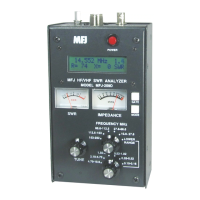
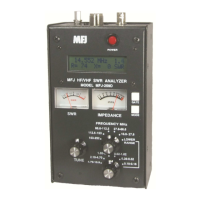
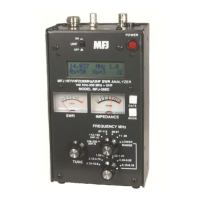
MFJ-269D Instruction Manual LF/HF/VHF/UHF SWR Analyzer
29
When tuning critical stubs, gradually trim the stub to frequency -- and adjust the feedline or stub using
the following method:
1. Determine the operating frequency and calculate the theoretical length for the feedline or stub.
2. Cut the stub or feedline 20% longer than the calculated length.
3a. Quarter-Wave: Measure frequency of the lowest resistance and reactance, or the lowest impedance
for odd quarter wave stubs. To fine tune, look only at the X= display and adjust frequency for X=0,
(or as close to X=0 as you can). That frequency should be about 20% below the desired operating
frequency if everything worked as planned during the length calculation.
3b. Half-Wave: Measure the frequency of highest Zo where the analyzer overflows and Z>1500 appears.
4. Divide the measured frequency by the desired frequency.
5. Multiply the result by the length of the feedline or stub to find the required length.
6. Cut the stub to the length calculated in step 5, and confirm lowest X is on he desired frequency.
The Distance to Fault mode can also be used. It will directly display the line length in degrees at any
frequency you choose. See section 5.5 Advanced 2.
7.2 Velocity Factor of Transmission Lines
The MFJ-269D accurately determines velocity factor of any transmission line. Select the Distance to
Fault mode in Advanced-2 (see section 5.5).
If balanced line is used, operate the MFJ-269D only from internal batteries and keep it a few feet away
from other conductors or earth. Do not attach any wires (other than the stub) to the unit. Use the
Antenna port shield for one lead and the center pin for the other. Two-wire balanced lines must be
suspended in a straight line a few feet away from metallic objects and ground.
Coaxial lines can lay on the floor and external power used (isolation net required). Coax is connect
normally, with the shield grounded.
The Distance to Fault mode measures the Electrical Length of a transmission line when a Vf of 1 is
entered. To obtain Vf factor for an unknown cable, you must know both the Electrical and Physical
length of the line. If the Length in Feet displayed (with a Vf entry of 1.0) is 75 feet, and the transmission
line actually measures 49.5 feet long, the velocity factor will be 49.5 divided by 75, for a result of 0.66
Vf.
Note: The far end of the line may be either open or shorted, but the line can not be terminated in any
impedance other than an open or short.
To confirm reliability, make two or more groups of measurements on different starting frequencies at
least one octave apart. If measured distances agree, they are almost certainly very reliable.
Use the following method:
1. Using procedures in 5.5 Advanced-2, measure distance to fault with Vf set at 1.00.
2. Measure the Physical Length of the line in feet.
3. Divide the measured Physical Length by the display reading.


 To Next Page