MFJ-495 Memory Keyer Instruction Manual
© 2001-2009 MFJ Enterprises, Inc. 13
spacing and the other number is the character spacing. Note the word space is always at least four units
longer than the inter-character space.
Keying Compensation
The Keying Compensation menu is used to increase the keying on-time and decrease the keying off-time
up to 25 milliseconds (ms). Some radios have a key delay of 5 ms or more. By setting 5 milliseconds of
compensation, the keyer will add 5 ms to the dots and dashes and subtract 5 ms from the intra-character
spaces. Although similar to increasing weight, this adjustment is independent of the speed. This setting
is used primarily to correct keying distortion by certain transceivers and to eliminate the problems with a
transmitter key delay.
Keying Delay
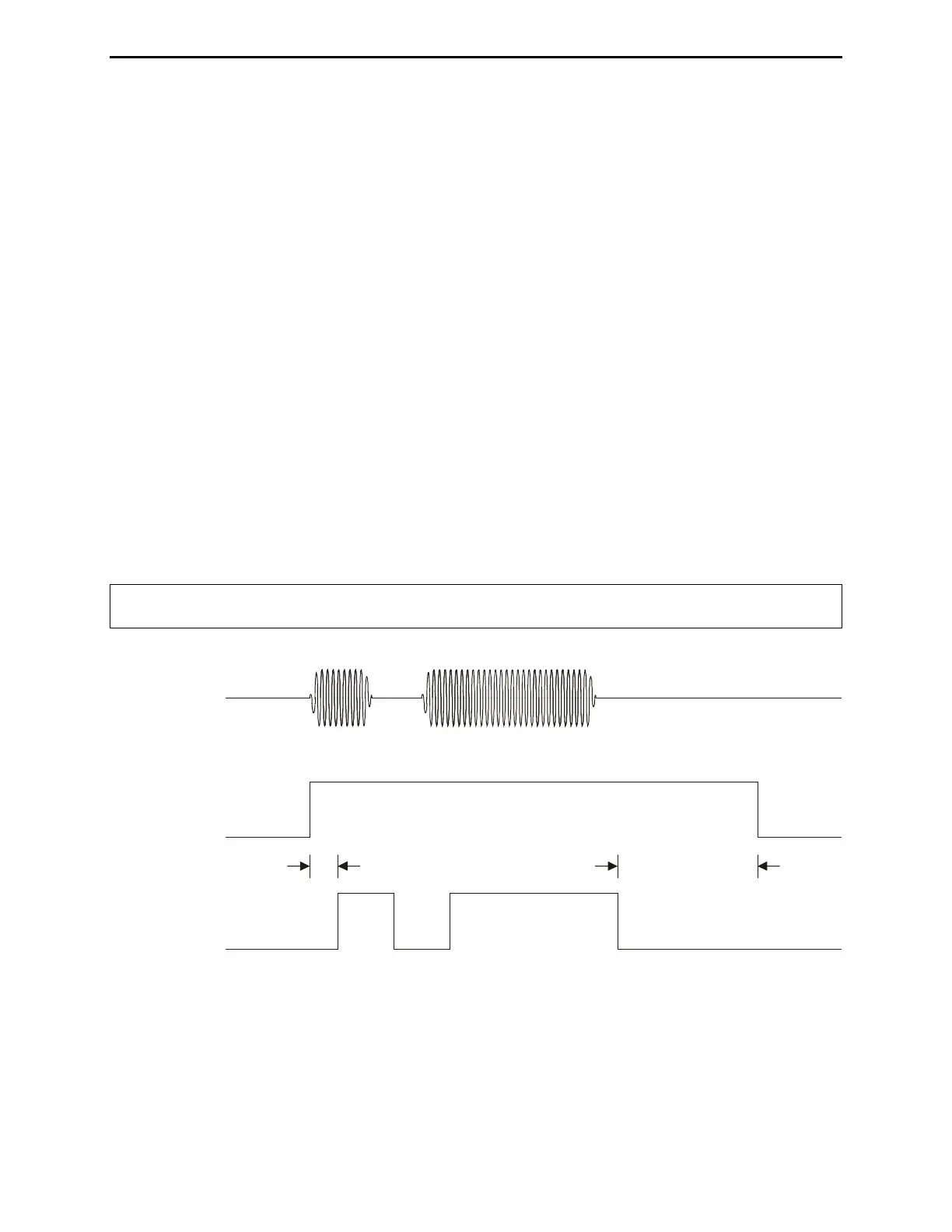
The Keying Delay menu is used to delay the keying output up to 20 milliseconds. This setting is used
primarily to accommodate switching delay in certain station setup. It is used in conjunction with the PTT
line to delay the keying output until all the switching is finished; that is, the keying output is lagged
behind the sidetone audio and the PTT output. This controls the time between when PTT is asserted and
when CW keying will start.
PTT Hang Time
The PTT Hang Time menu is used to set the PTT hang time from 1 to 9999 milliseconds. This controls
the time between when CW keying is ended and when the PTT will de-assert. You may adjust this to
your liking for on-the-air sending. Press the Up and Down buttons to change time in increments of 1 ms;
press and hold the Up and Down buttons to change time in increments of 100 ms.
Note: If Keying Delay and PTT Hang Time are equaled to zero, the PTT Output waveform will be
identical to the Keying Output waveform.
PTT Hang TimeKeying Delay
PTT Output
Keying Output
Sidetone Audio
Figure 7. Keying Delay and PTT Hang Time Timing.
Tone
The Tone menu allows you to set the audio frequency in the range of 305 to 1006 Hz. The MFJ-495
features smooth, clean audio, with sine wave output, instead of the harsh square wave audio used by many
other keyers. Also, the MFJ-495 produces each dit and dah with a rise and decay time of approximately


 To Next Page