MFJ-495 Memory Keyer Instruction Manual
© 2001-2009 MFJ Enterprises, Inc. 3
JMP1 JMP2 Keying Output
D D Direct *
D G Invalid
G D Invalid
G G Grid Block
Table 1. Keying Output Jumpers.
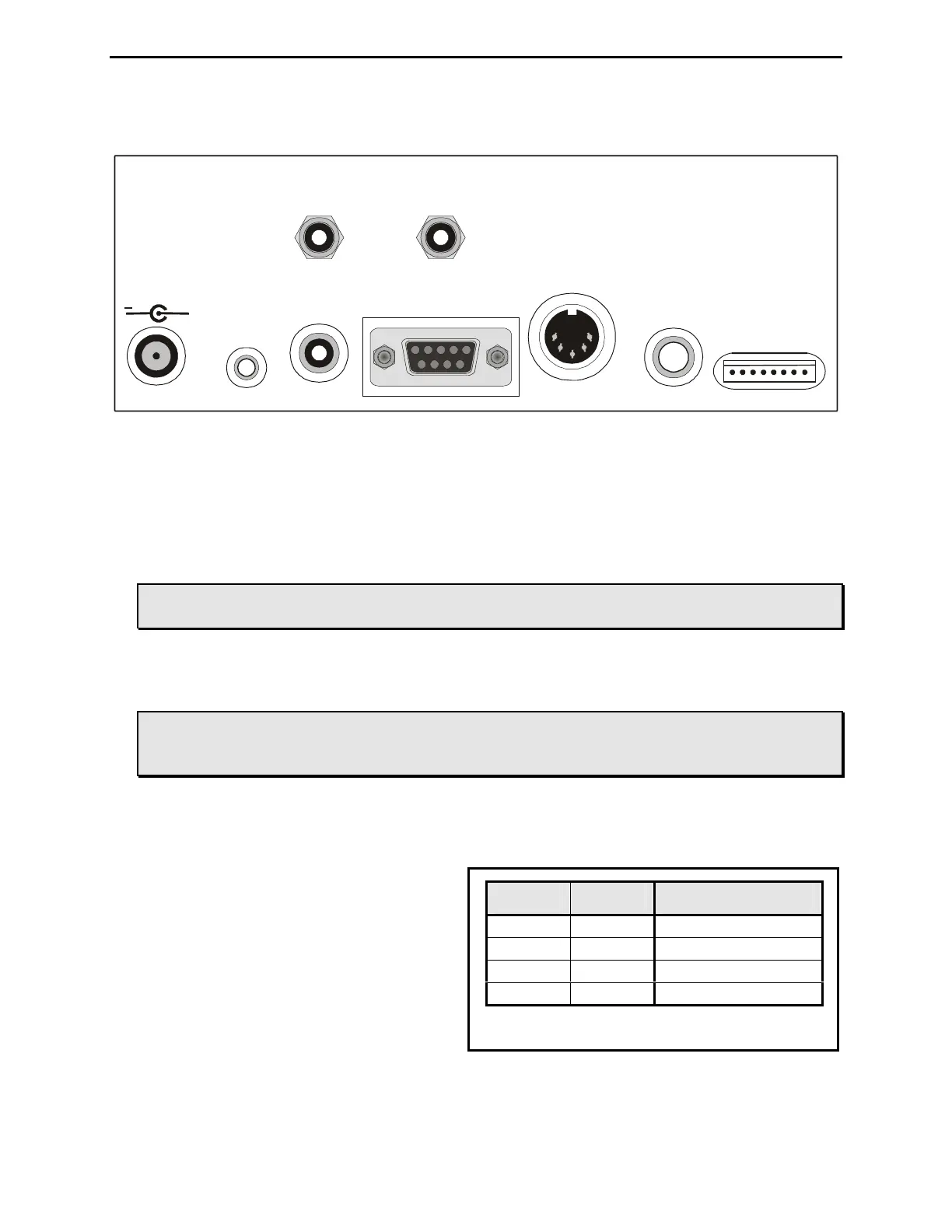
Back Panel
AUDIO
OUT
KEYBOARDPOWER
12VDC
+
KEY
INPUT
GND
DASH
DOT
F4
F3
F2
F1
MENU
MFJ ENTERPRISES, INC.
STARKVILLE, MS USA
SERIAL
PORT
KEYING
OUTPUT
REMOTE
MANUAL
KEY
PTT
OUTPUT
Figure 2. MFJ-495 Back Panel.
• Power: Accepts a standard 2.1 × 5.5 mm coaxial plug with positive center and negative sleeve. This
unit requires 12 volts DC. An optional 500 mA power supply, the MFJ-1315, is available from MFJ
Enterprises, Inc. This unit requires a minimum of 50 mA at no volume and without using a keyboard
and a maximum of 300 mA at maximum volume into an 8-ohm audio load with a typical keyboard. It
may require more current depending on the keyboard used; typical keyboard uses about 100 mA.
WARNING: Do not apply voltages greater that 18 volts to this unit, or permanent damage
to the unit may result.
• Audio Out: A 3.5 mm stereo phone jack for connecting to an external speaker or headphones. This
jack accepts both stereo and mono plugs. When this jack is used, the internal speaker is disabled. An
optional external speaker, the MFJ-281, is available from MFJ Enterprises, Inc.
WARNING: To prevent suffering hearing damage when using headphones, turn the
Volume control to minimum before putting on the headphones and then
slowly adjust for a comfortable volume.
• PTT Output: An RCA jack providing connection for a PTT (push-to-talk) output that goes low
when active. This jack is an open-drain output; an external pull-up can be used if so desired. Use a
quality-shielded cable for connection to this jack.
• Keying Output: This unit supports both
positive and negative keyed radios. Use a
quality-shielded cable for connection to this
RCA jack. Consult your transmitter's manual
to determine if it uses direct (positive) or
grid-block (negative) keying.
Two jumpers JMP1 and JMP2 inside the unit
set the keying output to direct for positive
keyed radios (most solid-state radios) or to
grid-block for negative keyed radios (most


 To Next Page