Rotary Microtome HM 340 E
MICROM International GmbH
Robert-Bosch-Str. 49
D- 69190 Walldorf 386 200 - English
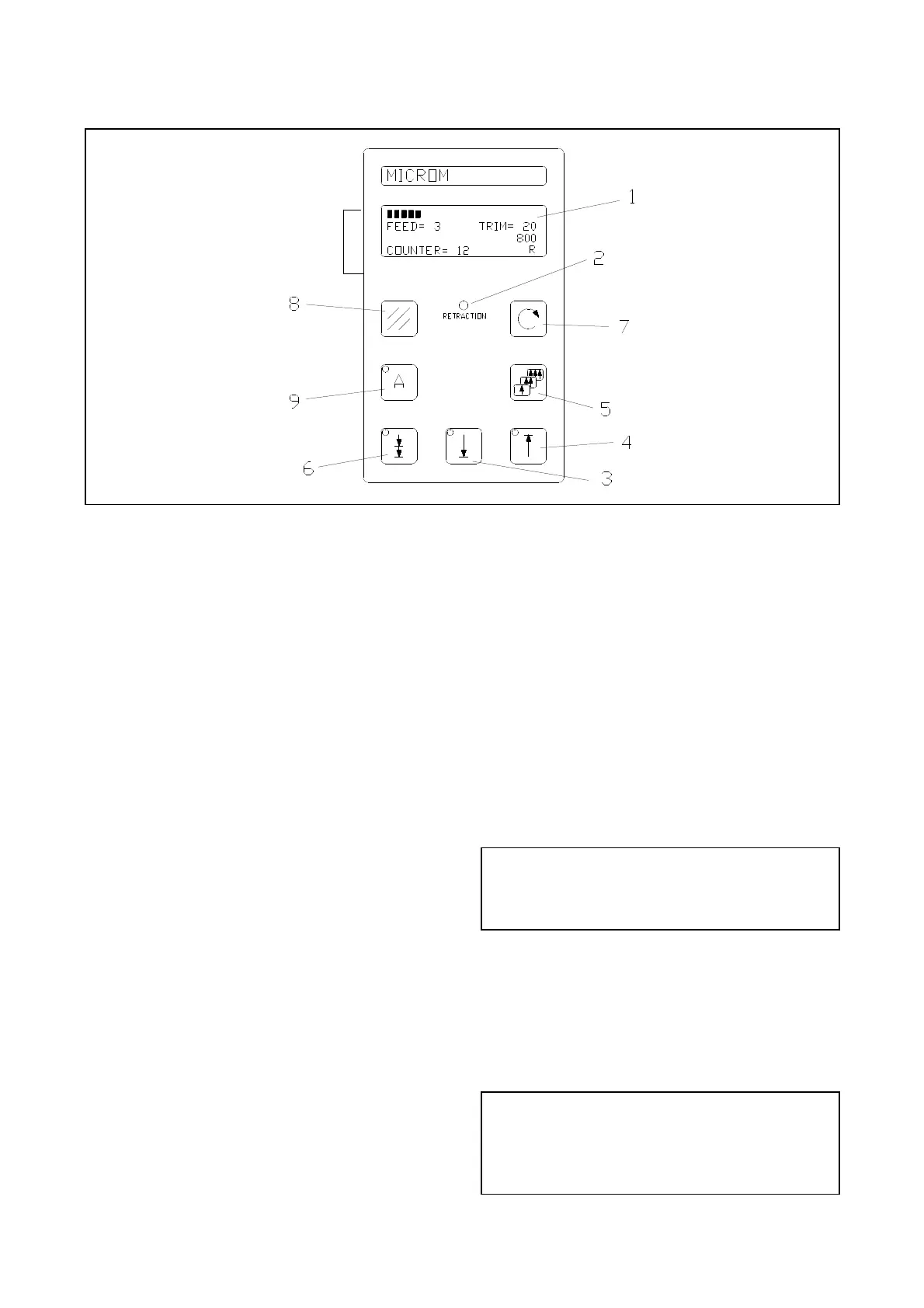
Fig. 6
2-6 SPECIMEN FEED
2-6-1 COARSE FEED AND SPEED
FOR COARSE FEED
For the fast forward and backward travel between
specimen and knife edge, the microtome has a
motorized coarse feed system. The specimen
holder is moved to the front as long as the button
<coarse feed forwards> (fig. 6.3) is pressed. To
move the specimen holder backwards, press the
button <coarse feed backwards> (fig. 6.4).
The instrument carries out movements of various
lengths according to how long the button (fig. 6.4)
is pressed. Press the button (fig. 6.4) only very
briefly and the specimen holder moves backwards
by a fixed value of 2 µm. If the button (fig. 6.4) is
pressed a little bit longer (not longer than 2
seconds), the specimen holder moves backwards as
long as the button is being pressed. If the button
(fig. 6.4) is pressed for more than 2 sec., the
specimen holder moves automatically to the back
end position and the motorized coarse feed shuts
off. This function can be stopped at any time. For
this, shortly press the button (fig. 6.4) again.
When the back end position is reached, the red
LED in button (fig. 6.4) lights up.
When the front end position of the specimen
movement is reached, the red LED in button (fig.
6.3.) lights up.
Three different speeds for the coarse feed are
available: 400, 800 and 1200 µm/s. To select or
change the speed, press button <speed coarse
feed> (fig. 6.5) until the required speed is shown
in the third line on the right side of the display
(fig. 6.1). When the instrument is turned on, the
speed 1200 µm/s is shown automatically on the
display. Press the button (fig. 6.5) once and the
speed 800 µm/s is shown on the display. Press the
button (fig. 6.5) again and the display shows the
speed 400 µm/s. If the button (fig. 6.5) is activated
for a third time, the speed 1200 µm/s will be
shown again on the display.
CAUTION! With the function <coarse feed
forwards> specimen and knife edge are adjusted
very quickly. To avoid damages to specimen and
knife, carefully observe this adjustment process.
Take note that the specimen and knife edge do not
come in contact with each other. Carefully observe
the narrowing gap between knife edge and
specimen to stop the function <coarse feed
forwards> in time before the specimen touches the
knife edge.
NOTE! At the beginning of a sectioning series, it
is advisable to use the coarse feed to move the
specimen to the back third of the horizontal
specimen movement and to move the knife carrier
towards the specimen.


 To Next Page
 Loading...