Rotary Microtome HM 340 E
MICROM International GmbH
Robert-Bosch-Str. 49
D- 69190 Walldorf 386 200 - English
2-10 SPECIMEN CLAMPING
To clamp specimens, different specimen clamping
systems are available. With the orienting adapter it
is simple to align the specimen properly in relation
to the knife.
2-10-1 UNIVERSAL CASSETTE CLAMP
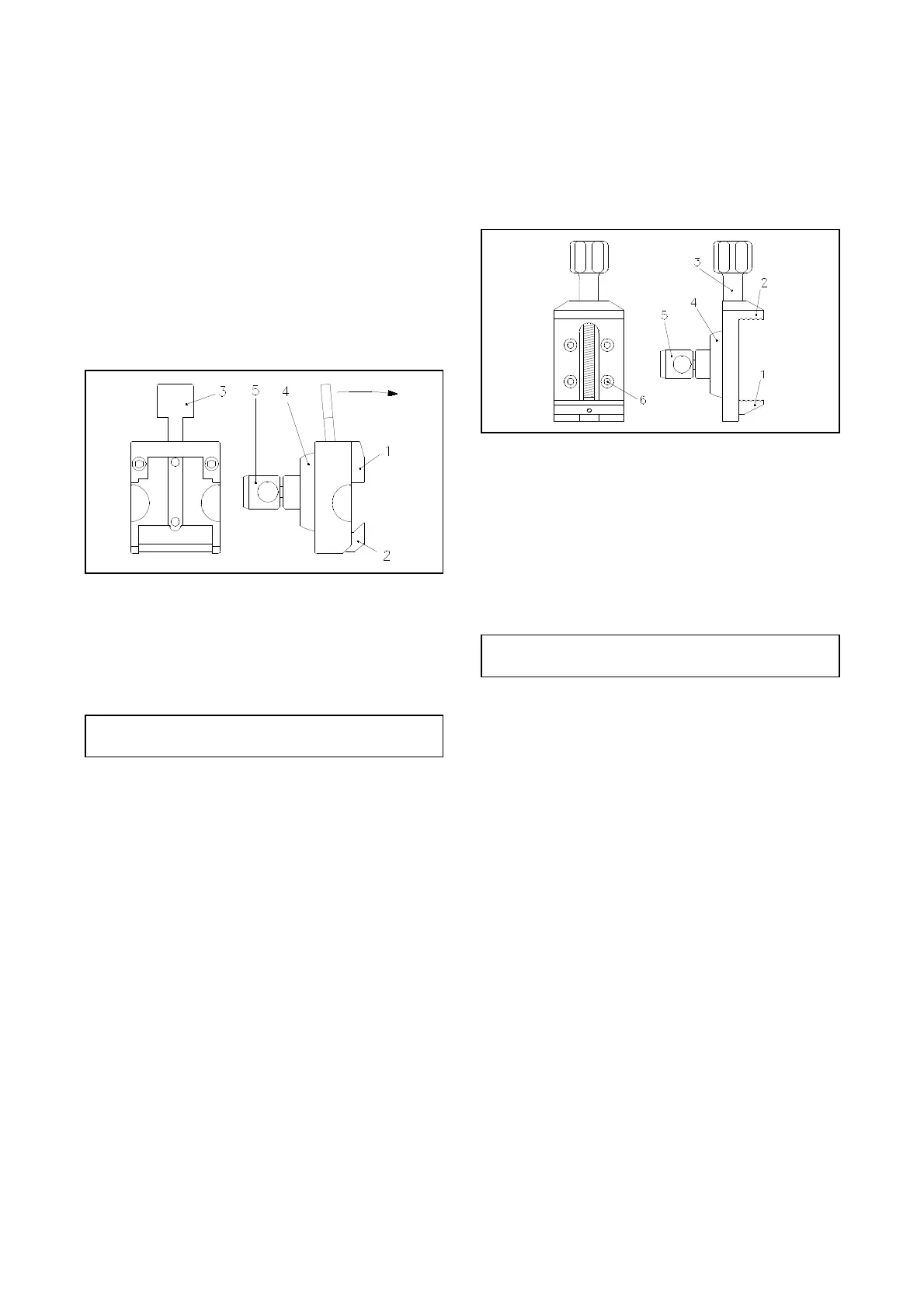
The universal cassette clamp (fig. 7) represents a
quick change system.
Fig. 7
To insert or remove the cassette from between the
fixed (fig. 7.1) and movable (fig. 7.2) jaws, pull
the lever (fig. 7.3) to the front.
CAUTION! To achieve an optimal clamping keep
the locating surface of the cassette free of paraffin.
2-10-2 STANDARD SPECIMEN CLAMP
The standard specimen clamp (fig. 8) is used for
rectangular and square paraffin and plastic blocks.
Fig. 8
Insert the specimen against the fixed jaw (fig. 8.2)
first. Then turn the knob (fig. 8.3) to tighten the
jaw (fig. 8.1). Fig. 8.4 and 8.5 show the orienting
adapter (see 2-11-2, adapter, orienting, specimen
orientation), fig. 8.6 indicates the four holes for
the fastening screws.
NOTE! For the stability of the specimen, do not
let it project over the clamping jaws too much.
The standard specimen clamp is supplied with two
movable jaws, which are different in weight.
The lightweight jaw is used in addition with
inserts for round specimens.
The heavier jaw is intended to be used together
with the standard specimen clamp with no other
holding elements.
To exchange the clamping jaw, unscrew the
clamping screw (fig. 8.3) to remove the jaw and
replace it with the other one.



 To Next Page