5Instruction Manual
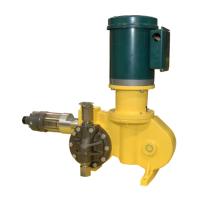
Reference the drawing for pneumatic capacity
control assembly and operating principles
(pages 3 and 4) for a schematic and cross section
representation of the pneumatic capacity control
positioner mounted on the mRoy pump. The
assembly consists of three major sections as
follows:
1. The Moore Products Company, Model 73N air
control valve which continuously compares the
location of the piston in the pneumatic cylinder
with the instrument air pressure and regulates
the supply air pressure imposed on one side
of the piston to obtain the required piston
position.
2. The pneumatic cylinder, with a differential area
piston, is the device that moves the capacity
control spool of the pump in response to the
metered supply pressure from the air control
valve. The cylinder is made of a clear impact
resistant plastic, so that the position of the
piston is visible at all times for comparison
against a “Percent Capacity” decal. (Read
percent capacity at the black line of the O-ring
contact).
3. The mounting ange, which is used to rigidly
mount the assembly onto the standard
production mRoy pump assembly, forms the
end of the pneumatic cylinder and seals off the
I.D. of the piston to establish a differential area
between the two sides of the piston.
At time of installation, the instrument air pressure
(Pi) and the supply air pressure (Ps) are connected
to the corresponding ttings in the air control valve.
The supply air (Ps) is routed internally to the pilot
valve and it is also routed unrestricted, internally
through the cylinder wall onto the small area (pump
side) of the differential area piston. The instrument
air pressure (Pi) is routed to a “dead end” cavity
formed by the exible diaphragm assembly.
As shown by the schematic, the supply pressure
imposed on the small area side of the piston
creates a force to move the piston until it bears
against, and compresses, the range spring. The
range spring in turn is supported by the exible
diaphragm assembly which bears against the stiff
suppression spring. The diaphragm assembly is
then a moveable element between two opposing
spring forces. This movement of the diaphragm
assembly is transmitted to the pilot valve which
acts to either increase or decrease the metered
supply air pressure (Psm) imposed on the large
area side of the piston. The relationship of metered
supply pressure (Psm) on one side and full supply
pressure (Ps) on the other side of the differentially
area piston is used to establish and maintain the
required capacity control position. A xed air bleed
is incorporated in the metered supply ‘pressure
chamber which will maintain a small air ow across
the pilot valve to provide instant response to any
changes in the operating conditions.
SECTION 1 - PNEUMATIC CAPACITY CONTROL



 To Next Page