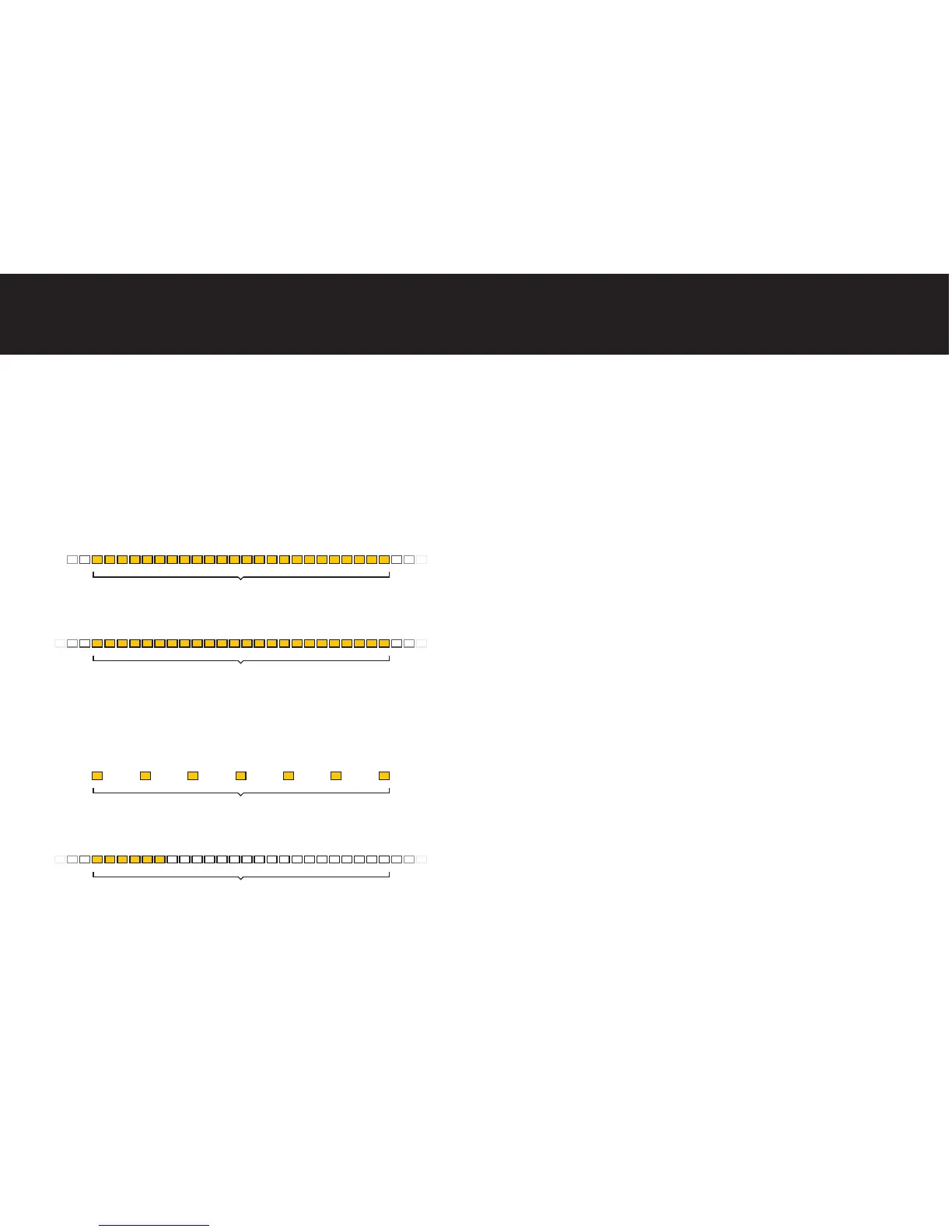
Abbreviated FPS, it just means how many pictures fit in a second
of video footage. Most videos are either 24 or 30 FPS.
This refers to the speed at which individual pictures/frames will
be played back. Since a video is essentially a collection of photos,
Playback FPS means how many pictures will be shown in one
second. Most videos playback at 24 or 30 FPS.
With a traditional video, the Recorded FPS and the Playback FPS
are the same; and thus, you don’t have to worry about it. In time-
lapse photography you control the Recorded FPS (interval between
photos) to achieve your desired results. Time-lapse photography
works by taking pictures at long intervals and playing them back
much faster, usually at 24 or 30 FPS.
Example: If photos are taken using a 15 second interval and played
back at 30 FPS, the video will playback 450 times faster than real-
time, and 12 hours will be compressed into just 96 seconds.
This is the number of pictures taken per second. Since time-lapse
photography requires taking pictures one or more seconds apart,
it is more practical to call it Interval. A long interval means that
photos will be taken further apart; while, a short interval captures
images in quick succession. For reference, traditional movies
are recorded at 24 FPS which means each picture is taken at an
interval of 1/24 seconds. In contrast, taking pictures in 2 second
intervals would be .5 FPS.
Frames per Second
Recorded FPS
Playback FPS
14
WHAT IS TIME-LAPSE?
Time-lapse photography is the process of capturing an event that
happens over a long period of time and playing it back as a video
of much shorter duration. While DSLR cameras are great, they are
not specifically designed to take time-lapse videos. For this reason
it is important to understand some basic concepts of time-lapse
photography and its potential pitfalls in order to achieve the best
results.
13



 To Next Page