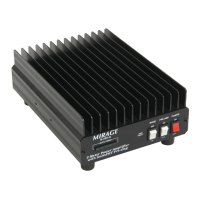
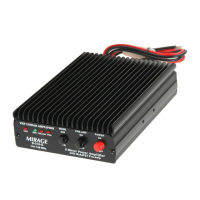
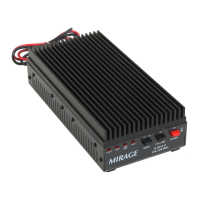
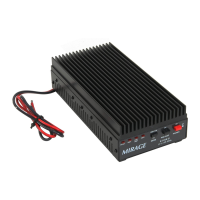
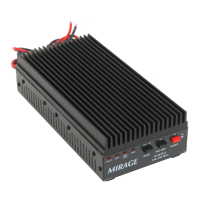
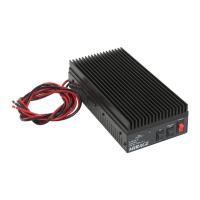
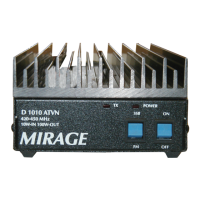
MIRAGE BD-35 Dual Band Amplifier
5
During 145MHz / 435MHz crossband full duplex operation, there may be
some minor interferences such as noise on certain frequencies (depending
on the combination of Transmit / Receive frequencies selected). Select
TX/RX frequencies which show no interferences and/or trouble especially
with a 145MHz band transmission and a 435MHz reception. Select
frequencies that are not mutually harmonic.
With some regulated DC power supplies, the output voltage may rise to an
abnormal level, resulting from malfunctions due to RF signal intrusion.
Therefore, use a power supply with sufficient current capacity as well as with
good protection against RF intrusion. If the power supply malfunctions,
discontinue operation by turning the power switch off.
If the amplifiers power cables are connected in reverse polarity, the cables
could sustain damage, especially when your source is a battery. Be sure to
check the polarity before connection!
After confirmation of proper connections, etc., turn the power switch
ON
.
Transmit either a 146MHz or a 440MHz signal to the antenna and confirm the
SWR and that the proper LED is illuminated for the band of operation. Switch
the band of operation to the opposite and of the one selected above and
transmit again to confirm that the amplifier has detected the proper band
(once again, by the illuminated LED) and SWR.
TROUBLESHOOTING:
The Mirage BD-35 is designed for long, trouble-free performance and should
not require extensive troubleshooting in the field. If difficulty is encountered,
check the following before assuming the amplifier has a malfunction:
1. Loose antenna or power supply connections
2. VSWR of the antenna system
3. Coaxial cables from radio to amplifier, and amplifier to antenna
4. Output voltage of power supply
5. Power output of radio
6. Improper fuse rating


 To Next Page