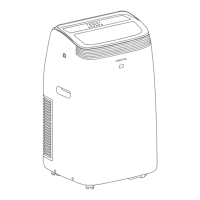
This document describes the Mistral Portable Air Conditioner, Model: MA02016KRY30, a portable air conditioning unit designed for household use. It functions as an air conditioner, dehumidifier, and fan, offering various modes to suit different environmental needs. The unit is designed for easy portability with omni-directional wheels and includes a remote control for convenient operation.
Function Description
The Mistral Portable Air Conditioner is a versatile appliance that provides cooling, dehumidifying, and fan functions.
- Cooling Mode: In this primary mode, the unit cools the room by expelling warm exhaust air outside through an exhaust hose. Users can adjust the desired temperature and fan speed (high, mid, low). The unit defaults to 22°C with low fan speed upon activation.
- Dehumidifying Mode: This mode is designed to remove excess humidity from the room without significant cooling. The unit collects water, which must be discharged regularly. For continuous dehumidification, a drain hose can be connected for constant draining. In this mode, the fan speed is pre-set to low, and the sleep function cannot be activated. The exhaust hose is not required for this mode.
- Fan Mode: In fan mode, the unit circulates air without cooling or dehumidifying. Users can select high, mid, or low fan speeds. The exhaust hose is optional; it can be used to remove stale or smoky air from the room if desired. Temperature adjustment and sleep function are not available in fan mode.
The air conditioner features an auto-water-evaporating system, where condensed water is used to cool the condenser, enhancing cooling efficiency and saving energy. If the internal water tank becomes full, a "Water Full" indicator will flash, and the unit will enter standby mode until the tank is emptied.
Usage Features
The portable air conditioner offers several features to enhance user experience and convenience:
- Control Panel and Remote Control: The unit can be operated using either the control panel on the top cover or the included remote control. The remote control allows for convenient adjustment of settings from a distance.
- Temperature Adjustment: In cooling mode, the temperature can be set between 16°C and 31°C, with increments of 1°C. The display shows the selected temperature.
- Fan Speed Selection: Users can choose between high, mid, and low fan speeds in cooling and fan modes to control airflow intensity.
- Swing Function: The air deflector can be set to swing continuously up and down to distribute air evenly throughout the room. Pressing the swing button again will stop the deflector in its current position.
- Timer Function: The timer allows users to program the unit to automatically turn ON or OFF after a delay of 1 to 24 hours. This can be set in both power-on and standby modes.
- Sleep Function: In cooling mode, activating the sleep function sets the fan speed to low. The set temperature will gradually increase by 1°C after the first hour and another 1°C after the second hour, remaining at that temperature to prevent the room from becoming too cold during the night. This function is not available in dehumidifying or fan modes.
- Auto Restart: In the event of a power failure, the unit will automatically resume operation with its previous settings (excluding Timer, Sleep, and Swing functions) once power is restored.
- Installation: The unit requires placement near a window or opening for the exhaust hose to vent warm air outside. It should be on a flat floor with at least 50cm clearance around it. The flexible exhaust hose can extend up to 1.5m, but it is recommended to keep it as short as possible for optimal performance. A window slider kit is provided for easy installation in standard vertical and horizontal sliding windows.
- Economical Operation Hints: To maximize efficiency, users are advised to keep doors and windows closed during cooling or dehumidifying, position the unit in shaded areas, close fireplace dampers and wall registers, keep blinds and drapes closed during sunny periods, ensure proper home insulation, use external house shading, and regularly clean the air filter.
Maintenance Features
Regular maintenance is crucial for the optimal performance and longevity of the air conditioner:
- Cleaning the Air Filter: The air filter should be cleaned every two weeks, or more frequently depending on indoor air quality, as a clogged filter reduces airflow and efficiency. To clean, turn off and unplug the unit, remove the screws on the bottom of the filter, and take off the upper and lower filters. Dust and dirt can be removed with a vacuum cleaner. For very dirty filters, wash them in lukewarm soapy water with a mild detergent, rub gently with a brush, and then wipe with a soft cloth and dry in the shade. Do not use harsh cleaners, hot water, or a dishwasher. Ensure filters are completely dry before reinstalling.
- Cleaning the Unit Case: The exterior of the unit can be wiped with a slightly damp cloth and then dried with a dry cloth towel. Avoid pouring water onto or into the unit, and do not use gasoline, thinner, or other chemicals, as these can damage the finish and plastic parts.
- Draining Water: When the "Water Full" indicator flashes, the internal water tank needs to be emptied. Disconnect the appliance from power, and if in cooling mode, detach the exhaust hose. Move the unit to a suitable drain location or outdoors, or place a pan under the drain port. Pull out the drain plug from the Drain Port to drain the water. Reinstall the drain plug securely once empty.
- Long Idle Period / Before First Use: Before prolonged storage or after a long idle period, drain all water from the unit. Run the fan for a few hours to thoroughly dry the interior. Clean the filter and outer surface, ensuring they are completely dry before reinstalling the filter. Remove batteries from the remote control and store the unit in a clean, dry location away from direct sunlight, extreme temperatures, and excessive dust. Remove and store the air exhaust hose.
- Refrigerant System Maintenance: The manual provides detailed instructions for servicing the refrigerant circuit, emphasizing safety precautions due to the use of flammable refrigerant (R32). This includes checks for ignition sources, proper ventilation, use of appropriate tools, and adherence to manufacturer guidelines for repairs, charging, and decommissioning. Only competent persons should carry out procedures affecting the refrigerant circuit.
The manual strongly advises against disassembling, overhauling, or modifying the machine arbitrarily, as this can lead to malfunctions or harm. It also warns against using extension cords, double adaptors, or power boards, recommending direct plugging into a domestic power outlet.


 To Next Page
 General