The waterway on the quarter deck is fit-
ted similarly, except it is flush with the
1/16” thick deck planks
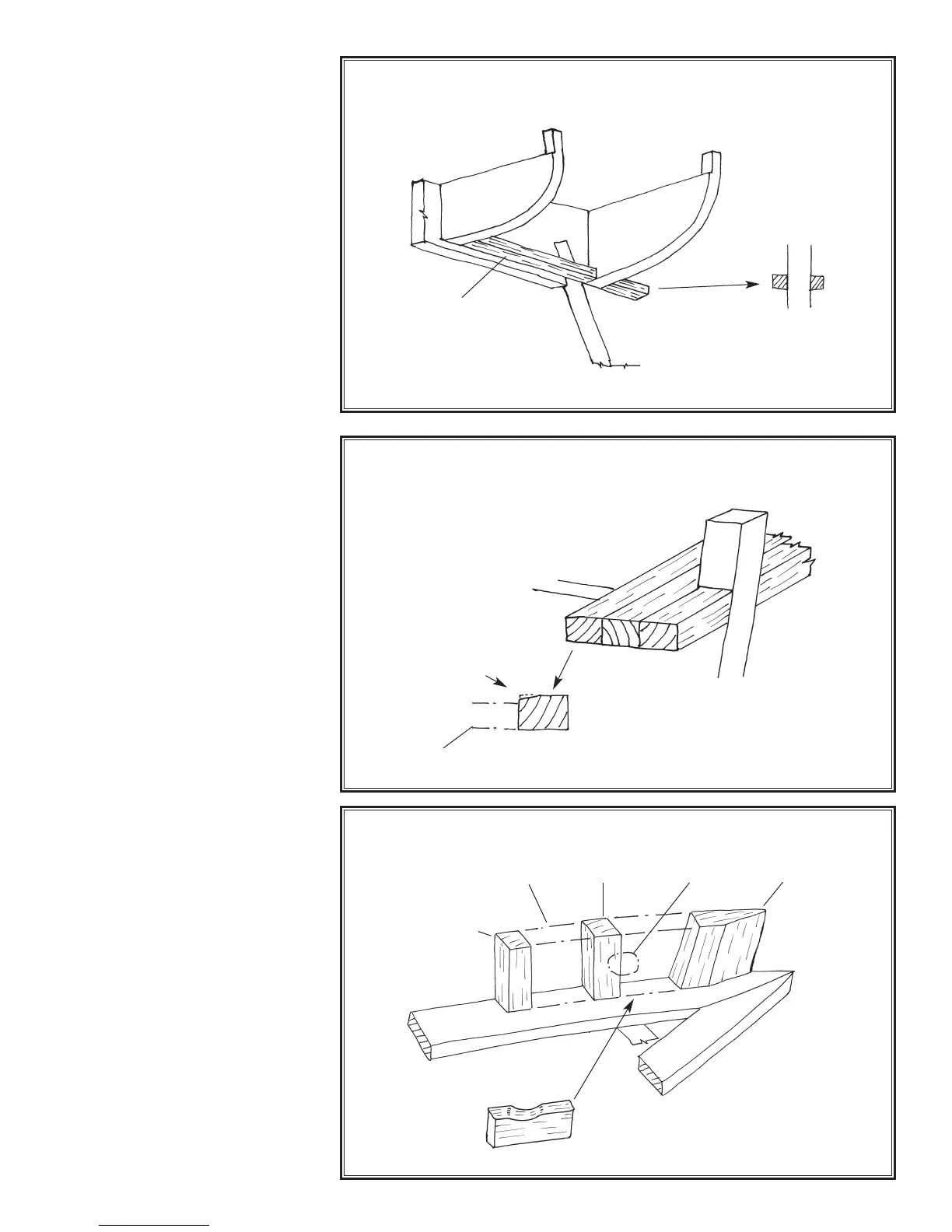
11. Installing the Knightheads
& Hawse Timbers
Knightheads and hawse timbers are 1/8”
thick. On the real ship, hawse timbers
angle forward. After mounting them, drill
the hawse holes, then add the anchor
cable chafing block (Figure 1-12).
Option: Use a solid sheet for the hawse
timbers and knightheads.
12. Installing the Main Rail
The forward and aft main rails are laser
cut, but make the middle portions from
stripwood. Use a scarf joint about every 6
inches, and position the rail with pins
(Figure 1-13). Be careful how the rail is
aligned. Remember, it must evenly over-
hang the hull planking and bulwark stan-
chions. When properly positioned, glue
the segments to the stanchions.
Note: The main rail is wider where
belaying pins are located.
13. Installing the Buffalo Rail,
Monkey Board
& Monkey Rail
Only the forward and aft sections of
these rails are laser cut. Fashion the mid-
dle sections from stripwood. Install like
the main rail, keeping alignment in mind.
The forward buffalo rail is 1/8” thick.
However, it may be supplied as two 1/16”
pieces. Simply glue them together. After the
rail is in place, taper accor
ding to the plans.
The monkey rail has a round section at
the deck step. Carve this fr
om stripwood.
When af
fixing the rails, be sur
e to clean
up any excess glue ar
ound the joints.
Clean joints are a must.
14. Installing the Remaining
Bulwark Stanchions
Fashion the three bulwark stanchions
between each bulkhead from 1/8” square
strip. Place a scrap plank outboard to main-
tain the proper alignment when mounting
them (Figur
e 1-14).
13
Fig. 1-10 Horn Timbers
Horn
Timber
Fig. 1-11 Fore Deck Waterway Planks
Bevel Edge
Deck Plank
Fig. 1-12 Knighthead & Hawse Timbers
Fill in for Hawse
Timbers
Fake
Stanchion
Chafe Block
Bulkhead A Drill Hole Knighthead


 To Next Page