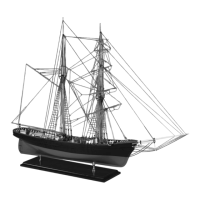
The alternative approach is to install
the coamings, hatches, and deck struc-
tures on top of the deck, but remem-
ber to reduce their height by 1/16”.
Deck Planks:
Deck planks are 1/16”
thick. They taper going aft on the
quarter deck, and run more parallel to
the cabin than the centerline. To omit
this detail, run planks parallel to the
centerline without tapering. While not
completely accurate, it will still look
presentable. Planks are parallel to the
centerline on the fore deck.
Prepare a deck plank by painting one
edge black or dark brown to simulate
caulking. Be careful! Too much paint
will penetrate too deeply with
unsightly results. Do a test first. If it
doesn’t work, edge glue the planks
with brown woodworker’s glue. This
adhesive dries dark enough to repli-
cate caulking.
Procedure:
Start deck planking at the
centerline and work outboard. Scrape
off any glue that squeezes out before
adding the next plank. Butts can be
included or omitted. On the real ship,
they don’t show up as readily as the
seams. Butts can also be scribed after
the plank is laid. If desired, fasten
planks with brads or treenails (see
hull plank discussion).
Nibbing Strakes:
A nibbing strake goes
where deck planks meet the waterways.
Installation is a little tedious, so the
strake could be omitted and the deck
planks feathered instead (Figure 2-10).
Completing the
Basic Hull Structure
Thoroughly examine the hull for
starved glue joints. Fill these with
wood glue or model spackling com-
pound, then smooth the hull,
buwarks, and deck with sandpaper
.
Mounting the Hull
Mount the hull as soon as basic fram-
ing and planking are completed to
prevent damaging fittings when han-
dling the model. Proper mounting is
important, because future alignments
will require a true waterline. Two
brass pedestals and a baseboard are
supplied. Another approach to dis-
playing the model is on a launching
ways. Scratch build the platform or
purchase the kit. Model Expo sells
them (MSL0010, 0018, 0024).
Models should be cased to protect
them from dirt and damage.
Furthermore, most competitions
require entries to be cased. A case is a
cheap insurance policy. However, the
kit’s baseboard may be too small to
serve as the base for the case. A case’s
outside diameter should be 4” longer
than the model (2” for
e and aft), 4”
wider (2” port and starboard) and 2”
higher. If the baseboard doesn’t mea-
sure 36-3/4” long by 9-1/4” wide,
make a new one to accept a case
.
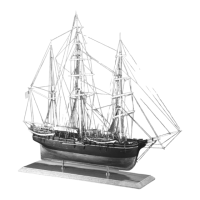
1. Mounting Board
with Two Pedestals
Round the top edges of the baseboard
or cut a simple chamfer. Those with
access to a router can cut mouldings
along the edges. Paint or stain the
baseboard. Alternatives: Prefinished
baseboards are available or make your
own from basswood, cherry, walnut,
bubinga, or rosewood.
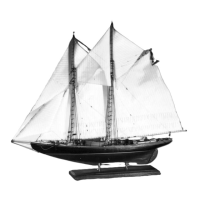
Mount the model with the waterline
parallel to the baseboard. Because
Bluenose has a slight drag to her keel,
the forwar
d pedestal is a little taller
than the aft one. Drill pilot holes in the
keel and baseboard for the pedestal
scr
ews. If something goes awry and
the balance is off, add a brass shim
under one pedestal to corr
ect it.
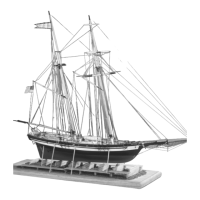
2. Launching Ways
Models without sails display best on a
launching ways. They are easy to
assemble and fasten to a baseboar
d.
With a large enough baseboard, a
builder can cr
eate a diorama based on
a shipyard activity. Drill holes in the
keel for the anchoring rods, then fol-
low the directions to achieve the prop-
er waterline level.
Note: Stain or paint the baseboard or
launching ways before mounting the hull.
19
Stage 3
Stage 4


 To Next Page