By the early 1900s, the fishing schooner had developed
into a fast, efficient vessel. American and Canadian
schooners were similar in design. Both operated on the
Grand Banks off Nova Scotia. They carried 10 or more
small dories from which two-man crews fished.
In the days before refrigeration, fishing schooners had to
be fast, or their catch would spoil before it reached market.
Grand Banks’ schooners were divided into two classes:
those carrying ice as a preservative and staying out two or
three weeks, and the salt bankers that fished until their
hulls were full. The latter made two or three trips a season
and were hauled out in winter.
In the United States, most schooners’ home port was
Gloucester, Massachusetts. These became known as
Gloucester fishermen, or just Gloucestermen. In Canada,
the boats hailed from Nova Scotia.
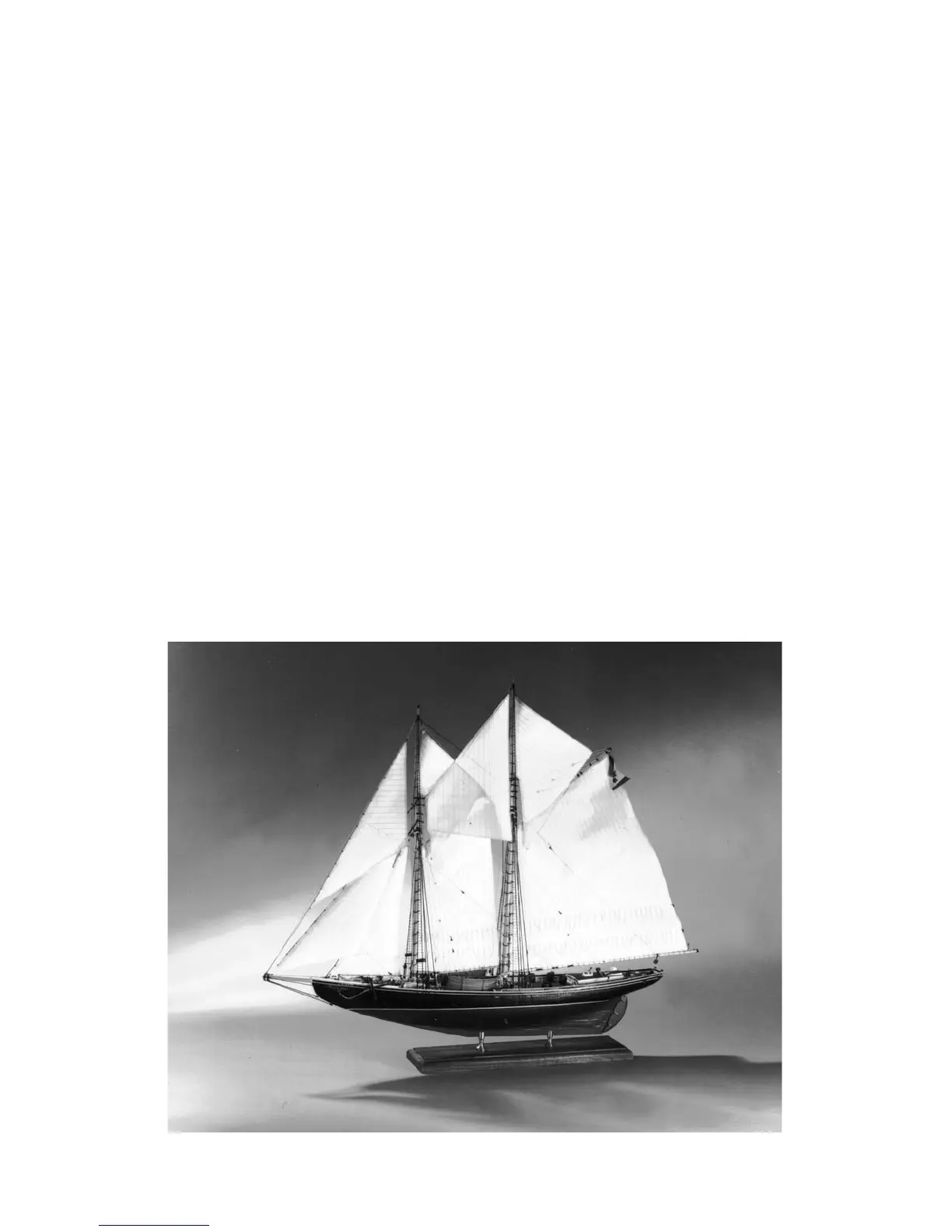
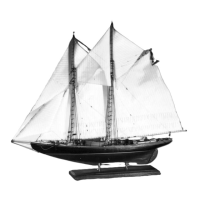
The Canadian fishing schooner
Bluenose was designed by
William J. Roué and built in 1920-1921 at the Smith and
Rhuland Shipyard in Lunenburg, Nova Scotia. Launched
26 March 1921, she was 143 feet long, 112 feet at the
waterline, with a beam of 27 feet, and displacement
around 280 tons. She was a salt banker, carrying salt in
her bins rather than ice.
Bluenose is famous for beating Gloucestermen in the
International Fishing Schooner Races. She was twice
crowned queen of the Lunenburg fleet, and retains the
record of fastest fishing schooner in Canadian history.
Skippers had raced each other for years, but the friendly
rivalry took on its international flavor in 1920. H. W.
Dennis of the
Halifax Herald and Halifax Evening Mail
offered a $4,000 prize and the Dennis Cup to the schooner
winning a series of 40-mile races. His motive was to pre-
serve the fishing schooner while stimulating development
of faster designs.
The first regatta was won by the Gloucesterman
Esperanto
over the Canadian Delawanna. Seeking retribution, Captain
Angus Walters formed a Canadian syndicate to recapture
the Dennis Cup. This produced Bluenose. In 1921, she out-
sailed Elsie, and the following year she bested Henry Ford.
During the 1923 regatta, Captain Walters protested that
Columbia crossed the line ahead of the starting gun. When
race officials failed to resolve the issue, Walters became
angry and sailed back to Halifax. He returned in 1930 to
compete for the Thomas Lipton International Trophy, but
lost to
Gertrude L. Thebaud. In 1931, Bluenose beat Thebaud
for the Dennis Cup. No more international regattas were
held until 1938, and that was the last one. Bluenose retained
her supremacy over
Thebaud and kept the Dennis Cup in
Canada forever.
Bluenose was sold in 1942 to carry freight in the West
Indies. She sank four years later off Haiti.
In 1955, Captain Walters and the
Bluenose were inducted
into the Canadian Sports Hall of Fame.
2


 To Next Page