When done, iron the sails. Be careful not
to burn them. Next, cut the sail shape
using Line A in Figure 7-4. Fold the
hem, iron it flat, and sew as close to
Line B as possible. Tuck the ends and
hand stitch the corners. The sail is ready
for stretching.
Sewing Aids: Visit a fabric shop and pur-
chase a bottle of Fray-Chek. Running or
brushing it along the edge of the cloth
prevents the material from unraveling
when cut and produces a sharp edge.
Apply it to the sail before rolling the
hem.
Stitch-Witchery and Wonder-Under are
basically the same product. They are
heat fusible bonding tapes. Stitch-
Witchery comes in a roll and is bond
sensitive on both sides. To join two
pieces, simply place a strip between
them and iron.
Wonder-Under comes in sheets with a
thin, paper backing on one side. This
material is useful for bonding letters
and numbers to a scale sailboat’s sail.
First, buy the colored fabric for the
numbers. Place the Wonder-Under sheet
on the cloth with the paper backing up.
Iron the sheet to bond it to the material.
Next, cut out the letters, numbers, logo,
or whatever with scissors or a sharp
blade. Peel off the paper backing, posi-
tion the letter on the sail, and iron. This
technique also works for making flags
from colored cloth.
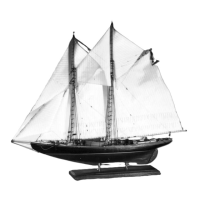
When racing,
Bluenose’s mainsail car-
ried an arabic “1” or “2” near its head.
Str
etching the Sails
: This step assur
es the
sail’s proper shape, since sewing may
have alter
ed it. Using the original pat
-
tern, trace the sail’s outline onto a piece
of paper. Place the paper on a solid, but
porous backing, such as a wood or cork
boar
d. Now wash the sail again and lay
it over the outline. Stretch the wet mate-
rial to the sail’s outline, then secure
with stick pins through its outer edges.
When dry, the sail will have resumed its
pr
oper shape. Ir
on it one more time.
Boltropes and Reef Points: Boltropes can
be omitted, since they are nearly invisi-
ble at 3/16” scale. However
, to include
them, follow the tedious method in
Figure 7-4. The sketch also shows how
to install reef points.
Furled Sails: Don’t furl sails made from
sailcloth and cut to the original’s scale
size. The material is usually too heavy,
resulting in a bulky furled sail. To solve
this problem, either proportionally
reduce the size of a sail by one-third
when using sailcloth (Figure 7-5), or
buy a lighter material such as Silkspan
(model airplane covering tissue).
Depending on their size, even Silkspan
sails may require being reduced by one-
third. Test the percentage reduction to
determine how much material is needed
for a neat, tight furl.
Even furled sails need some seams and
hems, as these details are visible.
9. Rigging the Model
Without Sails
Include most of the lines, such as hal-
liards and downhauls, that remain
when sails are removed. These are
shackled together, tied off, or secured to
some other stowage point. Sketches here
and on the plans show some details.
Stage H
Standing Rigging
Standing rigging is black. Before start-
ing, sort lines by size, coat with
beeswax, and keep them handy. Use
cotton, silk, or nylon thread for seizings.
Treat this with beeswax. Keep white
glue at the ready for dabbing on a seiz-
ing if necessary. Usually sewing through
the shroud followed by a half hitch will
prevent a seizing from unraveling.
Shackles: These are difficult to make at
3/16” scale, so substitute a split ring.
1. Shrouds
Begin the standing rigging by making
the lower shroud chain plates from
brass strip (Figure 8-1).
The lower shr
ouds are set up in pairs
(Figure 8-2). To do this, make a tempo-
rary brass wir
e fixture to space the
deadeyes as seizing progresses (Figure
8-3). The fixtur
e should be longer than
the final spacing of deadeyes. Reeving
the lanyards will tighten the shrouds to
their final proper spacing. Make a test
shr
oud first to see how much it str
etch
-
es.
0


 To Next Page