halliard (Figure 9-2). Remove the sheet
and tack.
3. Fore & Main Topsails
Seized them to the mast hoops (Figure
9-3).
Fore Topsail: It has a double sheet and
tack. Tighten one, then run the loose
partner over the main topmast stay so
the sail can be set on either side.
Main Topsail: It always sets on the port
side of the main peak halliards, but with
the tack over the main gaff on the star-
board side. This sail has one sheet and
tack. The clewline feeds through fair-
leads and blocks.
No topsails: Hook the sheets to the hal-
liard, bring them to the mast, and hook
somewhere at the masthead.
4. Fore & Main Sails
Lace the sails to the boom and gaff and
to the mast hoops. Note: Double hoops
provide added strength near the boom.
When in place, add the parrels to the
main boom jaws and fore and main
gaffs. The fore boom sets to a goose-
neck.
Foresail: Attach the boom tackle per the
plans. Hook the topping lift to the end
of the boom. Reeve the peak and throat
halliards, then the sheet, and tighten in
the correct position. Add the downhaul
at the end of the gaff.
No sail: Rest the boom in its crutch.
Lower the gaff on top of the boom and
stack the mast hoops in a pile. Lash the
gaff to the boom with short lines.
Remember, peak and throat halliards
ar
e longer when the gaff is down, so
play out plenty of line.
Although not usually done on real
ships, one option is to leave the gaff up.
Some modelers like to fill the space with
something.
Mainsail: Rig the mainsail like the fore-
sail except for the topping lifts. Port and
starboard quarter lifts are primarily for
racing.
At mid height on them is a line
functioning as a lazy jack (contains sail
and keeps it off the deck when furling).
The main topping lift is mostly for fish-
ing, but has been used with the quarter
lifts during races.
Baggywrinkle is on the main topping
lift and quarter lifts. This fuzzed-up
rope prevents chafing. Simulate it by
gluing on some cotton or other material,
then painting it to look like rope.
No sail: Lower the gaff, set the boom in
its crutch, and add the crutch’s port and
starboard tackle. Note: The plans show
two types of boom crutch tackle. Both
could be used for fishing, but the chain
version is more common.
5. Flag Halliards
Both topmasts and the main gaff have
flag halliard
FINAL TOUCHES
When the model is rigged, recheck
every line and make sure the seizings
are sound. If necessary, add another dab
of glue. Touch up shiny spots on stand-
ing rigging with black paint or black liq-
uid shoe polish. Use a tan stain or
brown liquid shoe polish for running
rigging. Check if any painted wooden
parts were fouled during the rigging
process and make repairs.
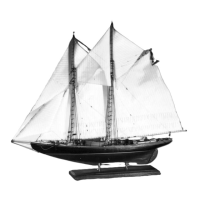
Congratulations - Bluenose is finished!
T
ake a moment to r
evel in your accom-
plishment. You’ve persevered when the
going became rough and your effort has
pr
oduced results. You’ve developed
skills you never knew you had,
incr
eased your vocabulary
, and become
a time traveler. We hope you’ve enjoyed
your voyage and look forward to sailing
with you on your next shipmodeling
pr
oject.
0


 To Next Page