Planking the Hull
Before starting, it’s a good idea to know
some common shipbuilding terms that
apply to the planking process.
Plank: A single length of wood used to
plank a hull or deck. A
strake is a con-
tinuous line of planks from wherever it
begins to where it ends.
Garboard strake: Planking adjacent to
the keel.
Sheer strake: Upper line of planking
on a hull.
Wale: A heavy layer of strakes below the
sheer strake. On
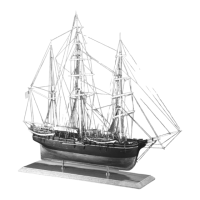
Charles W. Morgan, the
wale’s top edge protrudes beyond the
hull planking. However, no lower wale
edge exists. The thicker wale planks
gradually taper into the lower planking,
so the hull is flush from the top edge of
the wale down to the keel rabbet.
Belts: A group of planks along the hull.
Belts are laid out using
battens (tempo-
rary strips of flexible wood). A
ribband
is also a batten. It holds frames in posi-
tion during planking. Ribbands are
removed as planking is completed.
Spiling: Process for marking and cutting
a plank to a given shape.
Edge-bending or springing: To bend a
plank edgewise.
Fair: Refers to smooth, gradual curves
when planking.
Nib or nibbing: T
o avoid a feather edge
when a plank runs into another at a sharp
angle, the plank is often cut off and insert-
ed into a cut (nib) in the other plank.
Nibbing generally applies to decks, but
sometimes hull planks are nibbed.
Stealer: A plank inserted into another
plank or between two adjacent planks
to r
educe their width. Or
, when two
planks taper toward a narrow end, it
may be necessary to cut off both planks
and substitute a wider plank, ther
eby
leaving enough wood for fastening.
Counter: Underside of the portion over
-
hanging the stern.
1. Getting Started
Mount the hull upside down in a vise or
cradle. Whatever it is secured in should
rotate. Planking is tedious and time-
consuming. Think of each plank as a
project unto itself. Since hull sides are
identical, simultaneously cut one pair of
port and starboard planks to the shape.
Fit the plank on one side, then the other.
Don’t rush. Speed results in frustration
and a poor job.
2. Planking Battens and Belts
Hulls are easier to plank when divided
into belts. Each is designed to lay the
planks against the bulkheads without
excessive edge bending. They sweep up
at the ends like the deck sheer. Planks
within a belt are usually evenly spaced,
tapered, and fitted. Belts prevent errors
fr
om accumulating.
When selecting a belt width and the
number of planks it contains, consider
how the planks taper and lay against
the bulkheads. Taper too much and not
enough stock is left for fastening. Then
a larger plank must be substituted for
two planks to increase the width. Planks
too wide won’t lay flat. In some ar
eas,
the distance between planks widens
rather than tapers. If it becomes too
wide, a stealer must be added. While
these alterations are acceptable and
employed on many ships, the best run
of planking limits their number
. (Figure
2-1 illustrates some inserts.)
Sheet 2 shows the planking layout. For
e
and aft views along with a profile view
pr
ovide a complete pictur
e.
3. Planking Butts
Planking butts are another thing to con-
sider before starting. Few trees grow as
tall as ships are long. Consequently, real
planks were generally 20 or 30 feet long.
Some builders think a plank as long as
the model is easier to use. They scribe in
fake butts or omit them. Although this
can be done, working with shorter
planks has its advantages. For example,
tapers mark quicker and only one hand
is needed to hold and fasten the plank.
Should a mistake happen, just a small
piece is affected. So, the following is
based on scale-length planks.
Because this is a plank-on-bulkhead
model, butts must occur on bulkheads
and won’t simulate shipwright prac-
tice. Use plank length to cover four
bulkhead spaces. However
, to avoid
stubby pieces at the bow and stern, a
longer or shorter plank may be neces
-
sary to complete the r
un.
T
o emulate shipwright practice, stagger
the butts (Figur
e 2-2’s pattern is similar to
a r
eal ship). This also applies to deck
planking. Covering four bulkhead spaces
follows the r
ule; i.e., three full plank
widths between butts on a single frame.
One plank covering thr
ee bulkhead
spaces won’t work, because that leaves
only two full planks between butts.
12
STAGE 2


 To Next Page