as possible. They will be installed later.
Note: The maximum diameter of the
gaff and boom is not at the center, but
about one-third out from the forward
end. This is not clearly seen on the
plans. Gaff and boom are tapered just
like a yar
d, only the taper begins at a
different place.
The spanker boom and gaff have a hook
gooseneck (Figure 6-11).
General Rigging and
Sailmaking Information
Newcomers to the nautical world
should learn the following rigging
terms. Old salts can skip this part and
grab a mug of gr
og.
1. Each edge and corner of a sail has a
name. On a squar
e sail, the top is the
head, the bottom the foot, and the sides
the
leech. Lower corners are the clews.
On a for
e-and-aft sail, the top is the
head, bottom the foot, aft side the leech,
and forward side the
luff. The lower for-
war
d corner is the
tack, aft lower corner
the clew
, upper forward corner the
thr
oat
, and the aft upper corner the peak.
A
triangular sail is similar
, except the
upper corner is called the head. It has
no thr
oat or peak.
2. Standing rigging: Fixed lines support-
ing masts and spars. Standing rigging is
generally tarr
ed; hence, it is black or
dark brown.
3. Shr
ouds:
T
ransverse lines supporting
masts.
Deadeyes are wood and have
thr
ee holes for r
eeving the lanyar
d.
28
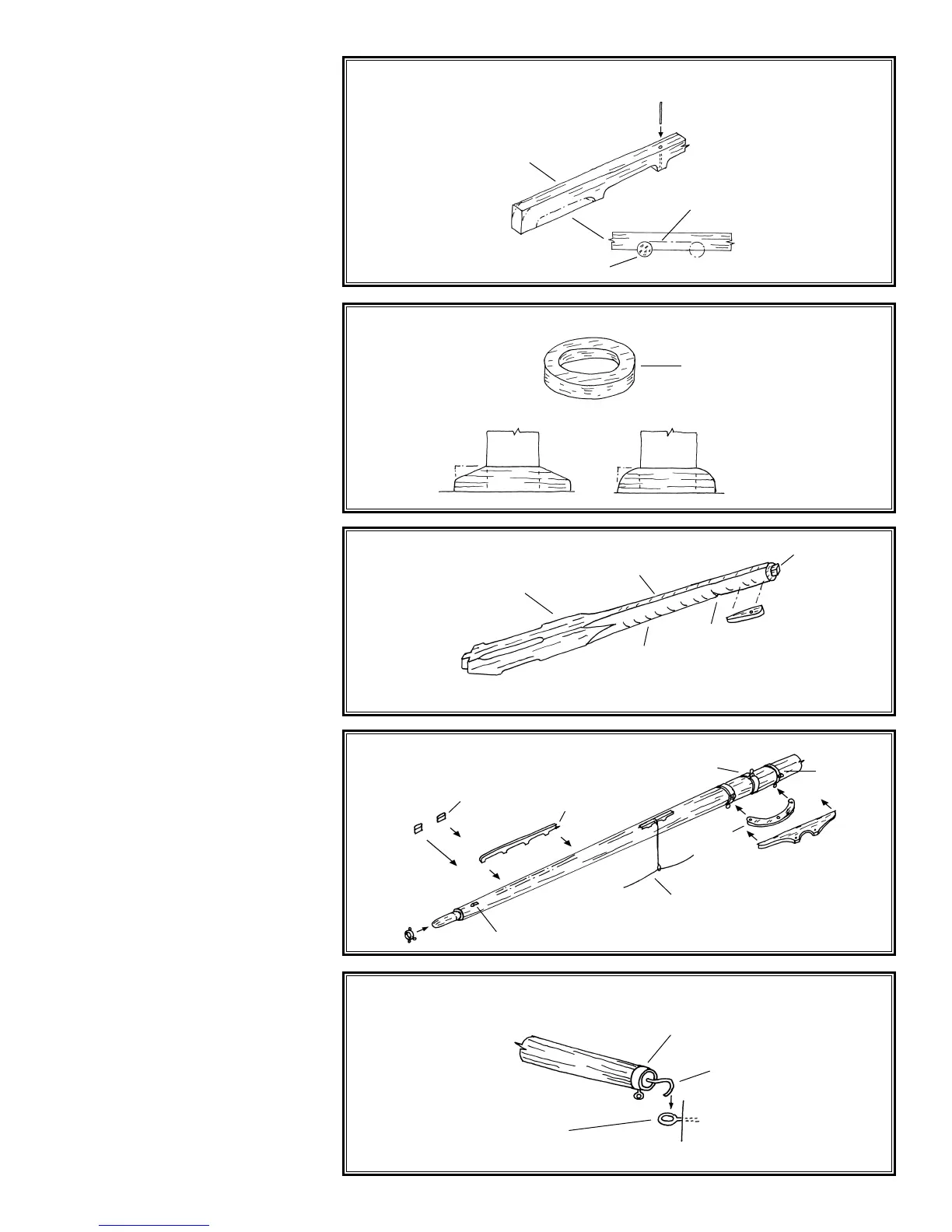
Fig. 6-7 Making a Wooden Jackstay
Wood strip
Pin to spar
Cut between file indents
Use round hand file or rotary power drill
Fig. 6-8 Mast Coats
Fore mast shape Main and mizzen mast shape
Laser cut ring
Fig. 6-9 Making the Bowsprit
Square
Flat on Top
Round
Tenon for cap
Groove for
Forestay
Bee
Fig. 6-10 Yard Details
Cleats on miz
crossjack yard
Jackstay
Sling or halliard tye band
T
russ / sheet
block band
Iron band
Hole represents sheave for sheets
Stirrup and footropes
Truss
(varies)
casting
Yoke on top-
gallent and
royal yards
(wood)
Fig. 6-11 Boom & Gaff Gooseneck
Eyeball in mast
Brass band
Wire hook


 To Next Page