sails may require being reduced by one-
third. Test first to see how much materi-
al is required for a neat, tight furl.
Even furled sails need some seams and
hems, as these details are visible.
9. Rigging the Model
Without Sails
Even though sails are omitted, include
most of the lines attached to them; i.e.,
clewlines and sheets, buntlines and
leechlines, and fore-and-aft sail hal-
liards and downhauls. These lines
remain when sails are removed. They
are shackled together, tied off, or
secured to some other stowage point.
The sketches here and on the plans
show some details.
When rigging a model without sails,
most builders do not install bunt and
leechlines or their blocks. Furthermore,
most of the fore-and-aft sail sheets are
omitted. The choice is yours. However,
more lines mean more fun and, in the
end, more realism. Try to visualize
which lines to remove with the sail and
which ones are easily left in place after
being unhooked or untied from the sail.
Standing Rigging
Befor
e starting, sort lines by size, coat with
beeswax, and keep them handy. Use cot-
ton, silk, or nylon sewing thread for seiz-
ings. Treat this with beeswax. Keep white
glue at the ready for dabbing on a seizing
if necessary. Usually sewing through the
shrouds followed by a half hitch will pre-
vent a seizing from unraveling.
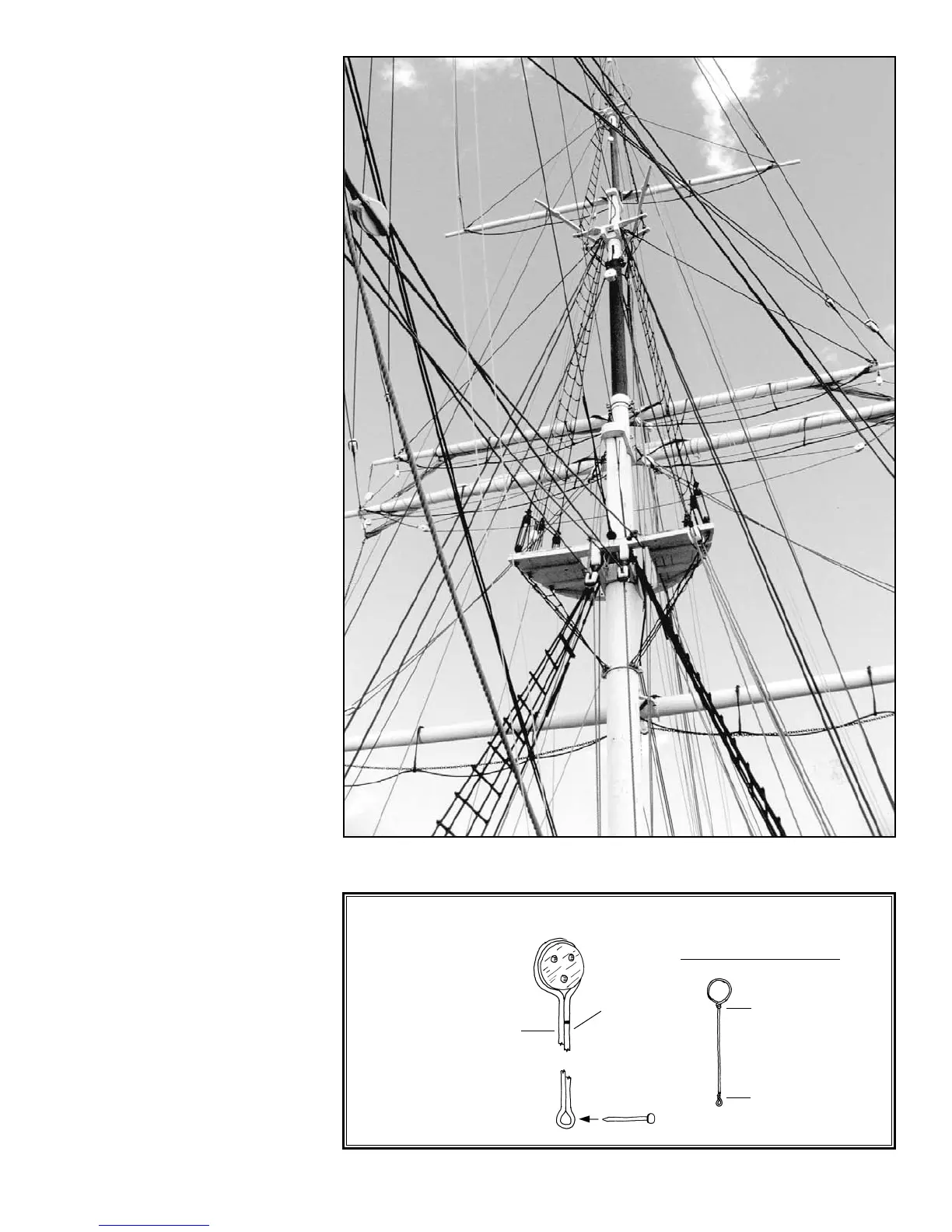
Caution: Before rigging the mizzen top-
mast, install the gaff topsail mast hoops.
1. Shrouds
Note: These directions assume the shrouds
will be installed first, then fore and aft
stays. However, as an option one could
install lower shrouds, then lower stays,
followed by upper shrouds and upper
stays. Just remember that at each mast-
head the stays go on top of the shrouds.
Begin the standing rigging with the lower
shrouds.
Morgan’s lower deadeyes have
steel rod chainplates. Make these from
brass wire (Figure 8-1).
32
Fig. 8-1 Chain Plates
Brass wire
Solder or
epoxy wire
Twist
T
wist
Simplified model option


 To Next Page