Heart rate
If chestbelt is used (available as a accessory)
A person's heart rate can be measured with a chest belt
that senses the electronic output of the heart. Chestbelt
is not included but available as an accessory.
Fuss-free HR measurement requires that the belt is
correctly placed. When it is correctly fitted the logo
on the belt will be central and readable, outward
and upright, by another person. Before putting on
the belt, clean the skin where the belt is to be placed.
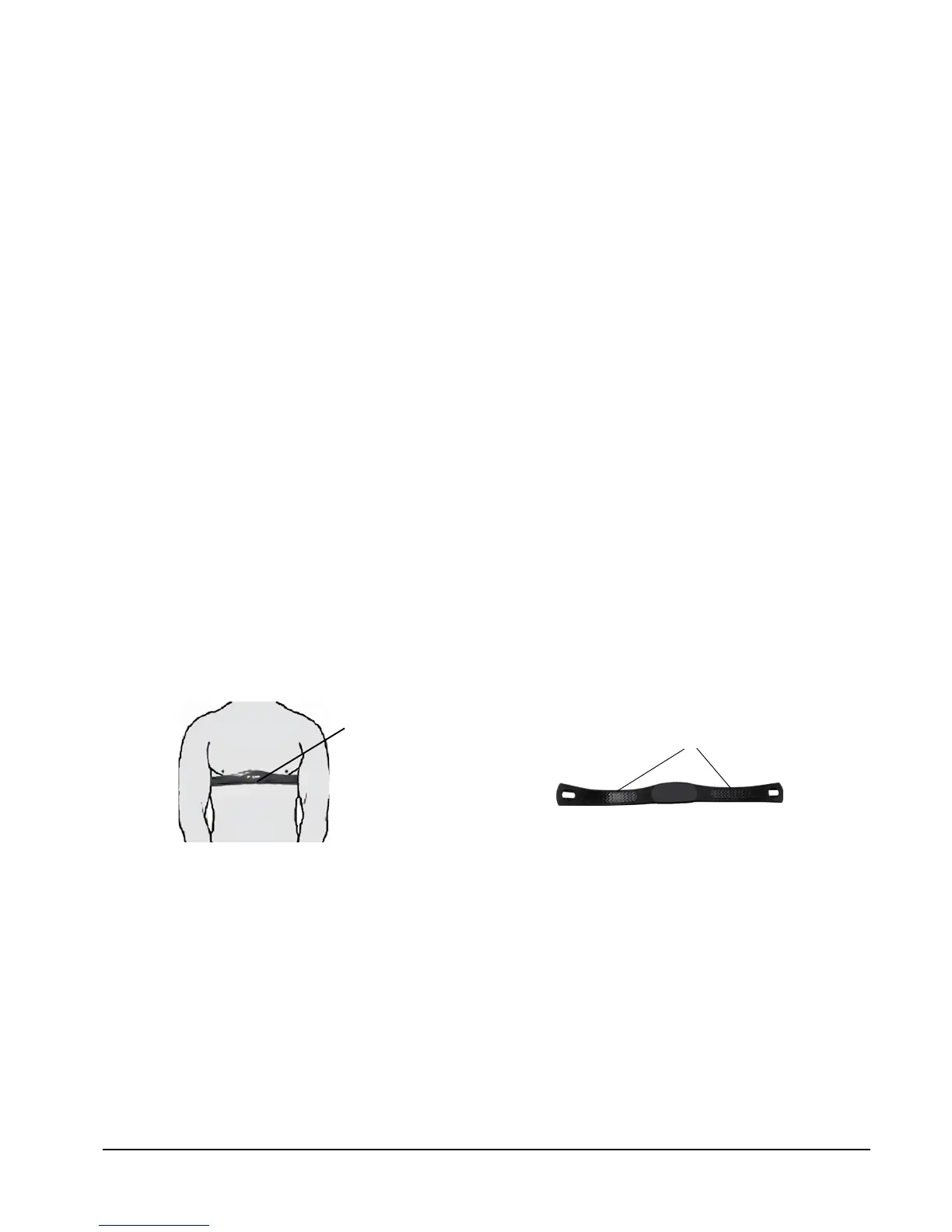
The chest belt should be secured at a comfortable
tension around the mid section, just below the breast
muscle, see Fig: Placement of the chest belt. Moisten
the electrodes before use, see Fig: Electrodes on the
back of the chest belt. To make contact with the HR
receiver on the bike, the distance should not be more
than 100 cm. It is especially important when first used
to identify the chest belt with the sensor, by standing
close to get the HR (maximum 60 cm).
NOTE! Electromagnetic waves may disturb heart rate
function. Cellular phones are not allowed to be used
near the bike during test.
Fig: Placement of the chest belt
Fig: Electrodes on the back of the chest belt (1)
Calories
There have been different theories to how to calculate
this since it is depending on a lot of factors and this
means that it can only be seen as an estimate.
As standard calculation when we display calories on
our calibrated bikes we use: 1 minute with 100W
gives 7 kcal. It is easy to convert watts to calories if it
was on the flywheel, the formula is 1W=0,2388x10
-3
kcal/s with four decimals. But when you normally
show calories you want to show the total amount of
calories your body has used during your training, not
only the calories "burnt" on the flywheel.
We have chosen the formula given above that we
think complies with the results given for a standard
cycle position.


 To Next Page