In a single wired system, unwanted mechanical and electrical resonances manifest as distortion at both
sets of speaker terminals. Due to the impedance of the speaker cables, these distortions will not be entirely
cancelled by the amplier. Instead, they modulate between the two crossovers, and degrade sound quality.
When bi-wiring, this interaction is minimised as signal distortion is ‘seen’ at the amplier’s output where it
can be more eectively cancelled. Bi-wiring/ bi-amping therefore presents a ‘cleaner’ signal at both the low
frequency and high frequency speaker terminals, and because the high and low frequencies have already
been separated, each has a minimal eect on the other - in essence the bass does not overpower delicate
treble.
In terms of the audible benet, bi-wiring/ bi-amping, provides more clarity and detail to the midrange and
high frequencies. Often the bass will become faster and tighter. Focus and staging will improve as well. In
all, this is a very eective and desirable improvement and is highly recommended by Monitor Audio.
Port bungs
WARNING: Care must be taken not to insert the port bungs too far into the port, as this may result
in the foam bung being lost inside the cabinet.
If the loudspeaker is to be installed in a small room, typically 9 sqM (80 sqFT), or a room known to reproduce
accentuated bass response, it may be desirable to t port bungs. However, experimentation is recommended
with positioning of the loudspeaker in the room prior to tting. To optimise performance from the loudspeaker
it is important to ensure the loudspeaker is not positioned too close to a wall or near the corners of a room
(refer to the suggestions on page 5).
If the positioning of the loudspeaker is predetermined by room aesthetics or layout, or you nd you have
accentuated bass, please move on and read point 1 for the Gold 50/ Gold 100 and point 2 for the Gold 200/
Gold 300.
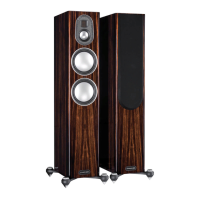
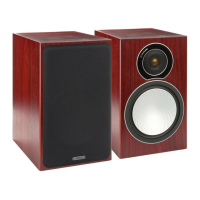
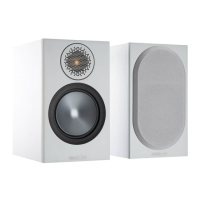
1. Where stand-mount speakers (Gold 50 & Gold 100) are to be sited in close proximity (less than 8
inches/ 20cm) to a rear wall (such as on a bookshelf, positioned in a cabinet or on a stand close to
a wall), we recommend tting port bungs to the ports. This will reduce the bass ‘boom’ sometimes
termed as overhang, and assist the loudspeakers to reproduce their best performance under these
environmental conditions. ‘Boom’ is generally caused when bass energy from the loudspeaker ‘excites’
room modes and causes an accentuation at a particular frequency, or number of frequencies.
2. Where oor-standing loudspeakers (Gold 200 & Gold 300) are to be sited in close proximity (closer than
18 inches/ 45cm) to a rear wall, we recommend tting the port bungs. This will reduce the bass ‘boom’
sometimes termed as overhang and assist the loudspeakers to reproduce their best performance under
these environmental conditions. This is caused when bass energy from the loudspeaker ‘excites’ room
modes and causes an accentuation at a particular frequency, or number of frequencies.
When tting port bungs the overall bass extension will not be reduced, however bass energy/ output
around the port tuning frequency will be reduced. This has the eect of reducing bass ‘boom’ while
increasing bass clarity and apparent agility.
In all circumstances experimentation is highly recommended.
ENGLISH
monitoraudio.com 11


 To Next Page
 Loading...