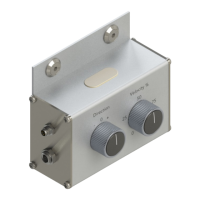
The MonTurn control unit, designated TB40, is a specialized device designed for controlling the TB40 conveyor system. It allows for precise adjustment of both the conveying direction and speed, making it an integral component for optimizing material flow in automated systems.
Function Description
The primary function of the MonTurn control unit is to provide intuitive control over the TB40 conveyor. It features two rotary switches on its front panel:
- Direction of Rotation (Transport Direction): The left-hand rotary switch allows users to set the conveying direction to either positive or negative. This enables flexible material handling, accommodating various operational layouts and requirements.
- Stepless Speed Adjustment (Conveying Speed): The right-hand rotary switch provides continuous speed adjustment from 0-100%. This analog setpoint (0-10V) allows for fine-tuning of the conveyor's operational pace, adapting to different product types or process stages. The speed change via the rotary switch is limited by the general stored acceleration and deceleration values of the conveyor belt drive. These acceleration values can be further modified using the MonTouch operating and parameterizing unit (BA-100157).
The control unit ensures that the maximum permissible load on the conveyor belt remains independent of the conveying speed, highlighting its robust design and operational stability. For proper operation, the TB40 conveyor belt drive must be parameterized in the PLC speed mode. While the drive is typically factory-parametrized, changes to the operating mode are possible with the MonTouch unit.
Important Technical Specifications
The MonTurn control unit is built to operate reliably in industrial environments, with several key technical specifications:
- Ambient Temperature: +10 to +40°C, indicating suitability for typical indoor workshop conditions.
- Relative Humidity: <95% (without condensation), ensuring performance in moderately humid environments.
- Air Purity: Designed for normal workshop atmosphere.
- Protection Category: IP 50, offering protection against dust ingress but not against water jets.
- Rated Voltage: 24 V DC.
- Permitted Supply Voltage: 20 ... 28 V DC.
- Rated Current: 0.5 A.
- Inverse-polarity Protection: Not equipped with inverse-polarity protection, requiring careful attention during electrical connection to prevent damage.
- Output Signal: Analog 0-10V, compatible with standard industrial control systems.
- Overload Protection: Yes, providing a safeguard against excessive electrical loads.
- Material:
- Casing: Aluminum
- Cap: Stainless steel
- Control knob: Aluminum, anodized natural / plastic
- Electronic assembly: Plastics / fiber-reinforced plastics / metal
- Cable: Polyurethane / copper
- Warranty: 3 Years.
The control unit's terminal connection method separates signal and power, utilizing metric connectors for both. Montech offers complete cable sets for MonTurn, and a 24VDC switching power supply (e.g., Mean Well SDR-480-24, Montech part no. 522208) is available as an accessory. If the MonTurn and conveyor belt are not connected to the same supply, equipotential bonding between the two ground connections is essential.
Usage Features
The MonTurn control unit is designed for straightforward installation and operation:
- Mounting: It can be directly mounted to the chassis of the TB40 conveyor using a fastening component, requiring an Allen key SW4.
- Electrical Connection: The unit requires a 24VDC/25A supply. Specific connecting cables are available for power (TB40 and MonTurn) and signal (TB40 <-> MonTurn). The power cable for the TB40 includes connections for a motor-integrated brake chopper with an external ballast resistor, which converts unneeded energy on inclined conveyor belts, activating if the voltage threshold of 27V is exceeded.
- Safety during Commissioning: Emphasizes the importance of proper installation by qualified personnel, ensuring sufficient workspace, careful handling of components, cleanliness, and adherence to specified bolt torques. It also warns against working under suspended loads and stresses that work on power hook-up and controller must be performed exclusively by a skilled electrician.
- Turn On/Off Behavior: The manual provides diagrams illustrating the power and logic voltage behavior during turn on and turn off sequences, highlighting that the power supply should only be switched on when all connecting cables are securely connected to the TB40 conveyor belt.
- Operation Mode: When stopping the conveyor belt via the direction of rotation switch, the drive enters freewheel mode and is not energized.
Maintenance Features
To ensure optimal and uninterrupted operation, the MonTurn control unit requires periodic maintenance:
- Maintenance-Free Operation: Possible if used according to its intended purpose and not exposed to life-reducing influences.
- Regular Cleaning: In environments with dust, oil-containing air, or foreign bodies (e.g., chips from processing machines), regular cleaning (e.g., weekly with cleaner's naphtha) is recommended.
- Maintenance Plan:
- Monthly: Check MonTurn for damage and inspect plug connections and cables for damage. These tasks can be performed by a machine operator.
- Semi-annually: Perform general cleaning and check plug connections and cables for damage. Cleaning can be done by a machine operator, while checking plug connections and cables should be done by a skilled electrician.
- Spare Parts: Only OEM (original equipment manufacturer) parts or manufacturer-approved spare parts should be used to avoid hazards, damage, malfunction, or total failure.
- Repairs: Repairs to the electrical part must be carried out exclusively by the supplier (Montech AG's skilled personnel). Safety instructions for electrical disconnection must be followed during repairs and reinstallation.
- Disassembly and Disposal: At the end of its service life, the device should be disassembled and disposed of in an environmentally compatible manner. This involves shutting down the system, disconnecting power, cleaning components, and sorting them by material type for recycling. Specific warnings are given regarding stored residual energies and sharp-edged components during disassembly. Authorized specialty firms should handle the disposal of electronic scrap and components.
Materials Used for Disposal:
- Aluminum (profile pressing, machining, casting, anodizing)
- Copper
- Brass (nickel-plating)
- Steel (machining, nickel-plating)
- Plastic (machining)

 Need help?
 General

 To Next Page