18
MONTEREY
BOATS
Safety Equipment
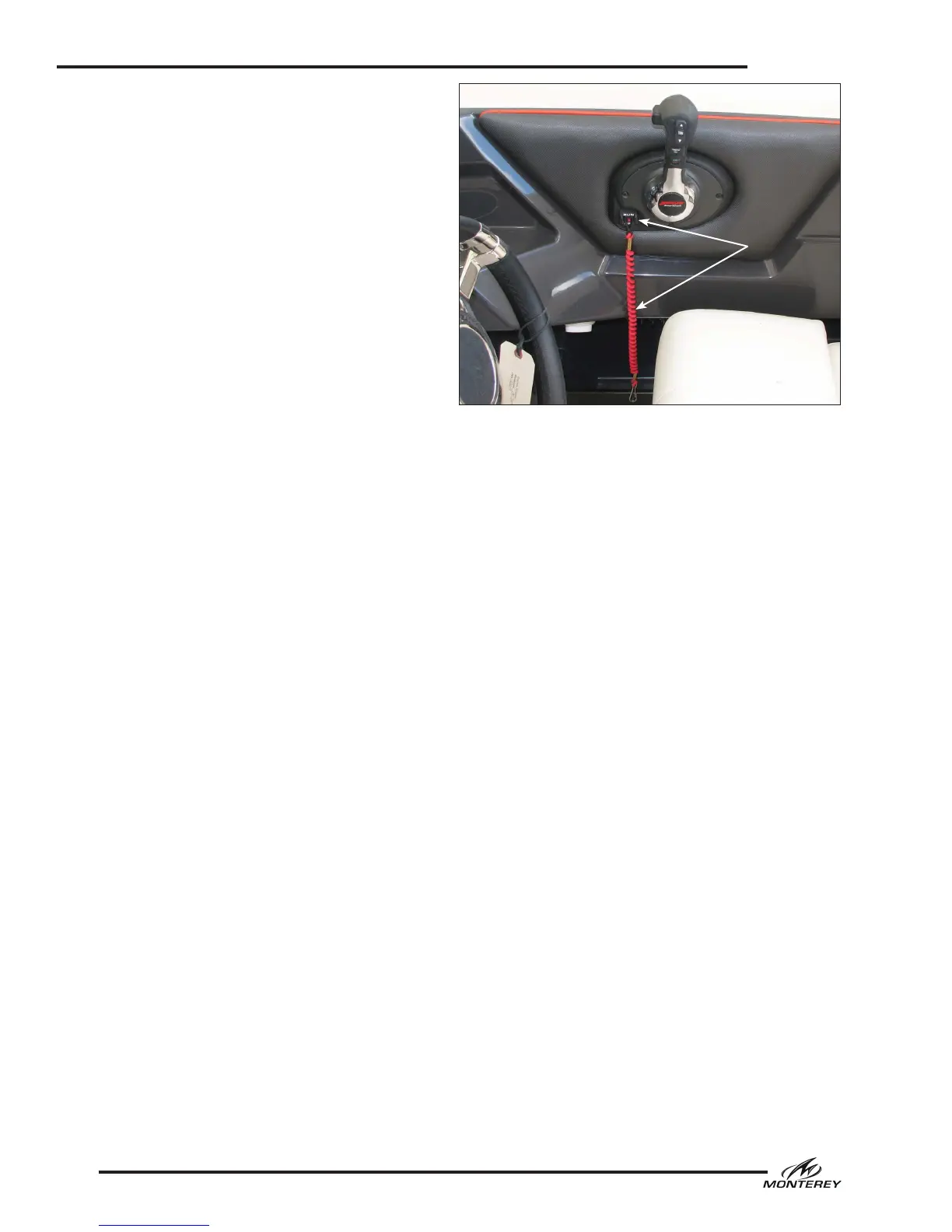
1.4 Engine Stop Switch
Single engine boats with a side mount throttle and
shift control are equipped an engine stop switch
and lanyard. When the lanyard is pulled it will
engage the switch and shut off the engine. We
strongly recommend that the lanyard be attached
to the driver and the stop switch whenever the
engine is running. If the engine will not start, it
could be because the lanyard is not properly in-
serted into the engine stop switch. Always make
sure the lanyard is properly attached to the engine
stop switch before attempting to start the engine.
Notice:
In some states, a lanyard attached to the
driver at all times is required by law.
1.5 Required Safety Equipment
Besides the equipment installed on your boat by
Monterey, certain other equipment is required by
the U.S. Coast Guard to help ensure passenger
safety. Items like a sea anchor, working anchor,
-
manently secured to your ring buoy, etc., could at
some time save your passengers’ lives, or save
your boat from damage. Refer to the “Federal
Requirements And Safety Tips For Recreational
Boats” pamphlet for a more detailed description
of required equipment. You also can contact the
U.S. Coast Guard Boating Safety Hotline, 800-
368-5647, for information on boat safety courses
and brochures listing the Federal equipment
requirements. Also, check your local and state
regulations.
The Coast Guard Auxiliary offers a “Courtesy Ex-
amination.” This inspection will help ensure that
your boat is equipped with all of the necessary
safety equipment. The following is a list of the
accessory equipment required on your boat by the
U.S. Coast Guard:
Personal Flotation Devices (PFDs)
PFDs must be Coast Guard approved, in good
and serviceable condition, and of appropriate
size for the intended user. Wearable PFDs must
be readily accessible, meaning you must be able
to put them on in a reasonable amount of time in
an emergency. Though not required, the Coast
Guard emphasizes that PFDs should be worn at
all times when the vessel is underway. Throwable
devices must be immediately available for use. All
Monterey boats must be equipped with at least
one Type I, II or III PFD for each person on board,
plus one throwable device (Type IV).
Stop Switch & Lanyard
NOTICE:
Many state laws now require that children
13 years old and under must wear a PFD at
all times.
Anyone being towed on skis, wakeboards and
other water sports equipment is considered
a passenger on the boat and must wear a
Coast Guard approved life jacket at all times.
Visual Distress Signals (VDS)
All boats used on coastal waters, the Great Lakes,
territorial seas, and those waters connected di-
rectly to them, must be equipped with Coast Guard
approved visual distress signals. These signals
are either Pyrotechnic or Non-Pyrotechnic devices.
Pyrotechnic Visual Distress Signals:
Pyrotechnic visual distress signals must be Coast
Guard approved, in serviceable condition, and
readily accessible. They are marked with a date
showing the service life, which must not have
expired. A minimum of three are required. Some
pyrotechnic signals meet both day and night use
requirements. They should be stored in a cool,
dry location. They include:
• Pyrotechnic orange smoke, hand-held or
• Launchers for aerial red meteors or parachute


 To Next Page