22
MONTEREY
BOATS
Safety Equipment
Persons who have been exposed to carbon mon-
oxide should be moved into fresh air immediately.
Have the victim breath deeply and seek immedi-
ate medical attention. To learn more about CO
poisoning, contact your local health authorities.
CARBON MONOXIDE IS COLORLESS, ODORLESS AND
DANGEROUS. ALL ENGINES, GENERATORS AND FUEL
BURNING APPLIANCES EXHAUST CARBON MONOXIDE (CO).
DIRECT AND PROLONGED EXPOSURE TO CO WILL CAUSE
BRAIN DAMAGE OR DEATH. SIGNS OF EXPOSURE TO CO
INCLUDE NAUSEA, DIZZINESS AND DROWSINESS.
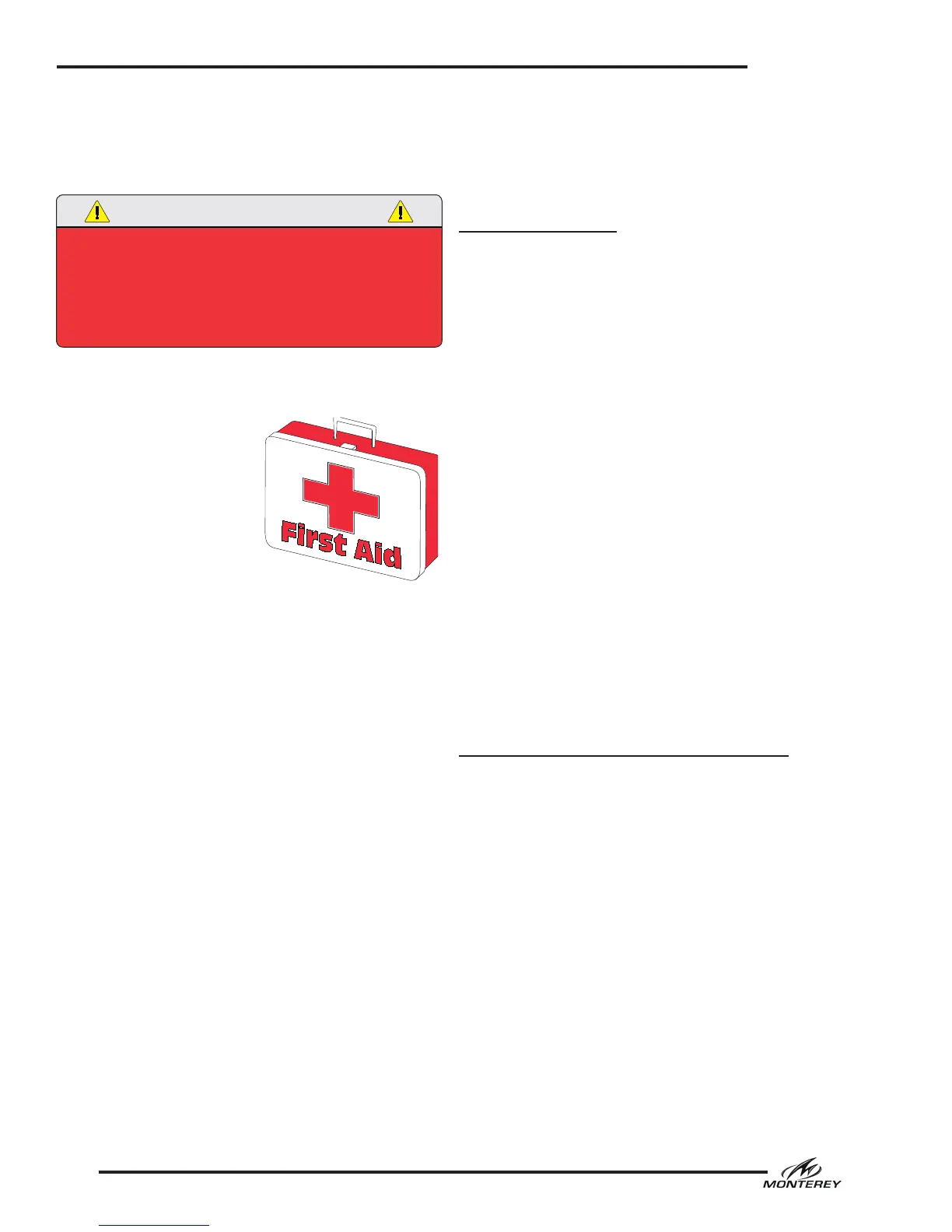
1.10 First Aid
It is the operator’s re-
sponsibility to be familiar
procedures and be able to
illnesses of your passen-
gers. In an emergency,
you could be far from
professional medical as-
sistance. We strongly
recommend that you be prepared by receiving
done through classes given by the Red Cross or
your local hospital.
Your boat also should be equipped with at least a
the marine environment and be well supplied. It
should be accessible and each person on board
should be aware of its location. As supplies are
used, replace them promptly. Some common
drugs and antiseptics may lose their strength or
become unstable as they age. Ask a medical pro-
fessional about the supplies you should carry and
the safe shelf life of prescription drugs or other
Replace questionably old supplies whether they
have been used or not.
In many emergency situations, the Coast Guard
can provide assistance in obtaining medical advice
are within VHF range of a Coast Guard Station,
make the initial contact on channel 16 and follow
their instructions.
1.11 Additional Safety Equipment
Besides meeting the legal requirements, prudent
boaters carry additional safety equipment. This
is particularly important if you operate your boat
offshore. You should consider the following items,
depending on how you use your boat.
Satellite EPIRBS
EPIRBs (Emergency Position Indicating Radio
Beacon) operate as part of a worldwide distress
system. When activated, EPIRBs will send distress
code homing beacons that allow Coast Guard
satellites that receive and relay EPIRB signals are
operated by the National Oceanic and Atmospheric
Administration (NOAA) in the United States. The
EPIRB should be mounted and registered accord-
ing to the instructions provided with the beacon,
so that the beacon’s unique distress code can be
used to quickly identify the boat and owner.
Marine Radio
A marine radio is the most effective method of
receiving information and requesting assistance.
VHF marine radios are used near shore and single
sideband radios are used for long range commu-
nication.
-
gency. The VHF emergency channel is 16 in
the United States. You should read the owners
manual for your radio and know how to use it in
an emergency or for normal operation. If you
hear a distress call you should assist or monitor
the situation until help is provided.
Additional Equipment to Consider:
Cell Phone Spare Anchor
Fenders Heaving Line
Mirror First Aid Kit
Tool Kit Flashlight & Batteries
Anchor Search light
Boat Hook Sunburn Lotion
Mooring Lines Ring Buoy
Binoculars Whistle or Horn
Extra Clothing Portable Radio
Chart and Compass Marine Hardware
Food & Water Spare Keys
Sunglasses Spare Parts
Spare Propeller



 To Next Page