33
MONTEREY
BOATS
Operation
maneuver the boat into alignment with the slip.
Reverse the engines and slowly back into the slip.
Shift from reverse to neutral frequently to prevent
the boat from gaining too much speed. Move the
stern right and left by shifting the engines in and
out of gear or turning the wheel. When nearly in
the slip all the way, straighten the outdrives and
shift to forward to stop. Keep the engines running
until the lines are secured.
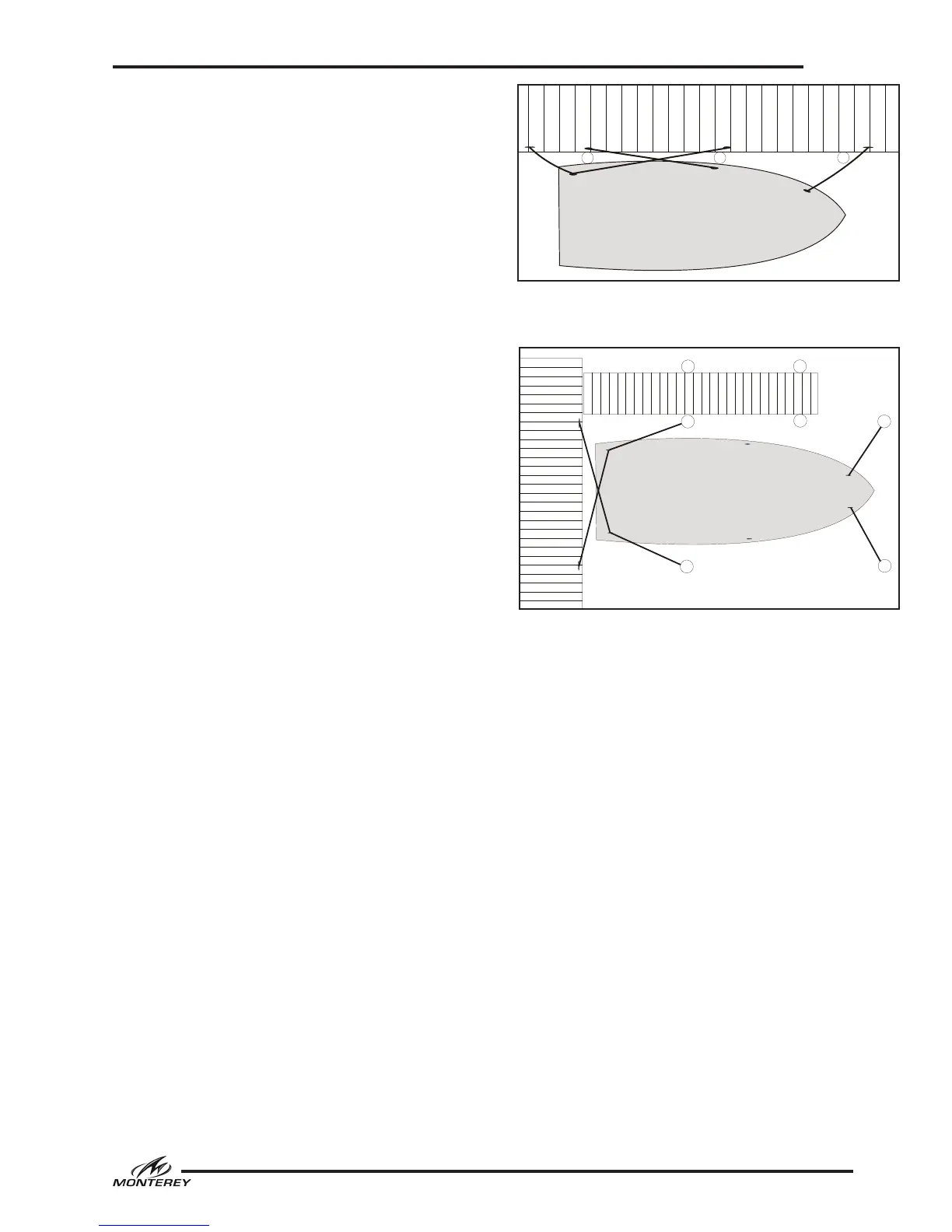
Securing Dock Lines
Securing a boat that is tied along side the dock
typically requires a bow and stern line and two
spring lines. The bow and stern lines are usually
secured to the dock at a 40° angle aft of the stern
cleat and forward of the bow cleat. The after bow
spring line is secured to the dock at a 40° angle aft
of the after bow spring cleat. The forward quarter
spring line is secured to the dock at a 40° angle
forward of the stern cleat or the stern spring cleat.
The spring lines keep the boat square to the dock
and reduce fore and aft movement while allowing
the boat to move up and down with the tide.
Securing a boat in a slip is somewhat different. It
typically requires two bow lines secured to pilings
on each side of the bow, two stern lines secured
to the dock and two spring lines that prevent the
boat from hitting the dock. The bow lines are
typically secured with enough slack to allow the
boat to ride the tide. The stern lines are crossed.
One line runs from the port aft boat cleat to the
starboard dock cleat and the other line runs from
the starboard aft boat cleat to the port cleat on
the dock. The stern lines center the boat, control
the forward motion, and allow the boat to ride the
tide. Two forward quarter spring lines typically
are secured to the stern cleats and to mid ship
pilings or cleats. The spring lines keep the boat
from backing into the dock while allowing it to
ride the tide.
Leaving the Dock
Always start the engines and let them warm up for
several minutes before releasing the lines. Boats
steer from the stern and it is important that you
achieve enough clearance at the stern to maneu-
ver the boat as quickly as possible. Push the
stern off and maneuver such that you get stern
clearance quickly. Proceed slowly until well clear
of the dock and other boats.
Mooring
Approach the mooring heading into the wind or
enough headway to reach the buoy. Position a
Securing The Boat Along Side A Dock (Typical)
Securing The Boat In A Slip (Typical)
B
o
w
L
i
n
e
F
o
r
w
a
r
d
Q
u
ar
t
e
r
S
p
r
i
n
g
L
i
ne
After Bow Spring Cleat
Bow Cleat
Stern Cleat
A
f
t
e
r
B
o
w
S
p
r
i
n
g
L
i
ne
S
te
r
n
L
i
n
e
crew member on the bow to retrieve the mooring
with a boat hook and secure the line. Keep the
engines running until the line is secured.
Leaving a Mooring
Start the engines and let them warm up for sev-
eral minutes before releasing the mooring line.
The boat will already be headed into the wind,
so move it forward enough to loosen the line and
untie it. Back the boat away from the mooring
until you can see the buoy. Move the boat slowly
away from the mooring.
Anchoring
Make sure the bitter end of the anchor line is at-
tached to boat before dropping the anchor. Bring
the bow into the wind or current and put the en-
gine in neutral. When the vessel comes to a stop,
lower the anchor over the bow. Pay out anchor
line so that it is at least 5 to 7 times the depth of
the water and secure the line to a cleat. Use cau-
tion to avoid getting your feet or hands tangled in
the line. Additional scope of 10 times the depth
may be required for storm conditions. Check



 To Next Page