3
Precise, accurate and continuous hydrogen readings allow detection of transformer incipient
faults at their earliest stage. Hydrogen is a reliable indicator of a recent or existing fault as all fault
types produce it to a greater or lesser extent. Hydrogen’s low solubility in oil and high diffusibility
facilitate its early detection at low concentrations thus providing the earliest warning of the presence
of a fault.
Precise, accurate and continuous moisture readings allow correlations to be established
between moisture in oil and transformer load. They also provide key information on long term
trends of the insulation conditions. In combination with polar products and acids, dissolved water
can significantly affect the dielectric properties of insulating fluids and materials. Monitoring
dissolved water over an extended period of time and undertaking proper action following sudden or
abnormal increases in dissolved water content extends the life expectancy, performance and
serviceability of oil-filled equipment.
Additional continuous measurement of dissolved carbon monoxide in oil differentiates the
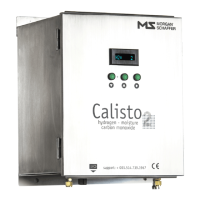
Calisto 2 from the Calisto monitor. Carbon monoxide readings can help transformer specialists
assess the remaining life of transformers. Carbon monoxide is often generated in large quantities
when transformer cellulose overheats.
Built-in oil circulation and flow monitoring assure reliability of the readings. Effective on-line
monitoring of dissolved fault gases requires that sensors be in continuous contact with
representative oil from the transformer, in order to react quickly to variations in gas concentrations.
To guarantee accuracy and fast response to developing faults, Calisto/Calisto 2 features an oil
circulation system based on an anti-cavitation reciprocating pump with an outstanding reliability
record. In addition, an integrated oil flow monitor, also designed for maintenance-free operation and
long-term reliability, provides a low-flow warning if the flow drops below a pre-set threshold, as may
occur if a valve is inadvertently closed.
Continuous enclosure and oil conditioning is essential for accurate readings. The most important
source of interference on dissolved gas sensors comes from environmental temperature variations.
Varying ambient and oil temperatures significantly affect the solubility and diffusion rates of
dissolved fault gases, leading to baseline drift and signal variation. This often limits the ability of
IEDs to monitor low levels of fault gases. Calisto/Calisto 2 features passive and thermo-electric
temperature conditioning modules which continuously maintain both enclosure and oil temperatures
constant to pre-set levels. This results in unequalled sensitivity, repeatability and long-term stability,
independent of the environment where the instrument is installed.
Reliable gas extraction and detection technologies are both crucial to produce reliable readings.
As the oil within the Calisto/Calisto 2 is conditioned to a precisely regulated temperature, it is
pumped past a bundle of PTFE capillary tubes which together form the gas probe. Dissolved gases
permeate through the walls of the tubing to form a representative gas sample within the probe.
Gases then diffuse along the capillary tubes to form a gas sample inside the detection cell. Any
change in gas concentrations in the oil will modify the equilibrium within the probe and the cell.
The Calisto/Calisto 2 detection cell uses an enhanced version of Morgan Schaffer’s proprietary
high-accuracy thermal conductivity detection (TCD) technology, to provide accurate gas


 To Next Page