12
13
DK ENG
In principle
Your stove has two air supplies:
Primary air is controlled by the upper air controler of the door. The air eventually washes
at high speed down the back face of the door glass. This super-heated air helps with the
combustion of volatile gases produced by the re.
Secondary air is supplied to the top of the re through two rows of holes in the steel bae.
This eectively burns o other residual gases, making for very clean emissions. This air sup-
ply is constant and cannot be varied. The lower air controler on the door is xed, and only
for decoration purposes.
2.2 Lighting and loading intervals
When rst lighting the stove, a large volume of air is needed. When the stove is cold, you
should leave the door open an inch or two for the rst few minutes and open the primary air
supply completely. While the door is open, do not leave the stove unattended.
To form a reasonable bed of ash on the oor of the stove, you should use 5-6 inches thick-
ness (2-4 pound) of dry kindling at the initial lighting. Always maintain a 1-1,5 inch (2-3 cm)
layer of ash on the oor of the combustion chamber at all other times.
The re is to be built directly on the rebox hearth. Do not use andirons or similar.
Do not built the re too close to the door glass
Do not for any reason attempt to increase the ring of your heater by altering the air control
adjustment range outlined in these directions
This wood heater has a manufacturer-set minimum low burn rate that must not be altered.
It is against federal regulations to alter this setting or otherwise operate this wood heater
in a manner inconsistent with operating instructions in this manual.
Warning: Fireplace stoves must never be left unattended with doors open.
If the door is left partly open, gas and ame may be drawn out of the replace stove open-
ing, creating risks from both re and smoke. We recommend that you t a smoke detector
in the room where the stove is installed.
DO NOT OVERFIRE THIS HEATER. Overring may cause a house re, or can result in per-
manent damage to the stove. If any part of the stove glows, you are overring.
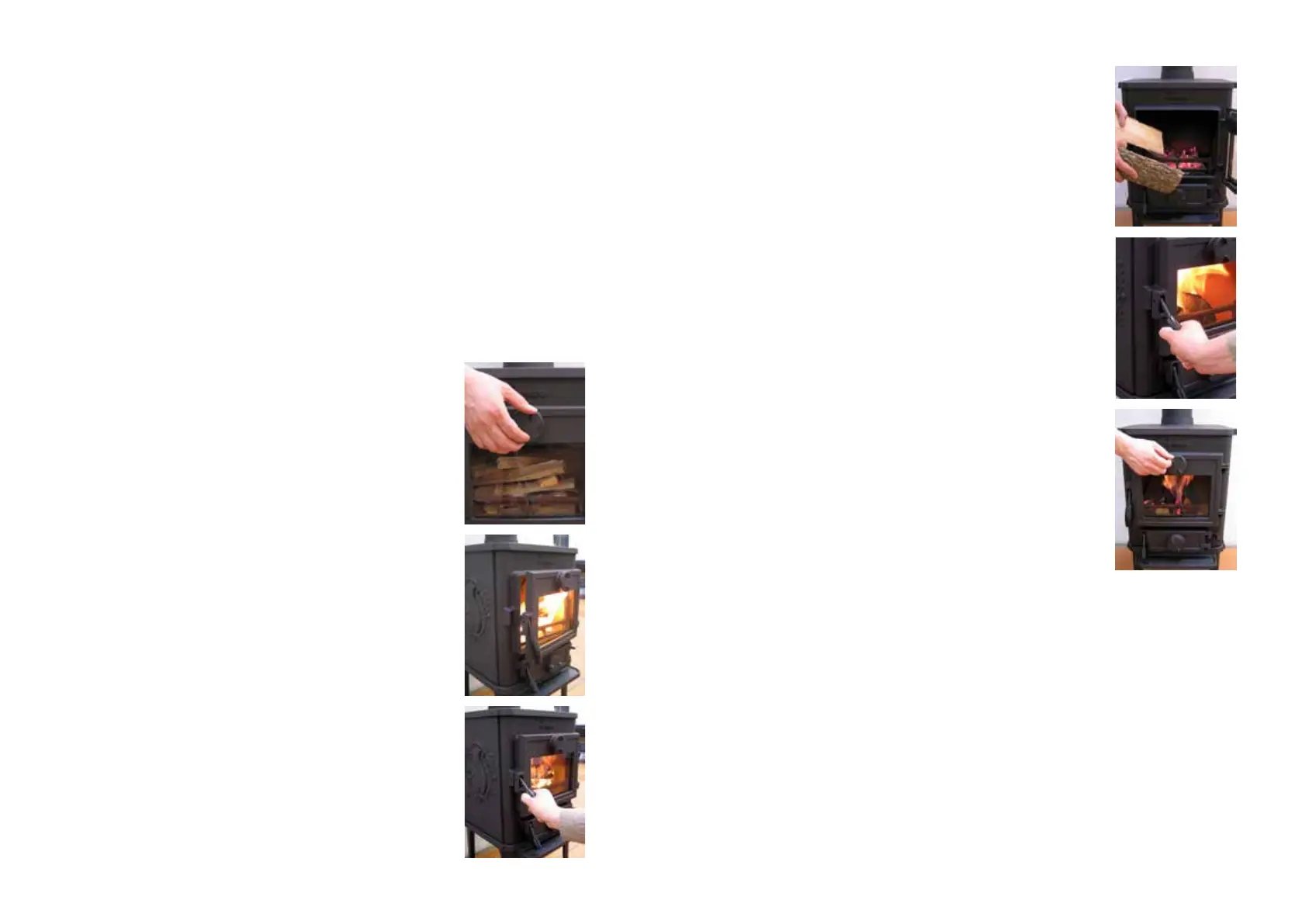
1. The air supply must be fully open. Maximum 4 turns.
2. Light the re. An ember bed will quickly be formed by light-
ing with relighters, Morsø kindling bags or 7-10 pieces of twist-
ed paper under the dry kindling wood (see above).
3. After lighting, partially close the door, leaving it open an
inch or two to allow in plenty of combustion air.
4. When the chimney is warmed through after 5-10 min-
utes, the door should be closed.
A suitable ember bed will be formed after a further 15-20
minutes.
5. When ready to reload, use a poker to spread the ember
across the rebox oor, bringing plenty towards the front
of the stove.
6. Lay three pieces of wood (see dimensions above) onto
the embers. Leave half an inch (1 cm) or more between
each piece. Place the ends of your logs towards the open-
ing, but not too close to the front.
7. Close the door. Leave the primary air supply fully open.
8. After a few minutes, and adjust the primary air supply
to suit your heating requirements.
9. Anticipate each refueling, remembering to add a modest
layer of wood while there are still plenty of live embers, Re-
peat steps 5-8.


 To Next Page