
 Need help?
Do you have a question about the Motorola MC9090 and is the answer not in the manual?
Troubleshoot scanner power issues by checking battery charge and insertion, or performing a warm/cold boot.
Resolve battery charging problems by ensuring the scanner is cradled, checking battery condition, or contacting support.
If the screen is blank, ensure the unit is fully powered on by holding the power button.
Fix sync issues by completing the sync process, checking cradle connection, or verifying ActiveSync setup.
Address lack of audio feedback by increasing the scanner's volume setting.
Troubleshoot automatic shutdown by checking battery level or adjusting inactivity timeout settings.
Resolve RFID reading failures by checking tag readability, range, compatibility, or application installation.
Fix barcode reading problems by verifying application installation, barcode readability, range, or battery power.
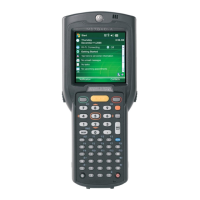
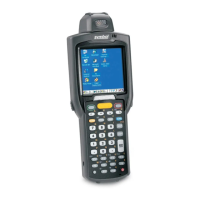
The Motorola MC9090 is a rugged, handheld mobile computer designed for demanding environments, often used in inventory management, logistics, and supply chain operations. It functions primarily as a data collection device, capable of reading both barcodes and RFID tags, and is equipped with a Windows Mobile operating system, allowing for various applications to be run on the device. Its robust design ensures durability and reliability in industrial settings, making it suitable for tasks that require frequent data capture and processing on the go.
The core function of the Motorola MC9090 is to facilitate efficient data capture and management. It integrates a barcode scanner and an RFID reader, enabling users to quickly and accurately collect information from items. The device is designed to run specialized applications, such as inventory tracking software, which process the collected data. This data can then be synchronized with a central system, typically via a cradle connected to a computer, ensuring that inventory records are up-to-date. The MC9090's operating system, often Windows Mobile, provides a familiar interface for users to navigate applications, manage files, and configure settings. The device's ability to perform both barcode and RFID scanning makes it versatile for different types of assets and tracking systems. It is particularly useful in environments where manual data entry would be slow, error-prone, or impractical, significantly improving operational efficiency and accuracy.
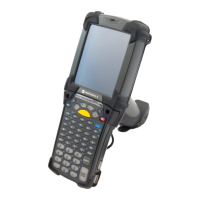
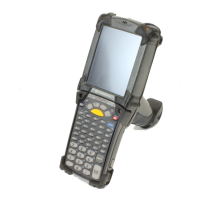
The Motorola MC9090 is engineered for ease of use in professional settings. It features a physical keypad for data input and navigation, complementing its touchscreen display. The device is designed to be held comfortably for extended periods, with a pistol grip form factor that often includes a trigger button for scanning. This ergonomic design reduces user fatigue during long shifts.
Power Management: The device is powered by a removable battery, which can be charged by placing the scanner in a cradle. The battery life is optimized for full-day operations, and spare batteries can be swapped in for continuous use. The device includes power-saving features, such as automatic shutdown after a period of inactivity, which can be configured by the user to extend battery life.
Data Capture: For barcode scanning, users typically aim the scanner at a barcode and press a trigger button. The device then reads the barcode and inputs the data into the active application. For RFID tag reading, the device is brought within range of the tag, and the RFID reader captures the tag's information. The range for RFID reading can vary, and users may need to adjust their distance from the tag for optimal performance. The device provides audible confirmations (beeps) and visual feedback (on-screen messages) to indicate successful data capture.
Data Synchronization: Data collected on the MC9090 is typically stored locally on the device until it is synchronized with a host computer or network. This synchronization is often performed by placing the scanner in a cradle connected to a PC running Microsoft ActiveSync (or a similar synchronization software). During sync, data is transferred, and the device's software can be updated. It's crucial to ensure the scanner remains in the cradle until synchronization is complete to prevent data loss or corruption.
User Interface: The device's operating system provides a graphical user interface (GUI) that allows users to launch applications, adjust settings, and view information. The touchscreen can be used with a stylus or finger, and the physical keypad offers tactile feedback for precise input, especially useful in environments where gloves might be worn.
Troubleshooting: The device incorporates basic troubleshooting steps that users can perform. A "warm boot" is a soft reset that can resolve minor software glitches without losing unsaved data. A "cold boot" is a more comprehensive reset that restarts the device and restores it to its default settings, which can resolve more persistent issues but may result in the loss of unsaved data not stored in flash memory or on a memory card.
Maintaining the Motorola MC9090 involves routine care and specific troubleshooting steps to ensure its longevity and reliable performance.
Battery Care: Proper battery management is critical. Batteries should be charged regularly using the designated cradle. If a battery is suspected to be faulty (e.g., not holding a charge), it should be replaced. It's important to ensure batteries are fully inserted into the device to maintain power and connectivity.
Cleaning: As a rugged device, the MC9090 is designed to withstand harsh conditions, but periodic cleaning is recommended. The screen, keypad, and scanning windows should be kept clean to ensure optimal performance. Specific cleaning instructions for industrial devices should be followed to avoid damage.
Software Maintenance: Keeping the device's operating system and applications up-to-date is important for security and performance. Software updates are typically applied during synchronization with a host computer. If an application, such as the RFID Read or barcode scanning application, is not installed or functioning correctly, it may require reinstallation or support from the system administrator.
Troubleshooting Steps:
By following these usage and maintenance guidelines, users can maximize the operational efficiency and lifespan of their Motorola MC9090 devices in demanding work environments.
 General
| Drop Specification | Multiple 6 ft./1.8 m drops to concrete |
|---|---|
| Sealing | IP64 |
| Operating System | Windows Mobile 5.0 or Windows CE 5.0 |
| Display | 3.8 in. QVGA |
| RAM | 64 MB |
| Flash Memory | 64MB or 128MB |
| Connectivity | USB, RS232 |
| Scanner | 1D Laser or 2D Imager |
| Resolution | 240 x 320 pixels |
| Keypad | Numeric or QWERTY |
| Wireless Connectivity | 802.11a/b/g |
| Operating Temperature | -20°C to 50°C |
| Battery | Rechargeable Lithium Ion battery |




 To Next Page