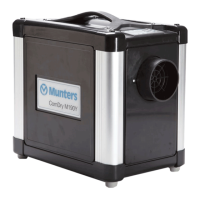
The Munters M120 is a desiccant dehumidifier designed for efficient air dehumidification in various indoor environments. This user manual provides comprehensive information on its installation, operation, maintenance, and technical specifications.
Function Description:
The M120 dehumidifier operates on the principle of desiccant adsorption. Its core component is a desiccant rotor, a composite material highly effective at attracting and retaining water vapor. The rotor is divided into two zones: a larger zone for process air and a smaller zone for reactivation air. As process air passes through the larger zone, it encounters a dry section of the slowly rotating rotor, resulting in continuous dehumidification. The air then exits as dry air. To regenerate the desiccant material, heated reactivation air flows through the smaller zone in the opposite direction to the process air, carrying away the absorbed moisture as wet air. This design allows the dehumidifier to operate effectively even at freezing temperatures. The unit's compact construction integrates fans driven by a common motor, the direct gear-driven desiccant rotor, and a reactivation airflow heater. The end casings contain distribution chambers with isolated sections, ensuring precise balance for dehumidification and reactivation airflows. The rugged casing is made from corrosion-resistant die-cast aluminum. The electrical equipment complies with EN 60204-1 standards and CE-marking requirements.
Important Technical Specifications:
- Model: M120
- Manufacturing Details: Fabr. No. 0944613872, Fabr. year 2009
- Weight: 26 kg
- Power Supply: 1~230V 50 Hz
- Fan Motor Power: 0.1 kW
- Max Power: 1.3 kW
- Heater Power: 1.2 kW
- Protection Class: IP44
- Dimensions (approximate):
- Width (A): 425 mm
- Width (B): 481 mm
- Height (C): 425 mm
- Diameter (D): 100 mm
- Diameter (E): 80 mm
- Service-space (F): 1000 mm
- Process Air (based on fan inlet temperature of 20°C and air density of 1.2 kg/m³):
- Free-blowing air 50 Hz: 180 m³/h
- Free-blowing air 60 Hz: 210 m³/h
- Rated airflow: 120 m³/h
- Available static pressure 50 Hz: 200 Pa
- Available static pressure 60 Hz: 360 Pa
- Fan motor power: 0.030 kW
- Reactivation Air (based on fan inlet temperature of 20°C and air density of 1.2 kg/m³):
- Rated airflow: 35 m³/h
- Available static pressure: 100 Pa
- Total Power, Voltage and Current:
- Total Power: 1.3 kW
- Voltage: 115V, 220V, 230V
- Rated current 50 Hz: 10.9A (115V), 6.3A (220V), 5.7A (230V)
- Rated current 60 Hz: 11.6A (115V), 6.6A (220V), 6.0A (230V)
- Temperature Increase across Heater: 100 °C
- Drive Motor Power: 18 W
- Max Noise Level Unducted: 48 dBa
- Impact Test (IEC-60068-2-27): 20 G for 25 ms
- Rotor Type: HPS
- Environmental Conditions:
- Operating temperature: -40 to +40 °C
- Maximum installation altitude: 2000 m above sea level
- Transport and storage temperature: -40 to +70 °C
- Sound Data (dB(A) at 100m² room absorption):*
- Noise path to dry air system (A): 66 dB(A)
- Noise path to surroundings (Freeblowing) (B): 62 dB(A)
- Noise path to surroundings (Dry air duct, length 1m) (C): 60 dB(A)
- Noise path to surroundings (Duct connected) (D): 56 dB(A)
Usage Features:
- Indoor Installation: The M120 is designed for indoor use and should be placed upright on a level surface, utilizing fixing lugs. Optional wall brackets (article no. 19030113) or floor foundation fittings (article no. 19020851) are available.
- Electrical Connection: The unit comes with a 2.5 m power cable for connection to an earthed outlet. It is crucial to connect the unit to the specified mains voltage on the identification plate. Do not operate if the power plug or cord is damaged.
- Duct and Hose Connections: Process and reactivation air inlets and dry air outlets can be connected to a duct system or used with free inlet/outlet. The wet air outlet must always be connected to a duct or hose, fitted at a downward angle to drain condensation. Ducts should be as short as possible, airtight, and vapor-tight. The wet air duct must be corrosion-resistant and withstand temperatures up to 70°C. Insulation of wet air ducts is recommended in freezing temperatures.
- Continuous Fan Operation: This mode can be activated by removing the humidistat socket cover, setting switch B to the down position, and then refitting the cover.
- Humidistat Control: For automatic operation, the switch cover (A) should be removed, the switch moved to the AUT position, and the cover replaced. A humidistat plug can then be inserted into the HYG socket. A room humidity sensor should be mounted 1-1.5 m above the floor, away from direct dry air, humid air, heat sources, and direct sunlight. The humidistat must be a single-stage type, closing the control circuit when relative humidity increases. A screened connection cable with a minimum cross-section area of 2 x 0.75 mm² is required.
- Automatic Restart: The dehumidifier will automatically restart after a power cut.
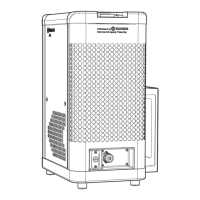
- Rotor Inspection: The rotation of the rotor can be observed by removing a plastic plug on the side of the unit.
- Reactivation Airflow Adjustment: The manual provides a table and graph to determine if the orifice plate in the inlet needs to be removed based on measured pressure drop (at 50 Hz or 60 Hz) to ensure sufficient airflow.
Maintenance Features:
- Minimal Supervision: Designed for continuous use with minimal supervision under normal operating conditions.
- Maintenance Schedule: Munters recommends a maintenance schedule with intervals of 3-6 months and 12 months.
- Process and Reactivation Filter (3-6 months): Clean the filter, grating, retainer, and cover. Change the filter if needed.
- Process and Reactivation Filter (12 months): Change the filter and clean the grating, retainer, and cover. When replacing the filter cassette, ensure the arrow points towards the dehumidifier.
- Unit Housing (3-6 months & 12 months): Check for physical damage and clean the unit exterior as necessary.
- Humidistat (12 months): Check sensor functions and calibrate if necessary. Contact Munters product service department for assistance.
- Filter Replacement: The manual provides detailed steps for replacing the filter, including removing screws, covers, and the filter cassette, cleaning components, and mounting the new filter.
- Troubleshooting: A fault tracing table is included to help identify possible causes and corrective actions for common issues like the unit not starting, dehumidification capacity decrease, or rotor stoppage.
- Professional Service: It is recommended to contact Munters for service or repair, as operating faults can occur if the unit is maintained insufficiently or incorrectly. Munters offers service plans tailored to specific installation conditions.
- Scrapping: The unit must be scrapped according to applicable legal requirements. The rotor material is non-combustible and should be disposed of like glass fiber. If the rotor has been exposed to dangerous chemicals, appropriate precautions must be taken. When cutting the rotor into pieces, a suitable CE-marked face mask must be worn to protect against dust.

 Need help?
 General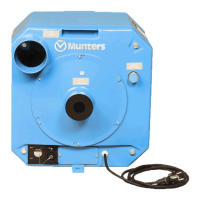

 To Next Page