Need help?
Do you have a question about the NAD 7100 Series and is the answer not in the manual?
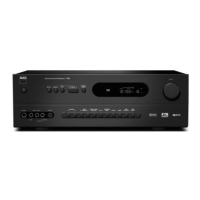
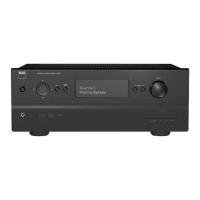
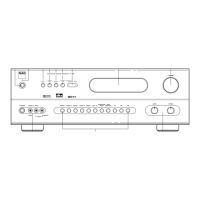
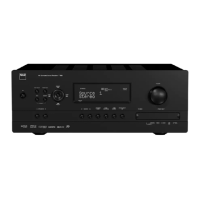
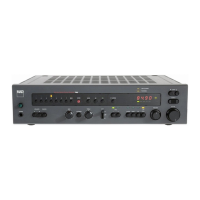
Identification and function of all front panel controls.
Description of rear panel input and output connectors.
Technical performance data for the power amplifier section.
Technical performance data for the FM tuner section.
Technical performance data for the AM tuner section.
Dimensions, weight, and power consumption of the receiver.
Overview of the remote control transmitter's buttons and functions.
Step-by-step guide for main amplifier calibration.
Procedure for preamplifier channel balance adjustment.
Required test equipment and setup for FM alignment.
Detailed steps for aligning the FM tuner circuitry.
Adjustments for AM tuning voltage, antenna, and IF stages.
Setting the AM scan stop and signal meter levels.
Component placement on the main amplifier PCB.
Component layout and schematic for the preamplifier PCB.
Component placement on the tuner PCB.
Component placement on the remote/display PCB.
Wiring connections for main and pre-amplifier sections.
Wiring for tuner and remote/display interface.
List of parts specific to different receiver versions.
Detailed listing of all electrical components and their specs.
Parts list corresponding to the exploded view.
Diagram illustrating the receiver's component assembly.
Contents of the product packaging.
The NAD 7100 Stereo Receiver is a versatile audio component designed to deliver high-quality sound reproduction and a range of features for an enhanced listening experience. This receiver integrates a power amplifier, preamplifier, and AM/FM tuner into a single unit, making it a central hub for a home audio system.
At its core, the NAD 7100 functions as a stereo receiver, capable of receiving radio broadcasts and amplifying audio signals from various sources. The power amplifier section is responsible for boosting the audio signal to drive loudspeakers, providing robust and clear sound. The preamplifier section handles input selection, volume control, and tone adjustments, allowing users to customize their audio output. The integrated AM/FM tuner provides access to radio stations, offering both analog and digital tuning capabilities.
The receiver supports multiple audio inputs, including Phono (for turntables with both MM and MC cartridges), CD, Video Sound, and Tape (Tape 1 and Tape 2). This extensive input selection allows users to connect a wide array of audio and video components, making the 7100 a flexible choice for diverse entertainment setups. The Tape Copy function enables easy dubbing between two tape decks, a useful feature for archiving or sharing audio content.
For output, the NAD 7100 provides connections for two pairs of speakers (Speakers A and B), allowing for multi-room audio or bi-wiring configurations. A dedicated headphone jack is also included for private listening. Preamp Out and Main In jacks offer flexibility for connecting external power amplifiers or signal processors, enabling system expansion and customization.
The tuner section features both AM and FM reception. The FM tuner includes a "Narrow I.F." mode, which can be engaged to improve reception in areas with crowded radio bands, reducing interference from adjacent stations. The receiver also incorporates a "Soft Clipping" feature, designed to prevent harsh distortion when the amplifier is driven beyond its rated power, ensuring a smoother sound even at high volumes.
The NAD 7100 is designed with user convenience in mind, offering a blend of intuitive controls and advanced functionalities. The front panel provides easy access to essential controls such as Power, Volume, Balance, Bass, Treble, and Loudness Compensation. The Speaker Selector allows users to choose between Speaker A, Speaker B, or both, or to turn off speakers for headphone listening.
Input selection is managed through dedicated buttons for Phono, Video, CD, Tape 1, and Tape 2, making it straightforward to switch between sources. The receiver also features a "Low Level" button, which likely provides an audio muting function for quick volume reduction.
For radio tuning, the NAD 7100 offers both manual and preset tuning options. The "Tuning Up/Down" buttons facilitate manual station searching, while the "Pre-sets" and "Bank Selector" buttons enable users to store and recall their favorite radio stations. The "Memory Enter" button is used to save these presets. The "Search mode" likely allows for automatic scanning of radio frequencies to find strong signals.
The "Mono" button converts a stereo signal to mono, which can be useful for improving reception of weak FM signals. The "AM/FM" button switches between the two radio bands. The "Narrow I.F." button, as mentioned, enhances FM selectivity.
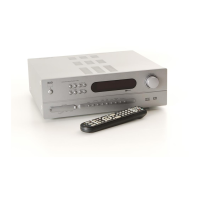
A remote control transmitter is included, providing convenient operation from a distance. The remote allows for station selection, CD track control, tape location control, signal source selection, volume adjustment, and playback controls (Pause, Stop, Rec). This enhances the overall user experience, allowing for command of the system without needing to be near the unit.
The rear panel offers a comprehensive set of connections. Speaker terminals are clearly labeled for Speakers A and B. The Phono input includes an MM/MC selector, catering to different types of turntable cartridges. An "Infrasonic Filter" button is available to remove very low-frequency rumble from turntable playback, which can improve sound clarity and protect speakers.
The "Soft Clipping On/Off" switch on the rear panel allows users to engage or disengage this distortion-prevention feature according to their preference. The "Bridging" switch, when engaged, likely configures the amplifier for mono operation with increased power output, suitable for driving a single, high-power speaker. The "Speaker Impedance" selector allows users to match the receiver's output to their speakers, optimizing performance and safety.
The NAD 7100 Service Manual provides detailed instructions for various adjustments and checks, indicating that the device is designed to be serviceable. Key maintenance procedures include:
While the remote control transmitter is noted as "NON-REPAIRABLE" in the schematic, the detailed service instructions for the main unit suggest that the NAD 7100 is built with longevity and repairability in mind, allowing for adjustments and component replacement to extend its operational life. The packing diagram also provides guidance for safe transportation and storage of the unit.
 General
| Frequency response | 20Hz to 20kHz |
|---|---|
| Total harmonic distortion | 0.03% |
| Output | 150mV (line) |
| Tuning range | FM: 87.5 to 108 MHz |
| Input sensitivity | 2.5mV (MM), 150mV (line) |
| Signal to noise ratio | 80dB (MM), 90dB (line) |
| Channel separation | 50dB |
| Speaker load impedance | 4Ω |

 To Next Page