EasyManua.ls Logo

NETGEAR C6300-100NAR - User Manual

NETGEAR C6300-100NAR
7 pages
Print Icon
To Next Page IconTo Next Page
Loading...
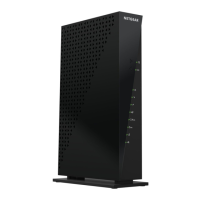
NETGEAR Certified Refurbished C6300-100NAR DOCSIS
3.0 WiFi Cable Modem Router with AC1750 16x4 download
speeds. Certified for Xfinity from Comcast, Spectrum, Cox,
Cablevision & more
NETGEAR Certified Refurbished C6300-
100NAR DOCSIS 3.0 WiFi Cable Modem
Router with AC1750 16x4 download speeds.
Certified for Xfinity from Comcast,
Spectrum, Cox, Cablevision & more:
TROUBLE SHOOTING STEPS
I’m experiencing connectivity issues with my NETGEAR
cable modem or modem router, how can I troubleshoot it?
If you’re experiencing connectivity issues, follow these troubleshooting steps:
1. Contact your Internet service provider (ISP) to verify that your device is activated. If you
never activated your cable modem or modem router, you must activate it using your
ISP’s self-activation process.
For more information about activating your cable modem or modem router, visit How do
I activate my cable Internet service and cable modem or modem router?.
To activate your Internet service:
1. Visit your cable Internet service provider’s website and follow the onscreen instructions
to activate your Internet service.
Note: You can find your cable Internet service provider’s contact information on your
monthly Internet service billing statement.
Question and Answer IconNeed help?

Do you have a question about the NETGEAR C6300-100NAR and is the answer not in the manual?

Summary

Troubleshooting Internet Connectivity

Experiencing Connectivity Issues

Steps to diagnose and resolve connectivity problems with your NETGEAR cable modem or modem router.

Activating Your Internet Service

Guide to activating your cable modem or modem router with your Internet Service Provider (ISP).

Checking Cable Line Power Levels

Instructions to check downstream and upstream power levels for optimal cable line performance.

Removing Cable Splitters

Advice on removing cable splitters to improve signal quality to your modem/router.

Checking Firmware Version

How to check your cable modem/router's firmware version.

Power Cycling Your Network

Step-by-step guide to power cycling your modem, router, and connected devices to resolve issues.

Understanding Wireless Frequencies

Explanation of the differences between 2.4 GHz and 5 GHz wireless bands for Wi-Fi performance.

Overview

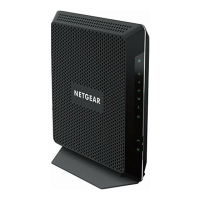
The NETGEAR Certified Refurbished C6300-100NAR DOCSIS 3.0 WiFi Cable Modem Router with AC1750 is a device designed to provide high-speed internet access through a cable connection. It combines the functionalities of a cable modem and a wireless router into a single unit, allowing users to connect to their Internet Service Provider (ISP) and create a local wireless network for their devices. This particular model is certified for use with major ISPs such as Xfinity from Comcast, Spectrum, Cox, and Cablevision, among others, ensuring compatibility and reliable performance with these providers.

Technical Specifications:

  • Model: C6300-100NAR
  • Certification: Certified Refurbished
  • DOCSIS Standard: 3.0
  • WiFi Standard: AC1750
  • Download Speeds: 16x4 channels, indicating 16 downstream channels for receiving data and 4 upstream channels for sending data. This configuration allows for theoretical maximum download speeds significantly higher than older DOCSIS standards.
  • Compatibility: Certified for Xfinity from Comcast, Spectrum, Cox, Cablevision, and other ISPs.

Function Description:

The primary function of this device is to act as a gateway between your home network and your ISP's cable internet service. As a DOCSIS 3.0 cable modem, it modulates and demodulates data signals over the coaxial cable line, converting them into a format that your computers and other devices can understand, and vice versa. The integrated AC1750 WiFi router then broadcasts a wireless signal, allowing multiple devices like laptops, smartphones, tablets, and smart home devices to connect to the internet without physical cables. It also typically includes Ethernet ports for wired connections, offering stable and high-speed connectivity for devices such as desktop computers, gaming consoles, or network-attached storage (NAS) devices.

Usage Features:

  • Integrated Design: Combines modem and router functions, reducing clutter and simplifying setup compared to using separate devices.
  • High-Speed Wireless: AC1750 WiFi provides dual-band wireless connectivity (2.4 GHz and 5 GHz). The 2.4 GHz band offers wider coverage, while the 5 GHz band provides faster speeds and less interference, ideal for bandwidth-intensive activities like streaming HD video and online gaming.
  • Broad ISP Compatibility: The certification for multiple major ISPs ensures that users can easily integrate this device into their existing internet service without compatibility issues.
  • Easy Activation: The device supports ISP self-activation processes, often allowing users to get online by visiting their ISP's website and following on-screen instructions.
  • Web-Based Management: Users can access the modem router's settings through a web browser using a default IP address (e.g., http://192.168.100.1). This interface allows for configuration of network settings, viewing of status information, and troubleshooting.
  • Default Credentials: The default username for accessing the management interface is "admin," and the default password is "password." These are case-sensitive.
  • Power Level Monitoring: The device allows users to check the downstream and upstream power levels of their cable line, which is crucial for diagnosing connectivity issues. Good downstream power levels are typically between -7 and +7 dBmV, while good upstream power levels are between 38 and 48 dBmV.

Maintenance Features & Troubleshooting Steps:

The manual provides comprehensive troubleshooting steps for common connectivity issues:

  1. Verify Device Activation:

    • Self-Activation: Users should first attempt to activate their device through their ISP's website. Contact information for the ISP can usually be found on the monthly billing statement.
    • ISP Contact: If self-activation fails, users should call their ISP. They will need to provide the modem router's model number, serial number, and MAC address (found on the device label). The ISP will then confirm if the device is active and visible on their network.
    • ISP Troubleshooting: If the device is not visible to the ISP, they can provide instructions to diagnose the connection issue. If it is visible but no internet connection is established, rebooting the modem router and rechecking the online status is recommended.
  2. Check Cable Line Power Levels:

    • Access Management Interface: Launch a web browser and enter http://192.168.100.1.
    • Login: Enter the default username "admin" and password "password."
    • Navigate: Go to "Cable Connection" (under the BASIC Home page) to view downstream and upstream power levels.
    • Interpretation: If power levels are outside the recommended range (-7 to +7 dBmV for downstream, 38-48 dBmV for upstream), contact the ISP as this indicates a potential issue with the cable line.
  3. Remove Splitters:

    • Splitters on the cable line can degrade signal quality. Removing any unnecessary splitters between the cable line and the modem router can improve connectivity.
  4. Check and Update Firmware:

    • View Firmware Version: Access the modem router's management interface (http://192.168.100.1), log in, and navigate to "ADVANCED" to view the current firmware version.
    • ISP Responsibility: Unlike many routers, cable modem firmware cannot be manually updated by the user. If the firmware is outdated, the ISP must be contacted to perform the upgrade. The manual includes a table of the latest firmware versions for various ISPs and NETGEAR models.
  5. Power Cycle Your Network:

    • Purpose: A power cycle can resolve most connectivity issues by resetting all networking devices.
    • Procedure (Standalone Modem + Router):
      1. Turn off all networking devices (cable/DSL modem, wired/wireless router, and all connected wired/wireless devices).
      2. If the modem has a backup battery, remove it to ensure a complete power off.
      3. Turn on the cable/DSL modem first and wait for it to fully boot up and establish a connection with the ISP (LEDs should stabilize).
      4. Turn on the wired/wireless router and wait for it to establish a connection with the modem (Internet LED should stabilize).
      5. Turn on all wired and wireless devices.
    • Procedure (DSL/Cable Gateway - Modem Router):
      1. Turn off all networking devices (DSL/Cable Gateway and all connected wired/wireless devices).
      2. Turn on the DSL/Cable gateway first and wait for it to fully boot up and establish a connection with the ISP (LEDs should stabilize).
      3. Turn on all wired and wireless devices.

Wireless Frequencies (2.4 GHz vs. 5 GHz):

The device supports both 2.4 GHz and 5 GHz wireless frequencies, each with distinct characteristics:

  • 2.4 GHz Band:
    • Range: Offers wider coverage and can penetrate solid objects (walls, floors) better.
    • Speed: Transmits data at slower speeds.
    • Interference: More susceptible to interference from other household devices (microwaves, cordless phones, garage door openers) as many devices use this band. It has fewer available channels (typically 11).
  • 5 GHz Band:
    • Range: Provides less coverage and is less effective at penetrating solid objects.
    • Speed: Transmits data at faster speeds.
    • Interference: Less prone to interference due to fewer devices using this band and a greater number of available channels (typically 23). Ideal for high-bandwidth activities.

Users experiencing significant interference on the 2.4 GHz band are advised to consider using the 5 GHz band for their devices.

If connectivity issues persist after following all troubleshooting steps, the manual advises contacting NETGEAR support for expert assistance.

NETGEAR C6300-100NAR Specifications

General IconGeneral
BrandNETGEAR
ModelC6300-100NAR
CategoryWireless Router
LanguageEnglish

Related product manuals