Chapter 2
NeuroSky Technology Overview
Brainwaves
e last century of neuroscience research has greatly increased our knowledge about the brain and
particularly, the electrical signals emitted by neurons ring in the brain. e patterns and frequencies
of these electrical signals can be measured by placing a sensor on the scalp. e Mind line of headset
products contain NeuroSky inkGear™ technology, which measures the analog electrical signals,
commonly referred to as brainwaves, and processes them into digital signals to make the measurements
available to games and applications. e table below gives a general synopsis of some of the commonly-
recognized frequencies that tend to be generated by different types of activity in the brain:
Brainwave Type Frequency range Mental states and conditions
Delta 0.1Hz to 3Hz Deep, dreamless sleep, non-REM sleep, unconscious
eta 4Hz to 7Hz Intuitive, creative, recall, fantasy, imaginary, dream
Alpha 8Hz to 12Hz Relaxed, but not drowsy, tranquil, conscious
Low Beta 12Hz to 15Hz Formerly SMR, relaxed yet focused, integrated
Midrange Beta 16Hz to 20Hz inking, aware of self & surroundings
High Beta 21Hz to 30Hz Alertness, agitation
ThinkGear
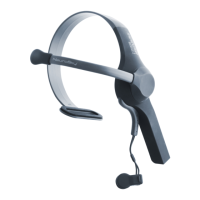
inkGear is the technology inside every NeuroSky product or partner product that enables a device
to interface with the wearers’ brainwaves. It includes the sensor that touches the forehead, the contact
and reference points located in the ear clip, and the on-board chip that processes all of the data. Both
the raw brainwaves and the eSense Meters (Attention and Meditation) are calculated on the inkGear
chip.
eSense
eSense™ is a NeuroSky's proprietary algorithm for characterizing mental states. To calculate eSense,
the NeuroSky inkGear technology amplies the raw brainwave signal and removes the ambient
noise and muscle movement. e eSense algorithm is then applied to the remaining signal, resulting
in the interpreted eSense meter values. Please note that eSense meter values do not describe an exact
number, but instead describe ranges of activity.
September 10, 2010 | © 2009 NeuroSky, Inc. All Rights Reserved.
5



 To Next Page