Need help?
Do you have a question about the Nice Road200 and is the answer not in the manual?
Essential checks before starting installation to ensure suitability and safety.
Procedure for physically installing the gearmotor unit onto the foundation.
Step-by-step guide for wiring the control unit and connected devices.
Procedure for safely connecting the unit to the main power supply.
Self-learning process for the control unit to detect gate travel limits.
Steps for programming radio transmitters to control the gate.
Procedures for testing all safety devices and system components.
Final steps to make the system operational, including documentation and labeling.
Guidelines for periodic checks and upkeep of the automation system.
Overview of the two-level programming system for functions and parameters.
Details on connecting safety devices and their compatibility with the STOP input.
Connection and function of safety photocells, including Phototest feature.
Guide to identifying and resolving common malfunctions and errors.
Important do's and don'ts for safe and proper use of the automation.
Guidance on handling malfunctions and basic user maintenance tasks.
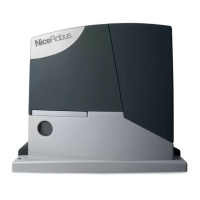
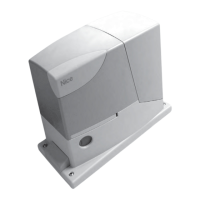
The ROAD200 is an electromechanical gearmotor designed for automating residential sliding gates. It integrates an electronic control unit and a radio receiver for remote control devices, offering a comprehensive solution for gate automation.
The primary function of the ROAD200 is to provide automated opening and closing of sliding gates. It operates with electric power and is equipped with an electronic control unit that manages all gate movements and safety features. The system can be remotely controlled via a radio receiver, allowing for convenient operation. In the event of a power failure, the gearmotor can be manually released using a key, enabling manual gate movement.
The control unit is designed to recognize the gate's opening and closing positions, measuring the leaf's length from the closing limit switch to the opening limit switch. This measurement is crucial for calculating deceleration points and partial opening points. During this recognition phase, the system also detects and memorizes the configuration of the STOP input and the presence or absence of the PHOTO input connection in "Phototest" mode. This self-learning process ensures precise and safe gate operation.
The ROAD200 offers various programmable functions to customize its operation. These functions are categorized into two levels:
The system incorporates a "Phototest" function to enhance the reliability of safety devices, achieving "category 2" compliance with UNI EN 954-1. This function ensures that every time a maneuver is activated, the related safety device is controlled, and the maneuver only starts if the test is positive. If the test fails (e.g., due to a blinded photocell or short-circuited cable), the fault is identified, and the maneuver is not performed.
The "Always open" function allows for an opening maneuver when the "Step-by-Step" command is held for more than 3 seconds, useful for connecting a timer to keep the gate open for a specific duration. The "Move anyway" function provides a way to operate the gate in "Man present" mode even if a safety device is malfunctioning or out of use, by actuating the control again within 3 seconds and keeping it actuated.
Installation of the ROAD200 must be carried out by qualified personnel in compliance with current legislation and safety standards. Preliminary checks include verifying the suitability of the gate structure, ensuring the gate's weight and dimensions are within operating limits, and checking for smooth movement without excessive friction or derailing risks. The gearmotor should be mounted on a sturdy, level surface, ensuring a 1-2mm play between the rack and the pinion to prevent the leaf's weight from affecting the gearmotor.
Electrical connections must only be performed after switching off the electricity supply and disconnecting any buffer batteries. Cables should be routed through designated holes, secured with clamps, and connected to the appropriate terminals as per the wiring diagram.
After installation, a series of final checks and start-up procedures are required. This includes choosing the direction of the opening maneuver, verifying the power supply connection (checking the "OK" LED for regular flashes), and recognizing the length of the leaf through a self-learning process. This process involves pressing specific buttons to initiate opening and closing maneuvers, allowing the control unit to measure the gate's travel and configure safety inputs.
Once the self-learning is complete, several maneuvers should be performed to check proper gate travel, ensuring smooth operation, correct slowdown and stop points, and proper flashing light signaling. All safety devices must be tested individually, confirming that the "OK" LED flashes twice quickly upon activation. Photocells should be tested by passing a 5 cm diameter, 30 cm long cylinder through their optical axis at various points to ensure proper triggering.
The radio receiver, incorporated into the control unit, operates at 433.92 MHz and is compatible with various transmitter types (FLO, FLOR, SMILO). Transmitters can be memorized in two modes:
Regular maintenance is crucial to ensure the long life and safety of the ROAD200 automation system. Maintenance operations should be performed by qualified personnel in strict compliance with safety directions and applicable legislation.
Scheduled maintenance is recommended every 6 months or after 10,000 maneuvers, whichever comes first. Before any maintenance, the power supply (and buffer batteries, if present) must be disconnected. Maintenance tasks include:
Users can perform periodic maintenance tasks such as cleaning photocell glasses and removing leaves and debris that might impede automation. To prevent accidental activation during cleaning, the automation system should be released.
In case of malfunctions or power failures, users are advised to disconnect the power supply and operate the manual release device to move the gate manually. Any repairs or modifications to the system or its programming should only be carried out by an installation technician.
At the end of its useful life, the ROAD200 must be dismantled by qualified personnel, and its materials should be recycled or disposed of in compliance with local regulations. Electronic components and batteries, which may contain polluting substances, should be disposed of separately.
 General
| Operating temperature | -20°C to +50°C |
|---|---|
| Speed | Up to 0.2 m/s |
| Warranty | 2 years |
| Power supply | 230 V, 50 Hz |
| Safety Features | Obstacle detection |
| Remote Control | 2-button remote included |

 To Next Page