3) Signal sound becomes stronger and changes in pitch
while getting closer to the target center and the circles
start disappearing in the pinpoint graphics.
4) At the spot which provides the loudest sound, the
circles will all disapper and only a dot will be left. Mark
this spot using a tool or your foot.
5) Repeat the above procedure by changing your
direction 90°. Actions to be performed from a couple
of different directions will narrow the target area and
provide you with the most exact details of the target
location.
NOTE: Inexperienced users may put the search coil
on the ground, press the pinpoint button and then
scan over the target until they get experienced to
perform the above pinpointing method.
LARGE OR NEAR-SURFACE TARGETS
Targets which are near the surface may give multiple
different signals to the device. If you suspect a target
near the surface, lift the search coil and swing it more
slowly until a single signal is received.
FALSE SIGNALS AND REASONS
Sometimes, the device may produce signals which
are similar to a target signal although no metal target
is present. There are various reasons for the false
signals received by the device. The most common ones
are ground mineralization or rocks with high mineral
content, surrounding electromagnetic signals, operation
of another nearby detector, rusted or corroded iron or
foil in the soil or sensitivity value set too high.
Surrounding electromagnetic signals can be eliminated
by reducing the gain. If another detector is operating
nearby, you may attempt to shift the frequency or
perform your search at a distance where no interference
occurs.
DETECTION ON THE BEACH AND UNDERWATER
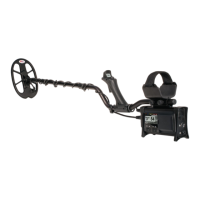
In the FINDX version, only the search coil is waterproof.
The FINDX Pro, on the other hand, is designed to be
entirely waterproof up to 5 meters (16ft) according
to IP68 standards. This provides convenient use
underwater and on the beach.
As explained before, salt water and alkali grounds
are significantly conductive and cause effects similar
to iron in detectors. FINDX’s Beach mode is specially
designed for such conditions. You can perform your
search easily using the Beach mode without requiring
any special settings.
Beach mode is ideal for salty wet beach sand. You can
use the other modes while performing search over dry
beach sand.
You should consider the following while performing
search over wet beach sand or underwater:
1) When you swing the search coil over the holes you
dig in wet beach sand, you can receive metal signals,
this is a normal condition.
2) The search coil may give false signals when going
into and coming out of the water so please try to keep
the coil either in or out of the water.
3) While detecting on wet beach sand, avoid rubbing
or hitting the search coil on the ground. Otherwise, the
device may give false signals.
4) When going from wet sand to dry sand or from dry
sand to wet sand while detecting on the beach, the
device may emit false signals. Ground balance the
detector after you switch from one another.
15
CONTENTS



 To Next Page