Notice: On initial start-up, it may take longer for
the burner to light because of air being
purged from the gas supply line.
Important Note: Altitude above 4000 feet affects the
performance of the gas burner, could reduce cool-
ing performance of the refrigerator, and may cause
nuisance burner outages. Norcold recommends
that the refrigerator be switched to AC or DC elec-
tric at an altitude above 4000 feet. An optional high
altitude kit is available through your dealer for gas
operation at altitudes up to 10,000 feet.
4. Set thermostat to desired temperature settin
.
Notice
:
Cleaning vehicle exterior by a power
(car) wash may allow water to enter
the refrigerator’s burner area through the
vent cap. Operate the refrigerator on
gas to ensure evaporation of any mosi-
ture that may have entered the burner
area.
AC Operation
1. Press mode selection button
C
.
2. Set the thermostat
B
to the coldest settin
.
Allow to operate at coldest settin
for 6 to 8 hours
before ad
ustin
.
DC Operation
1. Press mode selection button
D
. There is no
need to set thermostat to an
settin
. The DC
operation is a continuous run
no thermostat
control
mode.
Shut-Down: All Modes
1. Place the mode selector button to the off position.
This will interrupt all AC and DC power and stop
operation of the refri
erator.
Users Operating Guide
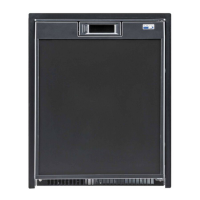
This appliance has been desi
ned for stora
e of
foods.
About Your Refrigerator
Storage Volume
1.8 cu. ft.
Leveling
The Norcold refri
erator does not re
uire critical lev-
elin
. Normal vehicle levelin
to provide comfort for the
vehicle occupants is satisfactor
for refri
erator operation.
Operation in Transit
While the refri
erator should be level when the vehicle
is stationar
, performance durin
transit is not normall
affected.
Ventilation Fan
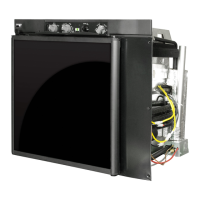
A thermostat controlled mechanical fan is used to
move air across the refri
erator’s coolin
s
stem. The
thermostat is calibrated to activate the fan whenever
the vehicle’s interior temperature reaches 85 de
rees
or hi
her.
When leavin
the vehicle unattended, it is advisable
to leave windows or roof exhaust vents open to main-
tain the vehicle’s interior temperature below 85 de-
rees. This will allow the refri
erator to operate efficientl
,
minimize fan operation, and limit current draw from the
batter
.
Information Regarding Battery Drain
A 12 volt DC source is re
uired for the
as and DC
modes of operation and the mechanical fan which
assists the air flow across the refri
erator’s coolin
s
stem. For
as operation, the DC power source
supplies volta
e for electronic i
nition
100 milliamps
and to the mechanical fan
240 milliamps
. The cur-
rent draw is 340 milliamps. This indicates that drain
on the batter
is ver
low and has little effect on
"batter
run down". For DC operation, the DC power
source supplies volta
e for the cartrid
e heatin
ele-
ment. The DC operation draws approximatel
11.7
amps at 12 VDC and 13.6 amps at 14 VDC. It is
evident that current draw for DC operation is hi
h,
therefore, the refri
erator should not be operated for
lon
periods of time from a batter
onl
without a
means of rechar
in
the batter
. The DC volta
e
should be checked while operatin
the refri
erator in
the DC mode. The volta
e at the refri
erator should
never be below 11.5 volts DC.
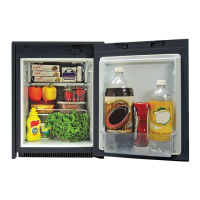
Fresh Food Compartment
This compartment is desi
ned to store and cool foods.
Refri
eration re
uires air circulation within the fresh
food compartment. Restriction of air circulation will
cause inade
uate refri
erator temperatures and possi-
ble food spoila
e.
Do not cover the refrigerator shelf
with paper or plastic.
To prevent food odors, store hi
hl
flavored foods in
covered dishes, plastic ba
s or wrap in foil. Cover
ve
etables to retain crispness.
To reduce frost formation on the coolin
fin, cover li
uids
and moist foods.
Do not put hot foods into the refrigerator
or let door remain open longer than necessary.
Allow the refri
erator to operate for a minimum of ei
ht
hours or overni
ht before loadin
the refri
erator with
food. Loadin
a warm refri
erator with warm foods will
8



 To Next Page