heating)will be usedas a sourceof heat.
Sustaineduse of electricresistanceheat in
placeoftheheatpumpwillresultinanincrease
in electricutilitycosts.
Defrost -- During cold weather heating
operation,theoutdoorunitwilldevelopacoating
ofsnowandiceontheheattransfercoil.Thisis
normalandtheunitwillperiodicallydefrostitself.
Duringthe defrostcycle,the outdoorfanwill
stop,whilethecompressorcontinuestorunand
heattheoutdoorcoil,causingthesnowandice
to melt. Duringdefrost,theremaybe some
steamrisefromtheoutdoorunitasthewarmcoil
causessomemeltedfrostto evaporate.
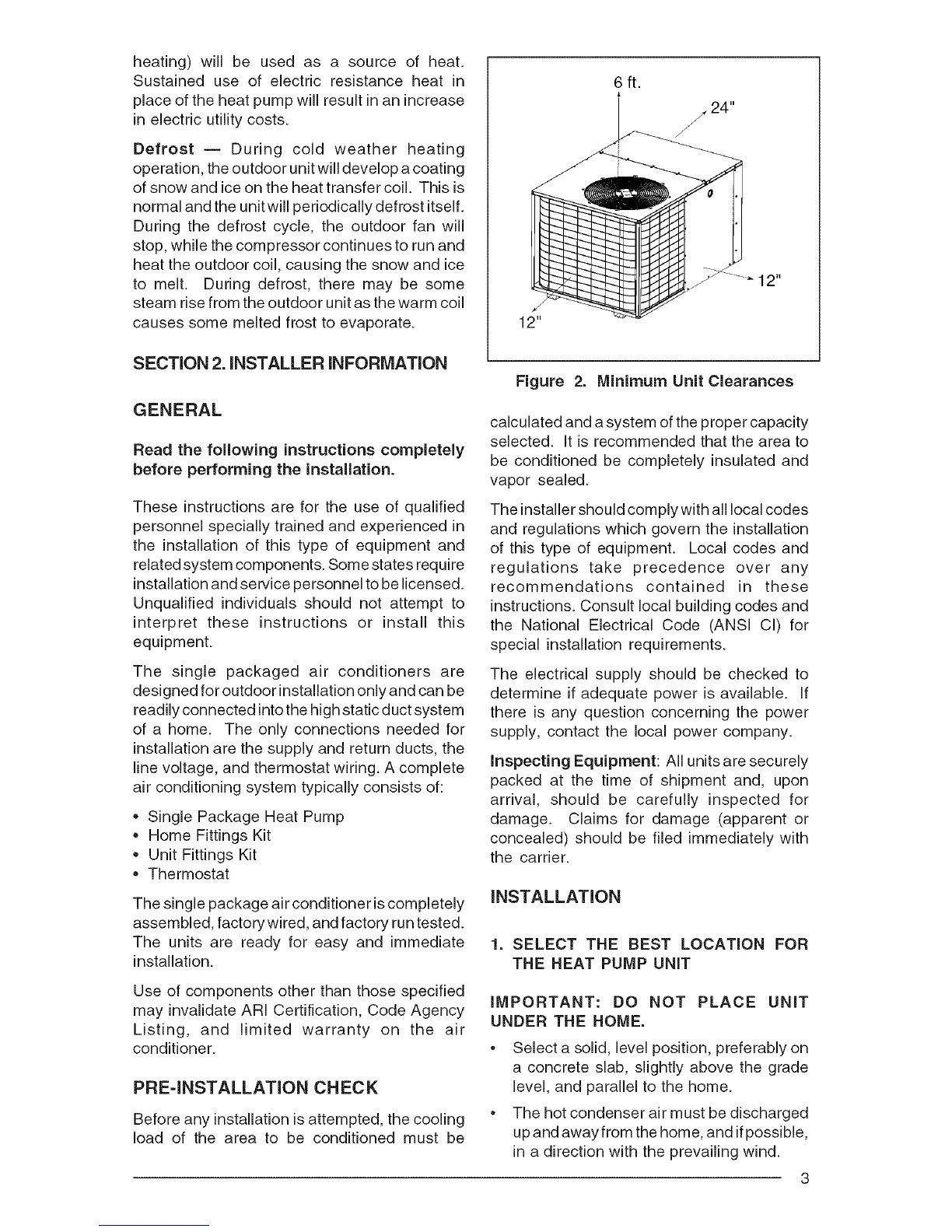
6ft.
12"
SECTION 2. INSTALLER INFORMATION
GENERAL
Read the following instructions completely
before performing the installation.
These instructions are for the use of qualified
personnel specially trained and experienced in
the installation of this type of equipment and
related system components. Some states require
installation and service personnel to be licensed.
Unqualified individuals should not attempt to
interpret these instructions or install this
equipment.
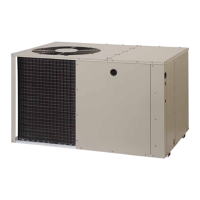
The single packaged air conditioners are
designed for outdoor installation only and can be
readily connected into the high static duct system
of a home. The only connections needed for
installation are the supply and return ducts, the
line voltage, and thermostat wiring. A complete
air conditioning system typically consists of:
• Single Package Heat Pump
• Home Fittings Kit
o Unit Fittings Kit
• Thermostat
The single package air conditioner is completely
assembled, factory wired, and factory run tested.
The units are ready for easy and immediate
installation.
Use of components other than those specified
may invalidate ARI Certification, Code Agency
Listing, and limited warranty on the air
conditioner.
PRE-INSTALLATION CHECK
Before any installation is attempted, the cooling
load of the area to be conditioned must be
Figure 2. Minimum Unit Clearances
calculated and a system of the proper capacity
selected. It is recommended that the area to
be conditioned be completely insulated and
vapor sealed.
The installer should comply with all local codes
and regulations which govern the installation
of this type of equipment. Local codes and
regulations take precedence over any
recommendations contained in these
instructions. Consult local building codes and
the National Electrical Code (ANSi CI) for
special installation requirements.
The electrical supply should be checked to
determine if adequate power is available. If
there is any question concerning the power
supply, contact the local power company.
inspecting Equipment: All units are securely
packed at the time of shipment and, upon
arrival, should be carefully inspected for
damage. Claims for damage (apparent or
concealed) should be filed immediately with
the carrier.
INSTALLATION
1. SELECT THE BEST LOCATION FOR
THE HEAT PUMP UNIT
IMPORTANT: DO NOT PLACE UNIT
UNDER THE HOME.
- Select a solid, level position, preferably on
a concrete slab, slightly above the grade
level, and parallel to the home.
. The hot condenser air must be discharged
up and away from the home, and if possible,
in a direction with the prevailing wind.





 To Next Page