36
420012001500 - 03182024 - Rev. 04
A. General
1. Installation should be made in accordance with the regulations of
the Authority Having Jurisdiction, local code authorities, and utility
companies which pertain to this type of water heating equipment.
2. Install the venting system in accordance with these instructions
and with the National Fuel Gas Code, ANSI Z223.1/NFPA 54, CAN/
CGA B149, and / or applicable provisions of local building codes.
3. This boiler must be vented with materials, components, and
systems listed and approved for Category IV appliances.
NOTE: To avoid contamination often contained in indoor air, it is best
to pipe all intake combustion air directly to the outdoors.
NOTE: Care must be taken to prevent condensate freezing in the
exhaust vent pipe system. See local, state, provincial, and national
codes for best practices to prevent condensate freezing in the exhaust
vent pipe system.
The boiler must be vented as detailed in this section. Ensure exhaust
vent and intake piping complies with these instructions regarding vent
system. Inspect finished exhaust vent and intake piping thoroughly
to ensure all joints are well secured, airtight, and comply with all
applicable code requirements, as well as the instructions provided
in this manual. Failure to properly install the vent system will result in
severe personal injury or death.
This boiler is certified as a “Category IV” appliance and requires a
special venting system. The vent system will operate with a positive
pressure in the pipe. Exhaust gases must be piped directly outdoors
using the vent materials and rules outlined in these instructions. Do not
connect vent connectors serving appliances vented by natural draft
into any portion of mechanical draft systems operating under positive
pressure. Follow the venting instructions carefully. Failure to do so will
result in substantial property damage, severe personal injury, or death.
Due to the extreme flammability of most glues, cements, solvents, and
primers used to join plastic exhaust vent and intake pipes, explosive
solvent vapors must be cleared from all vent piping before start-up.
Avoid using excess cement or primer, as this may pool in the vent
pipes. Vent assemblies should be allowed to cure for a period of
at least 8 hours before powering a connected appliance. Failure to
follow these instructions will result in substantial property damage,
severe personal injury, or death. It is the installers’ responsibility to
understand the hazards associated with explosive solvents and take
the necessary precautions to avoid these risks.
Improper seating of vent pipe gaskets can cause eventual gasket failure
and exhaust gas leakage. Ensure the exhaust vent pipe is properly
beveled and seated before insertion into the flue adapter. Failure to do
so could result in property damage, severe personal injury, or death.
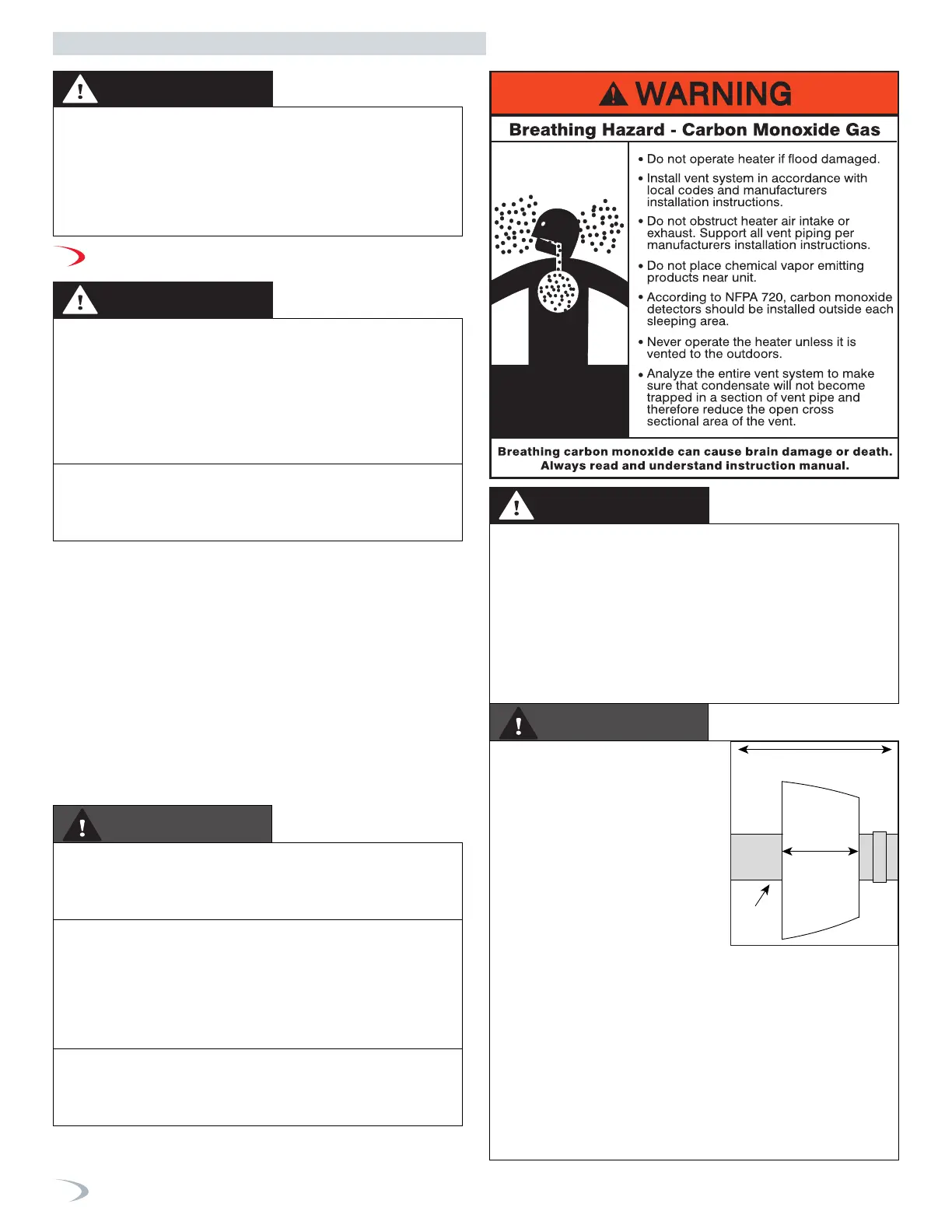
Only Stainless Steel exhaust vent pipe
material may be insulated.
DO NOT insulate the first three (3)
linear feet of the exhaust vent run.
DO NOT insulate PVC, CPVC, or
Polypropylene exhaust vent pipe
material. Doing so will cause increased
vent wall temperatures, which could
result in vent pipe failure.
CPVC, Polypropylene, or Stainless Steel
pipe material MUST be used if the first
three (3) linear feet of the exhaust vent
run passes through an enclosed space
greater than 6” in length, such as a wall or ceiling.*
If CPVC is used to meet these requirements, the balance may be
installed with approved PVC pipe.
If Polypropylene or Stainless Steel is used to meet these requirements,
the balance of the vent run MUST be installed with the same material.
Failure to comply with these requirements could result in property
damage, severe personal injury, or death.
*This rule applies when the exhaust vent passes through the enclosed space
into another interior space, i.e. through a floor or wall from the mechanical
room into another room. This rule DOES NOT apply when the exhaust vent
passes through the enclosed space immediately to the exterior of the building.
Exhaust vent adaptors are not designed as load-bearing devices, and
must not be used to support exhaust vent piping. All vent pipes must be
properly connected, supported, and the exhaust vent must be pitched
a minimum of 1/4” per foot back to the boiler to allow drainage of
condensate. Failure to properly support vent piping and follow the
information in this statement could result in product damage, severe
personal injury, or death.
It is required to insert the provided exhaust and intake screens into
the vent terminations to prevent blockage caused by debris or birds.
Failure to keep terminations clear could result in property damage,
severe personal injury, or death.
Exhaust and intake are to be piped separately. This boiler cannot
share a common exhaust or intake with multiple appliances. Failure
to follow these instructions will result in substantial property damage,
severe personal injury, or death.
DANGER
DANGER
DANGER
WARNING
WARNING
Part 5 - Venting
Exhaust
Length
Greater than
Six (6) Inches
Enclosed
Space
Within First Three (3) Linear Feet of
Appliance Exhaust Vent Adapter


 To Next Page
 Loading...