93
TRX Series II - Installation - Startup - Maintenance Instructions
WARNING
WARNING
WARNING
CAUTION
CAUTION
Ensure the boiler is full of water before firing the burner. Failure
to do so will damage the boiler. Such damage IS NOT covered
by warranty, and could result in property damage, severe
personal injury, or death.
Ensure the boiler is full of water before firing the burner. Failure
to do so will damage the boiler. Such damage IS NOT covered
by warranty, and could result in property damage, severe
personal injury, or death.
Eliminate all system leaks. Continual fresh make-up water will
reduce boiler life. Minerals can build up in the heat exchanger,
reducing heat transfer, overheating the heat exchanger and
causing heat exchanger failure.
Check if the condensate trap contains water. If not, it must be
refilled. Open the manual air vent on the main exchanger until
completely filled. Check the system pressure on the pressure
gauge again.
It is highly recommended to carefully follow the glycol
manufacturer’s recommended concentrations, expansion
requirements, and maintenance recommendations (pH
additive breakdown, inhibitor reduction, etc.) You must
carefully calculate the additional friction loss in the system as
well as the reduction in heat transfer coefficients.
Connect the condensate discharge pipe before filling and
purging the heating circuit.
It is important to purge the system of air to avoid damage to
the boiler.
6. Anti-freeze solutions expand more than water. For example: A 50%
by volume solution expands 4.8% in volume for a temperature
increase from 32 - 80
o
F, while water expands 3% over the same
temperature rise. Allowances must be made in system design for
expansion.
7. A 30% mixture of glycol will result in a BTU output loss of 15% with
a 5% increase in head against the system circulator.
8. A 50% mixture of glycol will result in a BTU output loss of 30% with
a 50% increase in head against the system circulator.
NOTE: BTU losses apply to both CH and DHW.
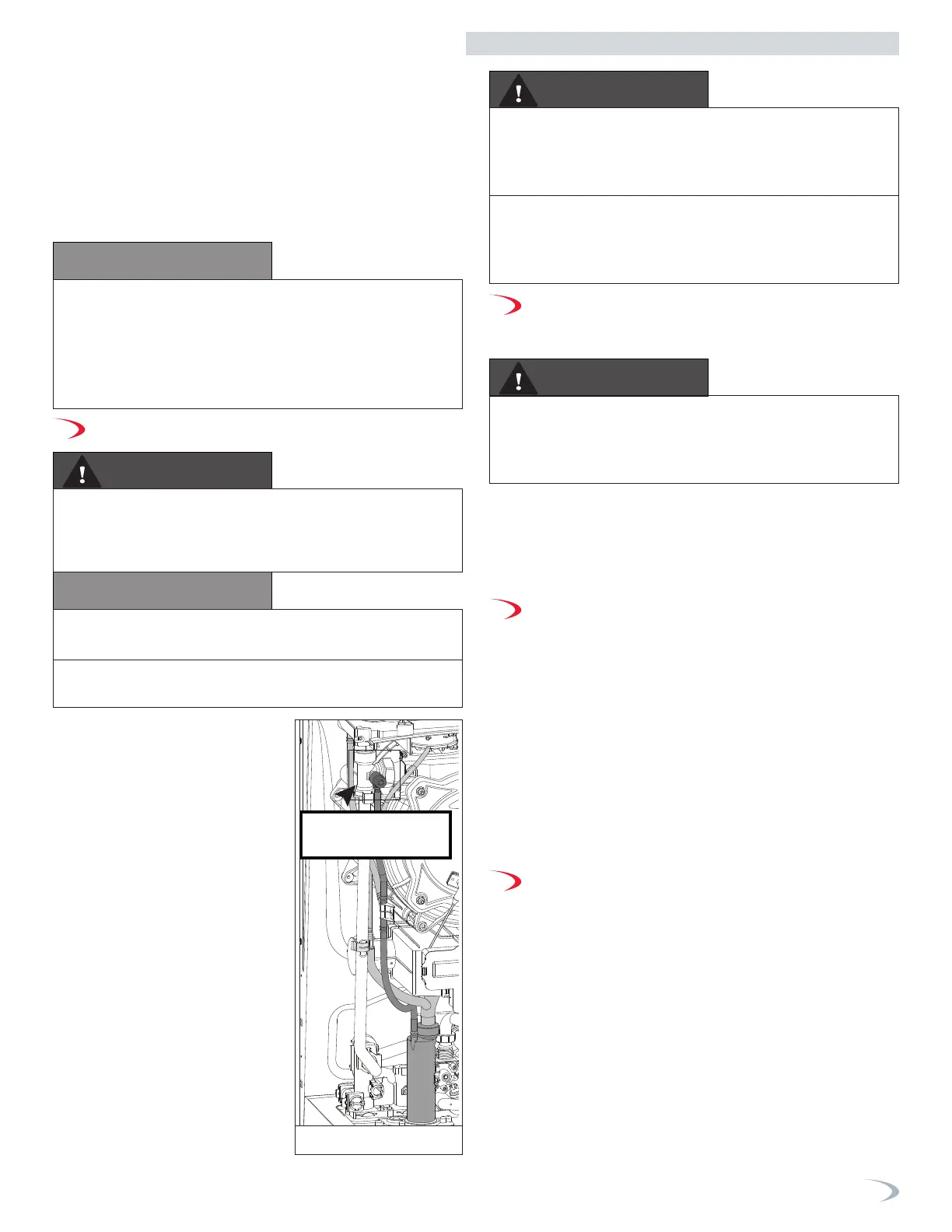
D. System Water Fill, Purge, and Test
The boiler and heating system must
be thoroughly purged of air during
the initial installation or system
maintenance. Proceed as follows to
purge the boiler and heating system:
1. Open the manual air vent positioned
on the side of the primary exchanger.
The valve is already connected
to a discharge hose routed to the
condensate trap.
2. Lift the cap on the automatic air
release valve on the pump. Leave
open permanently.
3. Gradually open the main water valve
until water flows. Do not open fully.
4. Thoroughly purge each zone starting
with the lowest point and close them
only when clear water free of air is
visible.
5. Close the manual air vent when clear
water free of air is visible.
6. Continue filling the system until at
least 12 psi registers on the pressure
gauge.
Figure 102 - Manual Air
Vent Position
F. Check Thermostat Circuit(s)
1. Disconnect the two external wires connected to the boiler
thermostat terminals TT1/TT2 (low voltage terminal strip).
2. Connect a voltmeter across these two incoming wires with power
supplied to the thermostat circuits. Close each thermostat, zone
valve and relay in the external circuit one at a time and check the
voltmeter reading across the incoming wires.
3. There should NEVER be a voltage reading.
4. If a voltage reading does occur under any condition, check and
correct the external wiring. (This is a common problem when using
3-wire zone valves.)
5. Once the external thermostat circuit wiring is checked and
corrected if necessary, reconnect the external thermostat circuit
wires to the boiler low voltage terminal strip. Allow the boiler to
cycle.
E. Purge Air from DHW System
1. Make sure the CH and DHW lines are open and full of water. Turn on
all electric power to boiler.
2. Open hot water faucets in the DHW system. Start with the faucets
nearest the boiler.
3. Keep faucets open until water runs freely and all air is purged. Then
move on to faucets further away from the boiler in the system.
4. When water flows freely from all hot water faucets, DHW purging is
complete.
G. Condensate Removal
1. The boiler is a high efficiency condensing appliance. Therefore, the
unit has a condensate drain. Condensate fluid is nothing more than
water vapor, derived from combustion products, similar to that
produced by an automobile when it is initially started.
Condensation is slightly acidic (typically with a pH of 3 to 5)
and must be piped with the correct materials. Never pipe the
condensate using steel, copper, brass or other materials that will
be subject to corrosion. Plastic PVC or CPVC pipe are the only
approved materials.
A condensate neutralizer, if required by local authorities, can be
made up of lime crystals, marble or phosphate chips that will
neutralize the condensate.
2. The boiler is equipped with a barbed outlet fitting, to which the
supplied hose must be installed and routed to a local drain. It is
very important that the condensate line is sloped downward away
from the boiler to a suitable indoor drain.
Boiler Manual Air
Vent
Part 10 - Start-Up Preparation


 To Next Page
 Loading...