49
TRX Series II - Installation - Startup - Maintenance Instructions
Part 5 - Venting
3. Power Venting, Indoor Combustion Air in Confined or
Unconfined Space
This boiler requires fresh, uncontaminated air for safe operation and
must be installed in a mechanical room where there is adequate
combustion and ventilating air. NOTE: To prevent combustion air
contamination, see Table 7.
When the installation uses Indoor Combustion Air, provisions for
combustion and ventilation air, in accordance with section “Air for
Combustion and Ventilation,” of the National Fuel Gas Code, ANSI
Z223.1/NFPA 54 (USA), or Clause 8.2, 8.3 or 8.4 of the Natural Gas and
Propane Installation Code, CAN/CSA B149.1 (Canada), or applicable
provisions of the local building codes, must be adhered to.
Combustion air from the indoor space can be used if the space has
adequate area or when air is provided through a duct or louver to
supply sufficient combustion air based on the boiler input. Never
obstruct the supply of combustion air to the boiler. If the boiler
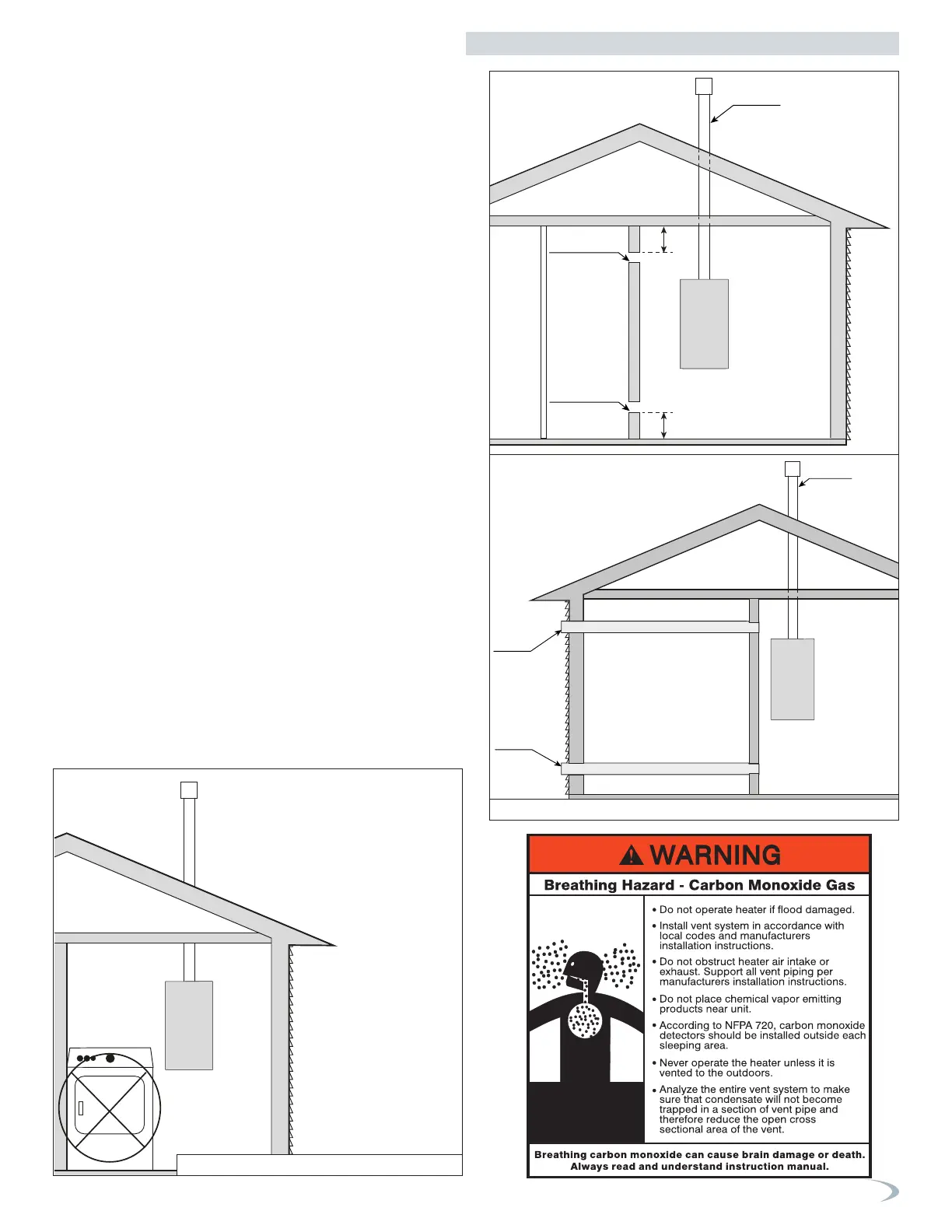
is installed in areas where indoor air is contaminated (see Figure 55)
it is imperative that the boiler be installed as direct vent so that all
combustion air is taken directly from the outdoors into the boiler
intake connection.
Unconfined space is space with volume greater than 50 cubic feet per
1,000 Btu/hour (4.8 cubic meters per kW) of the total input rating of
all fuel-burning appliances installed in that space. Rooms connected
directly to this space, through openings not furnished with doors, are
considered part of the space.
Confined space is space with volume less than 50 cubic feet per
1,000 Btu/hour (4.8 cubic meters per kW) of the total input rating of
all fuel-burning appliances installed in that space. Rooms connected
directly to this space, through openings not furnished with doors, are
considered part of the space.
When drawing combustion air from inside a conventionally
constructed building to a confined space, such space should be
provided with two permanent openings: one located 6” (15 cm) below
the space ceiling, the other 6” (15cm) above the space floor. Each
opening should have a free area of one square inch per 1,000 Btu/hr
(22cm2/kW) of the total input of all appliances in the space, but not
less than 100 square inches (645cm2).
If the confined space is within a building of tight construction, air for
combustion must be obtained from the outdoors as outlined in the
Venting section of this manual. See Figure 56.
DO NOT LOCATE
APPLIANCE
NEAR DRYER
6”
6”
ROOM OPENING
EXHAUST
INDOOR COMBUSTION AIR
(SINGLE PIPE)
ROOM OPENING
OUTDOOR COMBUSTION AIR
(SINGLE PIPE)
UPPER
AIR DUCT
LOWER
AIR DUCT
EXHAUST
Figure 55 - Do Not Place Appliance Near Dryer
Figure 56 - Indoor and Outdoor Combustion Air - Single Pipe



 To Next Page