EasyManua.ls Logo

NuAire Labgard NU-427-400 - User Manual

NuAire Labgard NU-427-400
100 pages
Print Icon
To Next Page IconTo Next Page
Loading...
Page 1 of 100
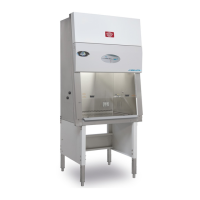
Labgard ES Energy Saver Class II,
Type B1 Laminar Flow
Biosafety Cabinet
Models
NU-427-400/600
Bench/Console
Operation & Maintenance Manual
NU-427-400/600 Series BR
Revision 2 September 2020
Manufactured By:
Nuaire, Inc.
2100 Fernbrook Lane
Plymouth, MN 55447
Toll-Free: 1-800-328-3352
In Minnesota: (763)-553-1270
Fax: (763)-553-0459
Congratulations!
You have just purchased one of the finest Laminar Flow Biosafety Cabinets available. With proper care, maintenance
(certification), and laboratory procedure, this cabinet will give you years of product and personnel protection from particulate
Question and Answer IconNeed help?

Do you have a question about the NuAire Labgard NU-427-400 and is the answer not in the manual?

Overview

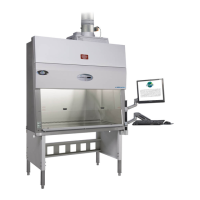
The Labgard ES Energy Saver Class II, Type B1 Laminar Flow Biosafety Cabinet (BSC) is a bench/tabletop model, with an optional base support stand for console operation. It utilizes an Energy Saver DC ECM motor and a forward-curved fan to optimize energy efficiency and filter loading capacity. The ECM motor is controlled by a solid-state DC motor controller with digital dual thermistor airflow sensors, providing automatic compensation for filter loading and line voltage variances.

Function Description:

The BSC is designed to control airborne contaminants in biological research or chemical containment settings. It provides optimum control over product quality while reducing exposure to airborne biological or particulate chemical agents. The NU-427 Bench LFBSC meets Class II, Type B1 requirements, maintaining a minimum average inflow velocity of 100 fpm (0.51 m/s) through the work access opening. It features HEPA-filtered downflow air, largely composed of recirculated air, and exhausts most contaminated downflow air to the atmosphere through a hard connection to the facility exhaust system after HEPA filtration. All contaminated ducts and plenums are under negative pressure or surrounded by directly exhausted negative pressure plenums. Type B1 cabinets can be used for work with volatile chemicals, subject to chemical risk assessment.

Important Technical Specifications:

  • Models: NU-427-400 (Nominal 4 ft / 1.2m) and NU-427-600 (Nominal 6 ft / 1.8m).
  • Performance: NSF/ANSI 49 compliant for Personal and Product Protection (Class II, Type B1).
  • Construction: All welded 16GA, Type 304 stainless steel, pressure-tight design. Non-flammable diffuser for air supply.
  • HEPA Filter Seal Type: HEPEX Seal, Neoprene, Spring loaded.
  • Filter Efficiency: 99.99% on 0.3 Microns for both Supply and Exhaust filters.
  • Airflow Rating:
    • Supply Filter: 100 fpm @ .60 ± .05" w.g. per sq. ft.
    • Exhaust Filter: 250 fpm @ .46 ± .05" w.g. per sq. ft.
  • Air Volume (CFM/CMH):
    • NU-427-400: Inflow 282/479, Exhaust Air 282/479 (at -0.7" w.g. / 18mm w.g.).
    • NU-427-600: Inflow 472/805, Exhaust Air 472/805 (at -0.9" w.g. / 23mm w.g.).
  • Cabinet Dimensions (Height, Width, Depth):
    • NU-427-400: 61" (1549mm) H, 53 5/8" (1362mm) W, 32 7/8" (835mm) D.
    • NU-427-600: 61" (1549mm) H, 77 5/8" (1972mm) W, 32 7/8" (835mm) D.
  • Work Access Opening: Standard 8" (203mm) H, 105 FPM (.53 m/s) Inflow Velocity.
  • Work Zone: 25 1/2" (648mm) H, 46 3/8" (1178mm) W (400 model), 70 3/8" (1788mm) W (600 model), 23 1/2" (597mm) D.
  • Electrical: U.L.-C, US Listed. 115VAC, 60Hz.
    • NU-427-400: 2.6 Amps (Blower/Lights), 3 Amps (Outlet), 10 Amps (Total).
    • NU-427-600: 4.5 Amps (Blower/Lights), 3 Amps (Outlet), 12 Amps (Total).
  • Heat Rejected: 543 BTU/hr (400 model), 774 BTU/hr (600 model).
  • Environmental Requirements: Temperature 60°F-85°F (15°C-30°C), Humidity 80% RH up to 31°C decreasing linearly to 50% RH at 40°C, Altitude 6562 Feet (2000 meters) maximum.
  • LED Lamp Life: B70 life rating of 50,000 hours based on 80,000 switching cycles.

Usage Features:

  • TOUCHLINK LCD Interface: Provides easy user interaction for controlling blower, lights, outlets, and accessing menu functions.
  • Automatic Airflow Control: Digital dual thermistor airflow sensors monitor and control downflow to setpoints, compensating for filter loading and voltage variances. A digital differential velocity pressure flow grid monitors exhaust volume and inflow velocity.
  • Sliding Window: Monitors window position with micro switches for height and closed positions.
  • Timers: Purge Timer (blower run time after shutdown), Outlet Timer (outlet run time after activation), UV Light Timer (UV light run time after activation), Auto Run Timers (programmable daily start/stop schedule for blower and lights).
  • Historical Performance: Displays week-long log data for downflow, inflow, and exhaust in graphical form.
  • Night Setback (Optional): Reduces exhaust air volume during non-usage periods to save energy. Can be initiated via main control board contacts or display icon.
  • Remote Override (Optional): Allows remote control of cabinet operation, typically for Bio Safety Level three facilities with room exhaust system failure.
  • Ergonomics: Designed with considerations for proper user posture, effective work zone layout, and vision/sightlines. Includes forearm/armrest support and recommendations for ergonomic chairs.
  • Safe Working Area: The work tray or depressed area is the safe working area; the front grill area is non-safe.
  • Minimizing Air Curtain Disruption: Recommendations to minimize items in the cabinet and reduce hand/arm entries/withdrawals.
  • Minimizing Room Activity: Advised to keep room activity low to prevent disruptive air currents.
  • Aseptic Technique: Emphasizes good laboratory practices to prevent contact contamination.
  • Bunsen Burner Usage: Recommended to use on-demand ignition burners, placed at the right rear of the workspace to minimize air turbulence. Not recommended on the left side due to influence on the electronic airflow control system.

Maintenance Features:

  • Certification: Nuaire recommends certification to factory standards after installation and annually. Tests include HEPA filter leak test, Downflow velocity test, Inflow velocity Test, Airflow smoke patterns, and Site installation assessment tests.
  • Cleaning Procedures: Interior surfaces should be disinfected with 70% alcohol or similar non-corrosive anti-microbial agents. Avoid chlorinated or halogen materials on stainless steel. Airflow blower should be operating during cleaning.
  • Decontamination: For microbiological decontamination, a procedure involving formaldehyde vaporization is outlined. This requires specialized personnel and sealing the cabinet.
  • LED Lamp Replacement: Two T8 LED lamps are cool white, external to the cabinet. Replacement involves removing screws from the control center and rotating it down.
  • HEPA Filter Replacement: Filters should be replaced when exhaust volume or inflow velocity cannot be maintained. Only use replacement filters of the same rated flow and size. Supply and exhaust filters can be replaced independently.
  • Motor/Blower Assembly Removal: Recommended to remove as a single unit. Inspect rubber isolation motor mounts for stress.
  • Sliding Window Replacement & Adjustment: Accomplished by removing front decorative panel, control center, and window glide assemblies. Right window glide is adjustable for tension.
  • Airflow Control System Setup & Calibration: Password-protected menu for qualified technicians to adjust setpoints, alarm limits, and calibrate airflow monitor sensors.
  • Cabinet Reset: Two software operating resets: Factory Reset (resets setpoints and selected options) and Master Reset (resets all calibration, cabinet type, motor type, sensor data, and option settings to default).
  • Digital Airflow Sensor Description & Replacement: Downflow velocity sensor uses two thermistors. Exhaust pressure sensor uses a digital differential velocity pressure flow grid. Both can be cleaned with alcohol.
  • Error Messages & Troubleshooting: Visual and audible alarms for various conditions (e.g., window alarm, airflow limits, power loss, sensor errors). Troubleshooting guide provided.
  • Remote Contacts: Dual normally open contact closure outputs for Fan Relay and Alarm Relay. AUX Relay contacts are common, normally open, and normally closed. Remote Override and Night Setback contacts are shorting contacts.
  • UV Light Maintenance: Output deteriorates with age. Useful life is approximately 7000 hours. Recommended to clean with lint-free cloth dampened with alcohol or ammonia and water. Replace when output falls below 40 microwatts per square centimeter or exceeds 7000 hours.
  • Disposal and Recycle: Cabinets contain reusable materials. All components except HEPA filters can be disposed of or recycled after proper disinfection. Follow local, state, and federal guidelines for HEPA filter solid waste disposal. Material types are listed for various components.

NuAire Labgard NU-427-400 Specifications

General IconGeneral
BrandNuAire
ModelLabgard NU-427-400
CategoryLaboratory Equipment
LanguageEnglish

Related product manuals