Need help?
Do you have a question about the NUVE NF200 and is the answer not in the manual?
Explains the primary applications and operational purpose of the centrifuge.
Details key performance parameters and physical dimensions of the NF200 centrifuge.
Lists available optional accessories and adapters for the NF200 centrifuge.
Provides an overview of the centrifuge's components and physical layout with labeled parts.
Outlines essential safety precautions and restrictions for operating the centrifuge correctly.
Details the procedures and precautions for safely lifting and moving the centrifuge unit.
Describes the steps for removing the centrifuge from its packaging and checking contents.
Provides guidelines for placing the centrifuge on a stable surface and ensuring proper clearance.
Specifies the required power supply voltage and frequency for operating the centrifuge.
Outlines the initial steps and checks before starting the centrifuge operation.
Explains the functions and indicators of the centrifuge's control panel and display screen.
Guides the user on how to set up and program operational parameters like speed, time, and RCF.
Describes the safety mechanism that prevents lid opening while the rotor is spinning.
Provides instructions for manually opening the lid in case of power failure or defects.
Details the steps for preparing the rotor, including cleaning and checking for corrosion before use.
Explains the correct method for loading tubes into the rotor, emphasizing balance and tube compatibility.
Describes the motor and control system responsible for driving the centrifuge rotor.
Outlines regular maintenance tasks for the centrifuge, including cleaning rotors and greasing parts.
Provides methods for sterilizing the centrifuge components using alcohol or autoclaving.
Discusses factors that can cause corrosion and how to maintain the rotor's longevity.
Specifies when and how to clean the centrifuge, emphasizing safety and proper disconnection.
Warns about high voltages behind panels and advises against opening the centrifuge.
Lists common error codes, their meanings, and potential causes for operational failures.
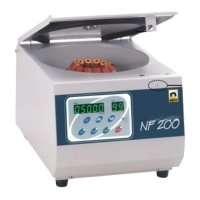
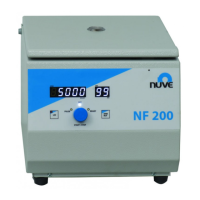
The NÜVE NF 200 Bench Top Centrifuge is a laboratory instrument designed for the separation of blood samples, sedimentation of urine particles, and the separation of various substances or mixtures. It features a programmable microprocessor control system that allows for the setting of speed, RCF (Relative Centrifugal Force) value, and time. A "pulse" function is also available for short spins.
The NF 200 ensures safe operation through a locking system that prevents the centrifuge from operating if the lid is open and prevents the lid from being opened while the rotor is spinning. The device provides audible and visible alarms to inform the operator about an open lid, program completion, or any error conditions. In the event of a power failure, the lid can be opened manually using a specialized tool. An observation hole on the lid allows for speed verification with a tachometer. The NF 200 is supplied with a 12x15 ml angle rotor made of polypropylene.
The centrifuge is designed for indoor use only, with an ambient temperature range of 5 °C to 25 °C and a maximum relative humidity of 80% for temperatures up to 22 °C. The maximum altitude for operation is 2000 m, with optimal performance between 15 °C and 25 °C.
The control panel includes a Status Display (showing speed, RCF, acceleration/braking status, power failure, lid open/close status, and error codes), a Time Display (showing run time), a LID Key (to open the lid), a LID Indicator LED (indicating an open or improperly closed lid), an ENCODER Button (for programming, setting values, and starting/stopping the device), a READY LED (indicating readiness to run), an RPM/RCF Key (to check values during operation), a PULSE LED (indicating program menu), and a Set Menu LED (indicating set value menu).
Users can set the rotor type, speed, time, acceleration, and braking rates. The process involves loading samples with attention to dynamic and static balances, setting parameters, closing the lid, and then using the Encoder button to select RCF or RPM, adjust speed, and set operating time. The device starts when the "READY" expression appears and the Encoder button is pushed.
In Pulse mode, the user can reach the desired speed by pressing and holding the Encoder button within the set RPM speed limits. The rotor operates according to the set acceleration and braking values. The timer starts counting when the rotor begins to accelerate, and stops when the Encoder button is released, initiating braking.
The lid is locked when the rotor is spinning and cannot be opened. The centrifuge will not operate if the lid is open or not properly closed.
In case of power failure or defects, the lid can be opened manually by powering off the instrument, inserting the manual lid opening tool into the front hole, and pushing it vertically until the lid opens. It is crucial to ensure the rotor has stopped spinning before attempting manual lid opening. After manual opening, the device should be turned off and on again.
Before use, the rotor should be checked for corrosion and cleanliness. Any particles in the inserts can cause tube breakage and imbalance. The central hole of the rotor and motor shaft must be clean and dry.
Tubes must be balanced by weight, with diametrically opposite inserts having equal weight. If fewer tubes than capacity are used, they must be placed in opposite inserts. For an odd number of tubes, a water-filled tube of equal weight should be used for balancing. Imbalance can cause significant damage. Liquids should never be introduced directly into tube inserts. Tubes must be able to withstand the set speeds.
The rotor is driven by a three-phase asynchronous motor, with the microprocessor control system ensuring correct drive speed. The centrifuge prevents operation at speeds the rotor cannot mechanically withstand.
Nüve aluminum rotors are designed for long-term use at proper RCFs. Regular checks of accessories are important, as laboratories often have conditions that lead to corrosion. Corrosive samples require more than just water rinsing; residuals can dissolve in water and humidity, affecting the rotor and buckets. Particles sticking to tubes, buckets, and adapters can damage the anodized surface during centrifugation, promoting corrosion.
Disconnect the centrifuge before cleaning. Daily cleaning is only necessary if a tube breaks or liquid spills.
High voltages are present behind the panels. Do not open the centrifuge.
The device and its components must be disposed of according to local regulations. Electronic accessories (without batteries/power packs) should be disposed of as electronic components. Batteries, power packs, and similar power sources must be dismounted and disposed of separately according to applicable regulations.
 General
| Brand | NUVE |
|---|---|
| Model | NF200 |
| Category | Laboratory Equipment |
| Language | English |

 To Next Page