6
P/N 30149, Rev. G [12/15/2016]
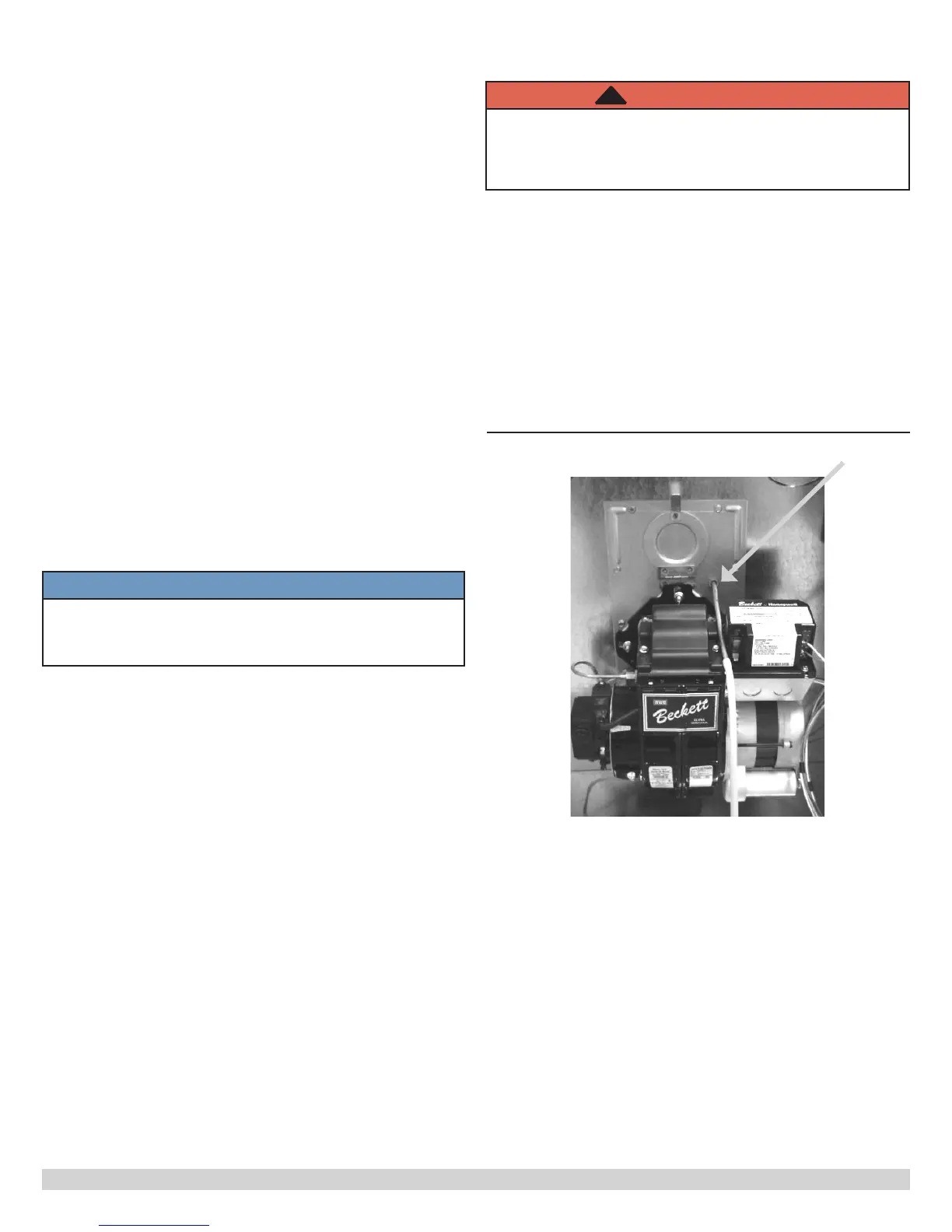
Manufacturer recommends over re draft of -0.02 in. w.c.
See gure 2.
Flue pipe must not pass through any oor or ceiling,
may pass through a wall where suitable re protection
provisions have been installed.
• Refer to CAN/CSA B-139 for rules governing the
installation of oil burning equipment.
• United States, refer to NFPA 31 for regulations
governing the installation of oil burning equipment.
See appendix A for burner set-up.
Over-re draft access port.
7. Combustion Air
Comply with CSA B139 (Canada) or NFPA 31 (U.S.)
standards for the Installation of Oil Burning Equipment
and applicable provisions of local building codes to provide
combustion and ventilation air.
8. Chimney Venting
• Flue pipe should be as short as possible with
horizontal pipes sloping upward toward the chimney
at a rate of one-quarter inch per foot.
• Flue pipe should not be smaller in cross sectional
area than ue collar on the furnace.
• Flue pipe should connect to chimney so the ue pipe
extends into, and terminates ush with the inside
surface of chimney liner. Seal the joint between pipe
and lining.
• Chimney outlet should be at least two feet above
highest point of peaked roof.
• All unused chimney openings should be closed.
• Chimneys must conform to local, provincial or state
codes, or in the absence of local regulations, to the
requirements of the National Building Code.
NOTICE
This furnace is approved for use with Type L vent or
equivalent. Maximum vent temperature for Type L
vent is 575°F (300C).
WARNING
Asphyxiation hazard. Chimney vented versions of furnace
must be connected to ue having sufcient draft at all
times. Failure to follow these instructions could result in
death or serious injury.
!
Figure 2 - Check Over-Fire Draft



 To Next Page