For proper furnace operation, air ow over the heat exchanger is of
utmost importance. Insu cient air ow accelerates metal fatigue and
failure in the heat exchanger and excessive air ow promotes acceler-
ated corrosion of the heat exchanger.
NOTICE
IMPORTANT: Do not bypass this step of the start up
procedures.
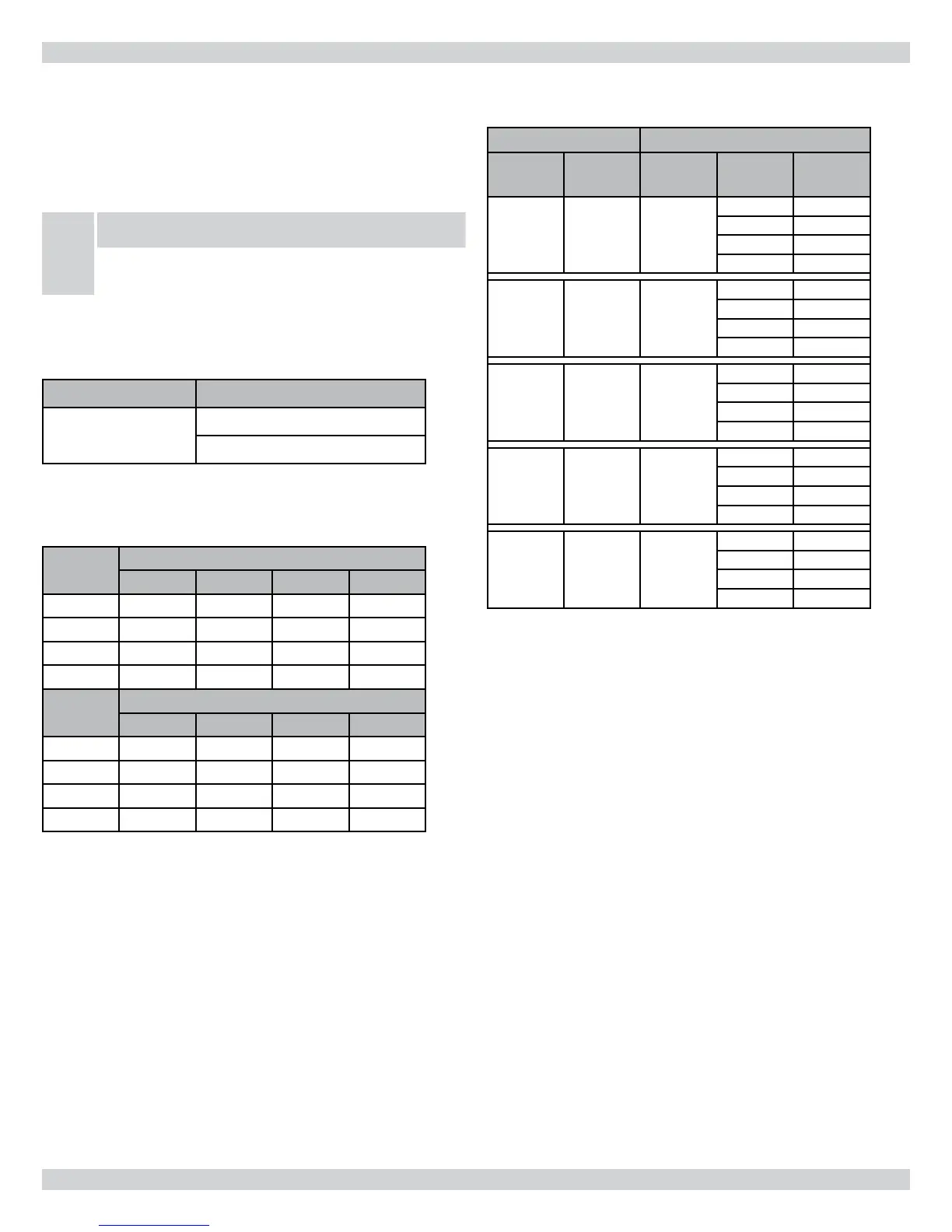
TABLE 1A - RANGE OF TEMPERATURE RISE
Furnace Model Temperature Rise
60, 80, 100, 120
High Fire (HF) 35 - 65°F
Low Fire (LF) 25 - 55°F
TABLE 1B - AIR FLOW FOR TEMPERATURE RISE
Furnace
Model
High Fire (HF) CFM Required for a ▲T of:
35 45 55 65
60 1501 1167 955 808
80 2001 1557 1274 1078
100 2502 1946 1592 1347
120 3002 2335 1910 1616
Furnace
Model
Low Fire (LF) CFM Required for a ▲T of:
25 35 45 55
60 901 700 573 485
80 1201 934 764 647
100 1501 1167 955 808
120 1801 1401 1146 970
Temperature Rise Check
When the duct system is complete and the air lter or lters are in
place, determine if the air ow is correct for both low and high re
input rates..
1.
Insert a duct thermometer in the supply air duct. e thermom-
eter should be placed as close as practical to the furnace, but out
of the “line of sight” of the heat exchanger (this prevents false
readings owing to radiant heat). Ensure that the thermometer
location is within the duct air stream. Avoid locations such as
the inside radius of an elbow, etc.
TABLE 10 - AIR FLOW
MODEL 95V ESP 0.1” to 1.0” w.c.
Input
A/C
Tonnage
ADJUST
Jumper
COOL
Jumper
CFM
60000 3 Ton NORM
A 1200
B 1000
C 800
D 600
80000 3 Ton NORM
A 1200
B 1000
C 800
D 600
80000 4 Ton NORM
A 1600
B 1200
C 1000
D 800
100000 5 Ton NORM
A 2000
B 1600
C 1200
D 800
120000 5 Ton NORM
A 2000
B 1600
C 1200
D 800
Note: Moving the ADJUST jumper from the NORM position to the
(+) or (-) position will increase or lower the CFM by 15%
2.
Insert a duct thermometer in the return air duct as close to the
furnace as practical. Ensure that the thermometer location will
be una ected by humidi er bypass ducts, etc. Choose a location
well within the main air stream.
3.
Operate the furnace long enough to obtain steady state condi-
tions at both input rates (High Fire and Low Fire).
4.
When the two thermometers have stabilized, usually within
5-8 minutes, compare the two readings. Subtract the return air
temperature from the supply air temperature. e di erence is
the temperature rise, also called ∆T.
5.
Compare the measured ∆T to the temperature rise range shown
on the rating plate. Unless stated di erently on the rating plate,
the temperature rise should normally range between 35° to 65°F
High Fire, 25° to 55°F Low Fire. When adjusting the tempera-
ture rise, the ideal temperature is approximately mid-range.
If the measured ∆T is above the approved temperature range,
there is too little air ow. It must be increased by selecting the
appropriate “HEAT” jumper setting , removing restrictions
in the ductwork, or adding supply or return
ductwork.
If the measured ∆T is too low, there is too
much air fl ow.
23 AIR FLOW
44


 To Next Page