EasyManua.ls Logo

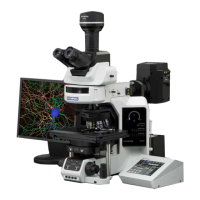
Olympus BX3-RFAS - User Manual

Olympus BX3-RFAS
36 pages
Print Icon
To Next Page IconTo Next Page
Loading...
INSTRUCTIONS
This instruction manual is for the Olympus Reflected Fluorescence System. To ensure the safety,
obtain optimum performance and to familiarize yourself fully with the use of this system, we
recommend that you study this manual thoroughly before operating the microscope. Retain this
instruction manual in an easily accessible place near the work desk for future reference.
A X 7 8 8 8
BX3-URA
BX3-RFAS
U-LH100HGAPO
U-LH100HG
U-RFL-T
U-AN-2
BX3-25ND6
BX3-25ND25
REFLECTED
FLUORESCENCE
SYSTEM

Questions and Answers

  • J
    John HughesAug 6, 2025
    Why can't I see anything through my Olympus Microscope, even though the burner is on?
    • A
      Allison JohnsonAug 6, 2025
      If the burner is on but the image from your Olympus Microscope is dark, first ensure the shutter is open. Then, check if the ND filter is engaged and remove it if necessary. Verify that the fluorescence mirror unit is correctly engaged and matches the specimen. Also, make sure that the aperture and field iris diaphragms are centered and fully enlarged.
  • L
    Laurie HuntAug 11, 2025
    What to do if the field of view on my Olympus BX3-RFAS Microscope is obscured?
    • N
      Nathaniel Martinez Jr.Aug 11, 2025
      If your Olympus Microscope's field of view is obscured, ensure the objective and fluorescence mirror unit are correctly engaged in the light path. The revolving nosepiece and ND slider should click into place properly. Also, check that the field iris diaphragm is not set too small; center the aperture iris diaphragm and field iris diaphragm, then fully enlarge the field iris diaphragm. Finally, ensure the mercury burner is properly centered.
  • R
    richard06Aug 16, 2025
    Why is the mercury burner flickering on my Olympus Microscope?
    • M
      Melissa LopezAug 16, 2025
      If the mercury burner of your Olympus Microscope flickers or appears dark, wait at least 10 minutes after ignition for it to stabilize. If the issue persists and the hour counter indicates 300 hours (USH-103OL), replace the mercury burner. Also, ensure the burner is centered on the optical axis.
  • E
    Emily PattonAug 21, 2025
    How to improve the image quality of my Olympus BX3-RFAS Microscope?
    • J
      jennifer26Aug 21, 2025
      If the image from your Olympus Microscope appears low quality, not sharp, or poor in contrast, start by thoroughly cleaning the objective and filter for any dirt or dust. Also, verify that the fluorescence mirror unit matches the specimen you are viewing.
  • T
    Tyler MooreAug 27, 2025
    What causes dark spots in the field of my Olympus BX3-RFAS?
    • N
      Natasha CrossAug 27, 2025
      If your Olympus Microscope field contains dark, spot-like areas, the burner or the burner side of the collector lens may be dirty or dusty. Clean these components to resolve the issue.
  • K
    Kelsey ArnoldAug 31, 2025
    Why won't the mercury burner light on my Olympus Microscope?
    • C
      Christopher EatonAug 31, 2025
      If the mercury burner on your Olympus Microscope does not light even when the main switch is set to “I” (ON), first, ensure all connectors are firmly connected. Then, check that the mercury burner is properly attached. Verify that the safety device in the lamp housing is correctly set up. If auto ignition is malfunctioning, set the main switch of the power supply unit to “ ” (OFF) then “I” (ON) again, repeating as needed.

Summary

Safety Precautions and Important Information

Important General Information

General information and guidance for safe operation of the system.

Nomenclature and Component Identification

Reflected Fluorescence Observation Procedure

Using the Controls and System Operation

General Precautions for Observation

Provides essential precautions for operating the reflected fluorescence system.

Selecting the Fluorescence Mirror Unit

Guidance on choosing the correct fluorescence mirror unit for specific applications.

Turning the Power Supply Unit On

Instructions for powering up the system and waiting for stabilization.

Centering the Field Iris Diaphragm

Procedure for aligning the field iris diaphragm for optimal illumination.

Centering the Aperture Iris Diaphragm (BX3-URA)

Procedure for aligning the aperture iris diaphragm for optimal contrast.

Centering the Mercury Burner

Steps for aligning the mercury burner for consistent illumination.

Mounting the ND Filters

Attaching the Light Shield Sheet

Simultaneous Fluorescence Observations

Simultaneous Reflected Fluorescence and Phase Contrast Observations

Combining reflected fluorescence with phase contrast observation methods.

Simultaneous Reflected Fluorescence and Transmitted Light DIC Observations

Combining reflected fluorescence with transmitted light DIC observation.

Troubleshooting Guide

Spectral Characteristics of Filters

Specifications and Technical Details

Assembly and Installation Procedures

Assembly Diagram

Visual guide showing the sequence of assembling microscope modules.

Detailed Assembly Procedures

Step-by-step instructions for assembling various microscope components.

Attaching the Mercury Burner and Lamp Housing

Procedure for correctly installing the mercury burner and lamp housing.

Making an Optional Fluorescence Mirror Unit

Instructions for fabricating custom fluorescence mirror units.

Lamp Housing Inspection Sheet

Proper Selection of Power Supply Cord

Olympus BX3-RFAS Specifications

General IconGeneral
Observation MethodBrightfield, Darkfield, Phase contrast, DIC, Polarized light, Fluorescence
Microscope TypeUpright Research Microscope
IlluminationLED or Halogen
Nosepiece6-position revolving nosepiece
Optical SystemInfinity-corrected optical system
Objective LensesUIS2 series objectives
StageMotorized or manual stage
Camera PortC-mount camera port
Software CompatibilityOlympus cellSens software
DimensionsVaries by configuration
WeightVaries by configuration

Related product manuals