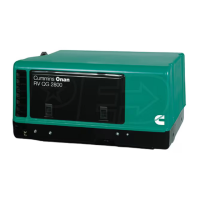
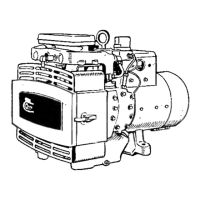
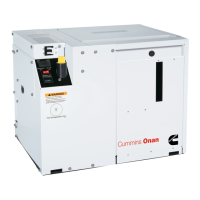
This document is an Operator's Manual for Onan DFM and DFP Diesel Fueled GenSets, providing essential information for operation, maintenance, and troubleshooting.
Function Description:
The Onan DFM and DFP GenSets are diesel-fueled generator sets designed to provide electrical power. They are equipped with an engine control module that monitors various engine parameters and provides protection functions, including overcrank, overspeed, low oil pressure, and high engine temperature shutdowns. The generator sets can be started locally from the control panel, remotely via a switch, or automatically through a transfer switch in standby applications. They are designed for continuous standby service and can be exercised regularly to ensure reliability.
Important Technical Specifications:
The manual details specifications for various models: 200 DFP, 250 DFM, 275 DFM, and 300 DFM.
- Engine: Cummins Diesel Series.
- 200 DFP: NT 855 G2, 355 BHP (265 kW) Gross Power at 1800 r/m.
- 250 DFM: NT 855 G3, 390 BHP (290 kW) Gross Power at 1800 r/m.
- 275 DFM: NTA 855 G1, 425 BHP (317 kW) Gross Power at 1800 r/m.
- 300 DFM: NTA 855 G2, 465 BHP (347 kW) Gross Power at 1800 r/m.
- Generator (Onan 3 Phase):
- 60 Hz YB:
- 200 DFP: 200 kW (250 kVA @ 0.8 PF)
- 250 DFM: 250 kW (312 kVA @ 0.8 PF)
- 275 DFM: 275 kW (343 kVA @ 0.8 PF)
- 300 DFM: 300 kW (375 kVA @ 0.8 PF)
- 50 Hz YB:
- 200 DFP: 165 kW (206 kVA @ 0.8 PF)
- 250 DFM: 210 kW (262 kVA @ 0.8 PF)
- 275 DFM: 250 kW (312 kVA @ 0.8 PF)
- 300 DFM: 275 kW (343 kVA @ 0.8 PF)
- Electrical System: 24 Volts DC starting voltage, using two 12-Volt BCI-8D batteries.
- Coolant System:
- Capacity (Standard Radiator): 14-19 gallons (53-72 litres) depending on model.
- Radiator Air Discharge (Static Pressure): 0.25 inch H2O (0.018 inch Hg) for all models.
- Lubricating System:
- Oil Type: SAE 10W-30 (-25°C to 35°C), SAE 15W-40 (-10°C and above), SAE 20W-40 (0°C and above).
- Oil Capacity (Filters, lines & Crankcase): 32.8 quarts (31 litres) for all models.
- Unit Weight (Not including oil, fuel or coolant): Ranges from 5930 lbs (2692 kg) for 200 DFP to 6650 lbs (3019 kg) for 300 DFM.
- Control Panel: Features a standard Detector 2 (two-lamp) or optional Detector 12 (twelve-lamp) monitoring system. The AC voltage regulator (VRAS-2) controls output voltage with a regulation of ±2% from no load to full load.
- Governor: Cummins model EFC electric governor with potentiometers for Idle Speed, Run Speed, Gain, and Droop adjustments. Governed speeds are 60.0 Hz (1800 RPM) for isochronous operation, 61.8 Hz (1854 RPM) for 3% speed droop, and 63.0 Hz (1890 RPM) for 5% speed droop (for 60 Hz full load). For 50 Hz full load, speeds are 50.0 Hz (1500 RPM) for isochronous, 51.5 Hz (1545 RPM) for 3% droop, and 52.5 Hz (1575 RPM) for 5% droop.
Usage Features:
- Prestart Checks: Before starting, operators must check engine oil level, coolant level, and ensure sufficient fuel.
- Starting Procedures: The generator set can be started from the control panel (RUN position), a remote location (REMOTE position), or automatically via a transfer switch. The starter disengages when the engine reaches 450-570 r/min.
- Stopping Procedures: For manual stops, move the Run/Stop/Remote switch to STOP. For automatic transfer switch setups, the unit stops automatically after normal power returns. It is recommended to run the generator at no load for 3-5 minutes before stopping to dissipate heat.
- Break-In: New generator sets require an oil change after the first 50 hours of operation.
- No-Load Operation: Should be minimized. If prolonged running without electrical output is necessary, a "dummy" electrical load is recommended.
- Exercise Period: For continuous standby units, regular exercising (at least once a week for 30 minutes with load) is crucial for lubrication, preventing electrical contact oxidation, and ensuring reliable starting.
- High/Low Operating Temperatures: Coolant heaters are recommended for reliable starting in adverse weather conditions.
- Control Panel Monitoring: The DC panel monitors engine parameters (oil pressure, water temperature, battery charge rate, running time, engine r/min), while the AC panel monitors generator output (voltage, current, wattage, frequency). Indicator lamps provide visual alerts for various conditions (RUN, FAULT, PRE LO OIL PRES, PRE HI ENGINE TEMP, LO OIL PRES, HI ENG TEMP, OVERSPEED, OVERCRANK, LO ENG TEMP, LO FUEL, SWITCH OFF).
- Fault System: The engine control module provides protection against overcrank, overspeed, low oil pressure, and high engine temperature, shutting down the engine and lighting a fault lamp when critical conditions occur.
Maintenance Features:
The manual outlines a comprehensive maintenance schedule (Daily/8 hours, Weekly/50 hours, Monthly/100 hours, 6 Months/250 hours, Yearly/500 hours) covering various components:
- General Inspection: Check for leaks (oil, fuel, cooling, exhaust), secure fasteners, and cleanliness.
- Lubrication System:
- Check oil level regularly.
- Change oil and filter at recommended intervals (e.g., 50 hours for break-in, then as per schedule).
- Use API Class CC/CD oil with appropriate viscosity based on ambient temperature. Synthetic oil is recommended for extreme cold.
- Clean crankcase breathers periodically.
- Coolant System:
- Check coolant level regularly.
- Use clean water, low in mineral content, and precharged with anti-corrosion additive (DCA). Antifreeze is required for freezing conditions.
- Change coolant filter as per schedule.
- Test DCA concentration periodically and add more if needed.
- Flush and clean the cooling system to remove rust and scale.
- Check zinc plugs in the heat exchanger and replace if eroded.
- Clean the coolant heater for efficient operation.
- Fuel System:
- Prevent dirt, water, or contaminants from entering the fuel system.
- Keep fuel tanks as full as possible to minimize condensation.
- Drain water and sediment from fuel tanks and fuel filters regularly.
- Replace fuel filters as per schedule.
- Air Cleaner:
- Check and service the filter element as per schedule.
- The paper cartridge filter element can be cleaned with compressed air and water/solvent, then air-dried.
- AC Generator:
- Inspect rotating rectifier assembly (diodes) for dust, dirt, and grease.
- Blow out assembly with filtered low-pressure air periodically.
- Generator bearing inspection every 1000 hours, replacement every 10,000 hours (prime power) or five years (standby power).
- Batteries:
- Check connections for cleanliness and tightness.
- Keep electrolyte at proper level with distilled water.
- Check specific gravity with a hydrometer and recharge if below 1.260.

 Need help?
 General

 To Next Page