
 Need help?
Do you have a question about the Osaka F 500 and is the answer not in the manual?
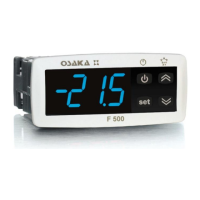
The OSAKA F 500 / F 500-RS is a digital electronic microprocessor controller primarily designed for refrigeration applications. It offers temperature control with ON/OFF regulation and sophisticated defrosting capabilities. The device can manage defrosting based on a Real Time Clock, time intervals, temperature thresholds, or continuous compressor operation. It includes special functions for defrosting optimization and energy reduction within the controlled system.
The controller features up to four relay outputs and up to four configurable inputs for PTC, NTC, and Pt1000 temperature probes, along with two digital inputs. An internal buzzer provides acoustic alarm notifications, and an RS485 serial communication interface with MODBUS-RTU protocol allows for integration into larger systems. A calendar clock enables scheduling of various events, such as defrosting, auxiliary output switching, set point changes, and instrument on/off, with up to 14 daily and 98 weekly events. The calendar clock version also includes an HACCP function, which stores the last 10 alarms with details like type, start time, duration, and temperature peaks. The outputs can control the compressor, defroster, evaporator fans, and a configurable auxiliary device (e.g., light, alarm, second evaporator).
The F 500 / F 500-RS supports multiple operating modes: "Normal," "Economic," and "Turbo." These modes allow for different regulating set points (SP, SPE, SPH) and corresponding differentials (r.d, r.Ed, r.Hd). Switching between these modes can be manual or automatic, based on programmed events or digital input signals, such as a door opening. The "Turbo" mode is particularly useful for rapid product temperature reduction after loading a refrigerator or for restoring product temperature after an economical mode.
The device measures and displays temperature from up to four probes, which can be configured for cell, evaporator, product, or condenser temperatures. It supports various probe types (PTC, NTC, Pt1000) and allows for selection of temperature units (°C or °F) and resolution (1° or 0.1°). Probe calibration is also possible. Digital inputs can be configured for functions like door signals, defrost commands, set point selection, external alarms, continuous cycle activation, or auxiliary output activation.
Alarm functions are comprehensive, including temperature alarms (high/low for two levels), external alarms from digital inputs, and an open door alarm. Alarms are indicated by an ALARM LED, an internal buzzer, and configurable outputs. The HACCP function records critical alarm data, which can be reviewed and managed. The instrument also features a keyboard lock function to prevent unauthorized modifications.
The controller is programmed via its front panel keys. A "SET" key allows for fast programming of the set point and access to function parameters. "UP" and "DOWN/AUX" keys are used to adjust values and select parameters. A "STAND-BY" key enables visualization of instrument variables and returns to normal mode. Manual defrosting can be initiated or stopped using the "UP/DEFROST" key.
Parameters are organized into groups, and access can be protected by a password. The device allows for customized parameter programming, where specific parameters can be made accessible without a password. A reset function restores parameters to factory default values. The calendar clock requires initial setup of current time and date.
The display provides clear indications of operating status, including output status (cooling, heating, defrosting, fan, auxiliary), alarm status, and clock status. The "Eco" label appears in economical mode, and "trb" indicates "Turbo" mode. Alarm messages and HACCP data are displayed as needed.
The manual emphasizes the importance of correct installation and adherence to safety regulations. It recommends periodic checks and verification of thermometers in compliance with standards. The device is designed for flush-in panel mounting, with attention to adequate ventilation and avoidance of high humidity or dirt. Electrical wiring should follow the provided diagram, ensuring proper power supply and load current. Overload protection and a circuit-breaker are required for the installation.
For maintenance, the instrument should be cleaned with a slightly wet cloth using water, avoiding abrasive cleaners or solvents. The device has a 12-month guarantee for manufacturing defects. In case of a defective product, users should contact post-sales service and follow the RMA (Return Material Authorization) procedure. The manual also provides a troubleshooting guide with common error messages and corresponding actions, such as checking probe connections or pressing the SET key. The internal clock has a lithium battery with an approximate lifespan of 5 years.
 General
| Input Voltage | 24 VDC |
|---|---|
| Output Voltage | 24 VDC |
| Number of Inputs | 16 |
| Communication Ports | RS-232 |
| Operating Temperature | 0°C to 50°C |

 To Next Page