OSAKA – USER MANUAL – F 500 / F 500-RS – V.1 – Page 1
The outputs can be configured for the following functions:
= ot - to control the compressor or however, the temperature control
device
= dF - to control the defrosting device (1)
= Fn - to control the evaporator fans
= Au - to control the auxiliary device
= At - to control a silenceable alarm device through a contact that is
normally open, and then closed when the alarm sounds
= AL - to control an alarm that cannot be silenced through a contact
that is normally open and closed when the alarm sounds.
= An - to control an alarm with a memory function through a contact
that is normally open and closed when the alarm sounds.
= -t - to control a silenceable alarm device through a contact that is
normally closed, and then open when the alarm sounds.
= -L - control an alarm that cannot be silenced through a contact
that is normally closed and open when the alarm sounds.
= -n - to control an alarm with a memory function through a contact
that is normally closed and open when the alarm sounds.
= on - Output on when the instrument is in on state. This mode can
be used to control lights, non-misting resistance on room door or
other utilities
= HE - to control an heating device in neutral zone control mode
(“r.HC” = nr).
= 2d - to control the defrosting device n. 2
= L1 - Light output managed by Normal / Economy mode.
This output will be on in Normal mode and off in Economy mode
operation.
= L2 - Internal Light output managed by digital input. This output will
be on when door is opened (only if “i.xF”= 1, 2, 3).
= oF - Disabled output
The function carried out for auxiliary output (par. desired output =
Au) is defined by the parameter “o.Fo” and the function is
conditioned by the time set in parameter “o.tu”.
The parameter “o.Fo” can be configured for the following functions:
= oF - Auxiliary output not active
= 1 - Temperature control output delayed with contact normally
open: the auxiliary output is activated with delay that can be set on
the parameter "o.tu" compared to the output configured as ot. The
output is then turned off at the same time as the ot output is
disabled. This function mode can be used as a command for a
second compressor or for all other working utilities according to the
same ot output conditions, but which must be delayed after the start
up of the compressor to avoid excess electricity absorption.
= 2 - Activation by front key (STAND-BY or DOWN/AUX) or by
digital input or by Real Time Clock : the output is activated by
pressing the keys STAND-BY or DOWN/AUX suitably configured
(“t.UF” or “t.Fb” = 1), by a digital input suitably configured (“i.xF” = 9)
or by Real Time Clock event. The commands by keys or digital
inputs have a bi-stable function. Which means that when first
pressed, the output is activated while the second is disabled. In this
mode, the AUX output can be turned off automatically after a certain
time that can be set on the parameter "o.tu". With "o.tu" = oF the
output is activated and deactivated only manually, using the key
(STAND-BY or DOWN/AUX). Differently, the output, once activated,
is turned off automatically after the set time. This function can be
used, for example, as a cell light command, for non-misting
resistance or other utilities.
If are programmed activation / deactivation events of the auxiliary
output by Real Time Clock the action of the keys or digital input
mode force output status until the next event.
The internal buzzer (if present) can be configured by par. “o.bu” for
the following functions:
oF = Buzzer always disable
1 = Buzzer signal active alarms only
2 = Buzzer signal key pressed only (no alarm)
3 = Buzzer signal active alarms and key pressed
4.6 - TEMPERATURE CONTROL
Most of the parameters for temperature control functions are found
in the “
]
rE” group.
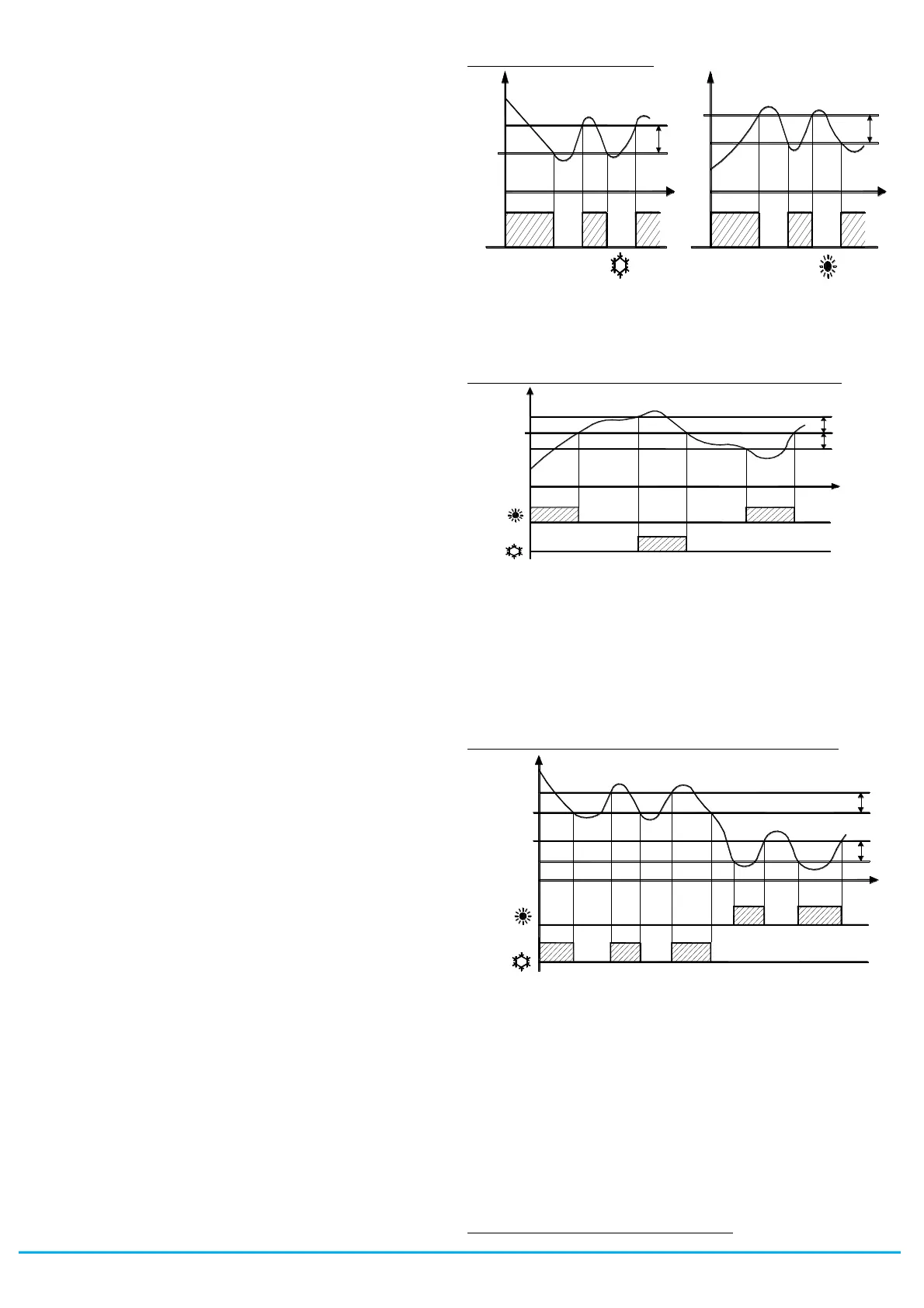
The instrument's method of regulation is of ON/OFF type acting on
the "ot"- and "HE"-configured outputs in response to: the reading of
the Pr1 probe; the active set point(s) “SP” (or “SPE” and/or
“SPH”); the intervention differential “r.d” (or “r.Ed” and/or “r.Hd”);
and the operating mode “r.HC”.
Via the parameter “r.HC” the following functions can be obtained:
= C (Cooling) or = H (Heating)
As regards the operating mode programmed in the "r.HC"
parameter, the regulator automatically assumes that the differential
has positive values for a Refrigeration control (“r.HC”=C), negative
values for the Heating control (“r.HC”=H).
= nr (Neutral Zone or Cooling and Heating a single set point)
If the parameter “r.HC” is programmed such that “r.HC” = nr the
output configured as “ot” operates with a cooling action (as “r.HC” =
C) whereas the output configured as “HE” operates with a heating
action. In this case the regulating set point for both outputs is
whichever of SP, SPE and SPH is active, and the intervention
differential (“r.d” or “r.Ed” or “r.Hd”) is automatically assumed by the
regulator to have positive values for the cooling action, negative
values for the heating action.
= HC (Cooling and Heating with two independent set points)
Similarly, if the parameter “r.HC” is programmed such that “r.HC” =
HC, the output configured as “ot” operates with a cooling action (as
“r.HC” = C) whereas the output configured as “HE” operates with a
heating action.
In this case the regulating set point for the "ot" output is whichever
of SP, SPE and SPH is active, whereas for the output "HE" the set
point is SPH.
The intervention differential for the “ot” output will be whichever is
active (“r.d” or “r.Ed” or “r.Hd”) and the regulator will automatically
assume it has positive values (in the case of Cooling) whereas for
the output "HE" it will be "r.HD" with values assumed to be negative
(in the case of Heating).
In this mode, activating the "turbo" cycle causes the instrument to
operate with neutral-zone regulation with set point SPH.
= C3 (Cooling with three automatic modes)
ON
r.H C = C
(ot)
O ut
P r1
T e m p.
SP
o ff
ON ON
o ff
r.H C = H
ONON
O ut
(ot)
tim e
r.d
SP
o ff
T e m p.
P r1
o ff
ON
tim e
r.d
o ff
O ut
O ut
(o t)
(H E )
o ff
0N
SP
P r1
T em p .
o ff
0N
r.d
r.d
tim e
0N
o ff
SP
(ot)
O ut
(H E )
O ut
ON
o ff
o ff
P r1
T e m p .
tim e
r.d
r.H C = H C
SPH
r.H d
o ff
o ff
ON ON
ON ON
o ff o ff


 To Next Page
 Loading...