OSAKA – USER MANUAL – F 500 / F 500-RS – V.1 – Page 1
If the evaporator probe is not used the duration cycle is set by the
parameter “d.dE”.
If instead the evaporator probe is used the defrost cycle end when
the temperature measured by the evaporator probe exceeds the
temperature set in the parameter “d.tE”.
If this temperature is not reached in the time set in the parameter
“d.dE”, defrosting is interrupted.
If the temperature measured by the probe is higher than the
temperature set in the parameter "d.tS" and “d.tE” the defrosting is
inhibited.
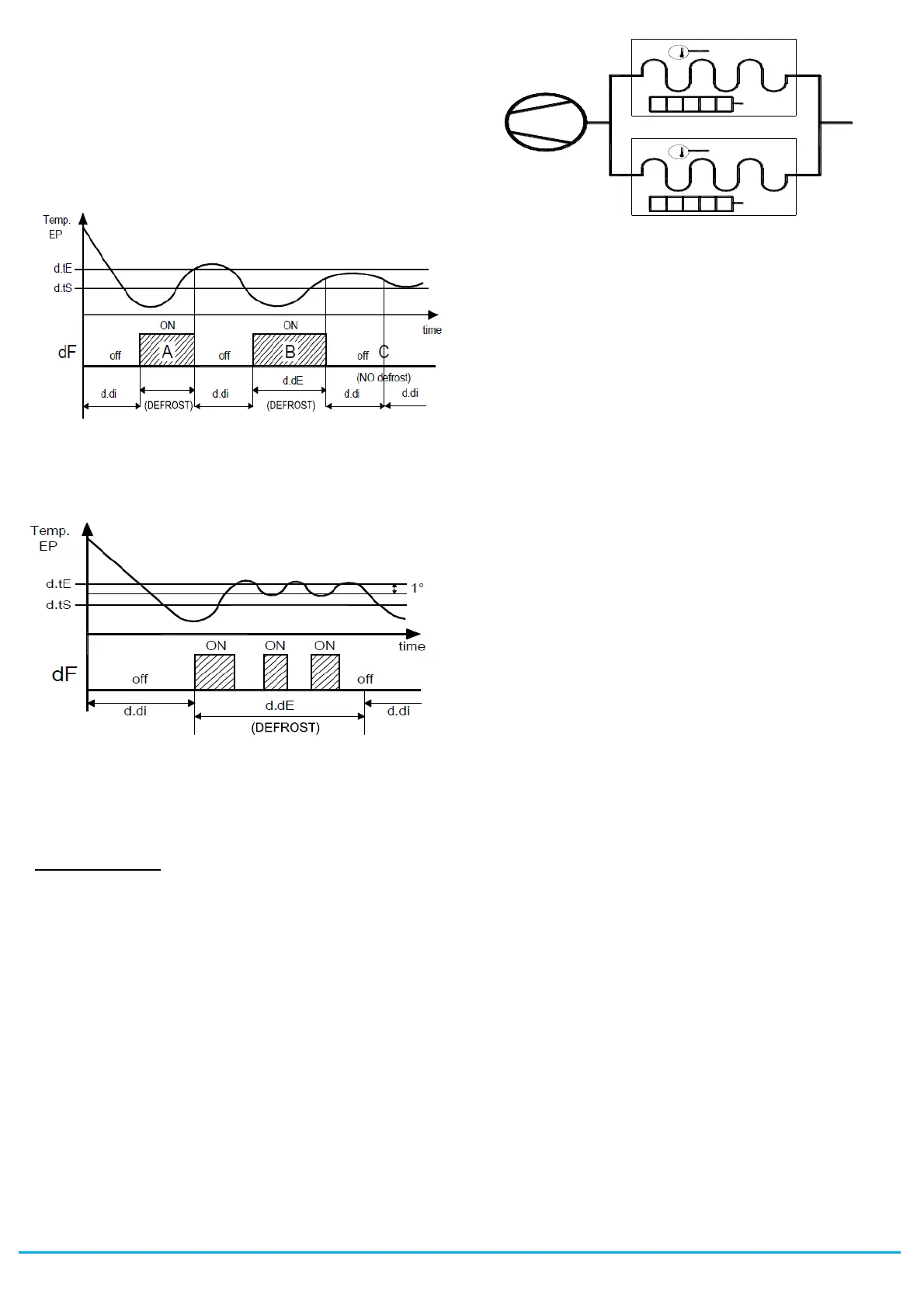
Examples: defrosting A ends due to reaching of temperature “dtE”,
defrosting B ends at the end of the “d.dE” time as the temperature
“d.tE” is not reached, defrosting C does not take place as the
temperature is higher than “d.tS”.
Example of electric defrost with evaporator temperature control: The
defrost end after "d.dE" programmed time. During defrost the “dF”
output switch on/off to control evaporator temperature in heating
mode with set point “d.tE” and 1° differential (Hysteresis).
With 2 evaporators
The instrument can also be used to control defrosts in twin-
evaporator systems (and in single evaporators large enough to
require two defrost control areas) by means of two defrost outputs
and two probe inputs for the two evaporators.
Defrosts are always launched simultaneously for both evaporators
and therefore the output configured as “2d” is always activated
jointly with the output configured as “dF”.
If the two evaporator probes are not used, the end of a defrost, in
the sense of deactivation of the defrosting outputs, happens
separately at the end of the times defined individually in the
parameters "d.dE" (for output "dF" which controls evaporator 1
defroster) and "d.d2" (for output "2d" which controls evaporator 2
defroster). The instrument can also be used to control defrosts in
twin-evaporator systems (and in single evaporators large enough to
require two defrost control areas) by means of two defrost outputs
and two probe inputs for the two evaporators.
Schematic example of plant with two evaporators with electric
defrosting.
However, the end of a defrost as a controller phase always occurs
when both times come to an end.
If the user wishes each of the two evaporators to have a probe, one
input must be configured as evaporator 1 probe (“i.Px” = EP) and
one input as evaporator 2 probe (“i.Px” = 2E).
In this case the instrument controls defrosting using the following
criteria:
– defrosting is enabled when at least one of the two readings is
below the temperature set in parameter “d.tS”
– defrosting by temperature starts when at least one of the two
readings remains below the temperature set in parameter “d.tF” for
time “d.St”
– the end of defrosting, in the sense of deactivation of the defroster
command outputs "dF" and "2d" in modes "d.dt" = EL, in, does not
occur separately for the two evaporators when their respective
temperatures sensed by the probes rise above the values set in
parameter “d.tE” (evaporator 1 with probe EP) and “d.t2”
(evaporator 2 with probe 2E).
If these temperatures are not reached within the times set in
parameters “d.dE” and “d.d2” their respective defrosting actions are
interrupted.
However, the end of defrosting as a controller phase occurs when
both readings exceed the intended values (or, if the temperatures
are not reached, when their maximum durations are reached).
If the selected defrosting mode is of the type employing electric
heating and thermostatting (“d.dt” = Et), the two defrosting outputs
“dF” e “2d” behave as temperature regulators with heating function
with the respective set points = “d.tE” (evaporator 1) and “dt2”
(evaporator 2), both with hysteresis fixed at 1°C and with reference
to the respective temperatures read at both evaporators.
If one of the two evaporator probes is not enabled or has an error,
its defrosting behaves as with selection EL (so the defrosting output
during defrosting must remain activated throughout).
Notes: The "Dynamic Defrost" function and the thermostatting
function of the fans operate always and only as a function of the
probe configured as EP (evaporator 1). If the control with the twin
evaporator is not used, it is recommended to set “d.d2 = oF in order
to avoid undesirable influences on total defrost duration.
The active defrost is shown on the instrument display with the
lighting up of the DEFROST led
At the end of defrosting, it is possible to delay the new start up of
the compressor (output “ot”) at the time set in parameter “d.td” to
allow the evaporator to drain.
During this delay, the led Defrost flashes to indicate the draining
state.
4.8.4 - DEFROSTS IN EVENT OF EVAPORATOR PROBE
ERROR
In event of evaporator probe error the defrosts occur at intervals
"d.Ei" and duration "d.EE”.
In case an error occurs when the time remaining to the start or the
end of defrost it’s lower than that normally set the parameters
related to error conditions probe, the start or the end take place with
the shortest time.
The functions are provided because when the evaporator probe is
used the defrost endurance time is usually set longer than
necessary (the time “d.dE” is a security time-out) and in case is
used the "Dynamic Intervals Defrost System” the interval is usually
T
E v a p . 1
E v a p . 2
"d F "
"E P "
"2 P "
T
"2 d "


 To Next Page
 Loading...