
 Need help?
Do you have a question about the Outback Saturn 4 and is the answer not in the manual?
Read instructions before use. Parts may be hot; keep children/pets away. Turn off gas after use.
Instructions for smelling gas: shut off gas, extinguish flame, open lid. Do not store flammable liquids nearby or gas bottles indoors.
Detailed safety rules and user responsibilities for barbecue operation.
Instructions for safely lighting burners and preheating the barbecue.
Solutions for problems with lighting burners using ignition or match.
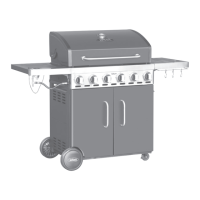
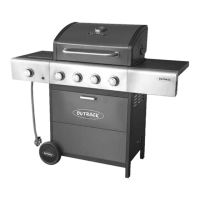
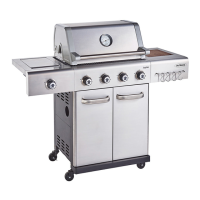
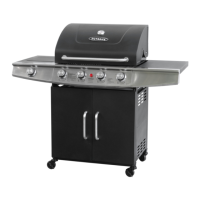
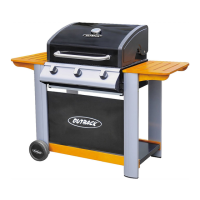
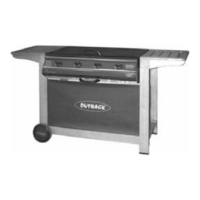
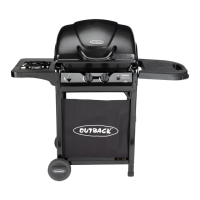
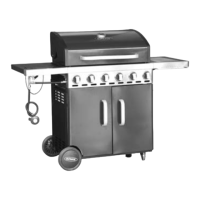
This document provides assembly and operating instructions for the Outback® NEW Saturn 4 Burner and Saturn 6 Burner Gas BBQs, designed for outdoor use only. It emphasizes safety, proper assembly, and maintenance to ensure optimal performance and longevity of the appliance.
The Outback® NEW Saturn Gas BBQ is a versatile outdoor cooking appliance designed for grilling, roasting, and baking. It features multiple burners, including a side burner, allowing for diverse cooking methods. The main cooking area is equipped with flame tamers, a round grill, and cooking grills, while a warming rack helps keep food warm. The roasting hood allows the BBQ to function as an oven for indirect cooking, ideal for larger cuts of meat or whole chickens. The side burner provides an additional cooking surface for pans and smaller utensils.
Assembly: The assembly process is detailed with step-by-step instructions and diagrams. Key components include the barbecue body, hood, control panel, burners, flame tamers, grills, drip tray, side shelves, and a trolley with wheels and lockable casters for mobility. Hardware, such as bolts, screws, and nuts, is provided and referenced in a diagram. Users are advised to remove all internal components and packaging before assembly and to exercise caution due to potential sharp edges. Tools required for assembly include a medium-sized flat blade or Phillips/Crosspoint screwdriver, an adjustable spanner, or a metric spanner set.
Gas Connection and Leak Testing: Before initial use and annually thereafter, or whenever the gas bottle is removed or replaced, a leak test is mandatory. All control knobs must be in the off position before turning on the gas supply at the bottle or regulator. Leaks are checked by brushing a solution of water and liquid detergent/soap over all gas system joints, including gas bottle valve, hose, and regulator connections. The formation of bubbles indicates a leak, requiring the gas supply to be turned off, joints retightened, and the test repeated. An open flame must never be used to test for leaks.
Lighting the Barbecue: To light the main burners, the barbecue hood must be open. All control knobs should be in the off position, and the gas control valve on the bottle or regulator opened. The desired burner's control knob is pushed in and turned anti-clockwise to the high position, held for 4 seconds, and then turned further until a click is heard and the burner ignites. This process is repeated for additional burners. If a burner fails to ignite, all knobs should be turned off, the gas valve closed, and after a 5-minute wait, the lighting procedure reattempted. Manual ignition involves inserting a lit match through the right match-lighting hole near the rightmost burner porthole, then pushing and turning the control knob anti-clockwise.
Lighting the Side Burner: The side burner lid must be raised. The side burner control knob is pushed in and turned anti-clockwise to the high position, while rapidly pressing the ignition button until the burner ignites. If it fails, the control knob should be turned off, and after a 5-minute wait, reattempt lighting or use a match.
Cooking: For grilling, the burners heat the flame tamers, which in turn heat the food on the grill. The vaporized food juices from the flame tamers impart a unique barbecued flavor. For roasting or baking, the hood is closed, and the barbecue functions as an oven. Food should be placed on a metal baking tray on one side of the cooking grill. The burner directly under the food should be turned off, and all other burners set to low to medium. The hood should remain closed as much as possible to maintain heat, and the temperature gauge can be used to monitor the internal temperature.
Flare-Up Control: To prevent excessive flare-ups, it is crucial to trim excess fat from meat and poultry, use cooking sauces and marinades sparingly, and avoid very cheap cuts of meat with high fat and water content. Burners should always be on the low setting during cooking. If flare-ups occur, they can be extinguished by applying baking soda or salt directly onto the flame tamers.
Safety Precautions: The barbecue is for outdoor use only, in a well-ventilated area, and on a stable, flat surface. It must not be used within 1 meter of flammable structures or surfaces, or under any combustible surface. LP gas bottles should never be placed directly underneath the barbecue or stored on their side. The hood must be open before lighting. The appliance should not be moved when lit and must not be left unattended. Accessible parts become very hot, so young children and pets should be kept away, and oven gloves should be used when handling hot parts. The gas supply must be turned off at the gas bottle after use.
General Cleaning: Regular cleaning is essential, especially after extended storage. The barbecue and its components must be cool before cleaning. It should not be exposed to outside weather conditions or stored in damp, moist areas. Covering the unit when left outside, particularly during winter months, is recommended. Any rust not in contact with food should be treated with a rust inhibitor and barbecue paint.
Cooking Surfaces & Warming Rack: After cooling, these parts should be cleaned with hot soapy water. A mild cream cleaner on a non-abrasive pad can be used for stubborn food residue. Scouring pads or powders should be avoided as they can damage the finish.
Burners: In normal usage, burning off residue after cooking helps keep burners clean. Annually, or when heavy build-up is observed, burners should be removed and cleaned to ensure no blockages in the portholes or primary air inlet. A pipe cleaner can be used to clear obstructions. Surface rust on burners is normal and can be cleaned with a soft brass wire brush.
Flame Tamer: Food residue should be removed from the flame tamer surface with a plastic or wooden scraper or brass wire brush. Steel scrapers or wire brushes should not be used. Clean with hot soapy water and rinse well.
Drip Tray: The drip tray (and foil liner, if applicable) must be emptied and cleaned after every use to prevent fat fires, which can be hazardous and damage the barbecue. A plastic or wooden scraper can be used for cleaning.
Barbecue Body: Excess grease or fat should be regularly removed from the barbecue body using a cloth wrung out in hot soapy water. A soft plastic or wooden scraper can be used for internal food debris. A nylon-bristled brush can be used for thorough cleaning. Gas controls and the manifold should not be immersed in water.
Barbecue Hood or Lid & Trolley: These parts should be cleaned with a non-abrasive cloth or pad and hot, soapy water. Abrasives should be avoided to prevent damage to the finish.
Stainless Steel: Stainless steel surfaces can be cleaned with a stainless steel cleaner or methylated spirits. Spotting should be addressed immediately to prevent permanent discoloration. Chlorine-based cleaners, wire brushes, steel wool, or abrasives should not be used as they can strip the protective layer and lead to rusting. Always rinse and allow to dry after cleaning.
Fixings: All screws and bolts should be checked and tightened regularly.
Storage: Before covering or storing, the barbecue must be properly cooled. It should be stored in a cool, dry place. Burners should be covered with aluminum foil to prevent insects or debris. If stored indoors, the gas bottle must be disconnected and left outside in a dry, well-ventilated area, away from heat or ignition sources.
 General
| Type | Gas Grill |
|---|---|
| Number of Burners | 4 |
| Burner Material | Stainless Steel |
| Material | Stainless Steel |
| Side Burner | Yes |
| Fuel Type | Propane |
| Dimensions | 139cm x 59cm x 115cm |



 To Next Page