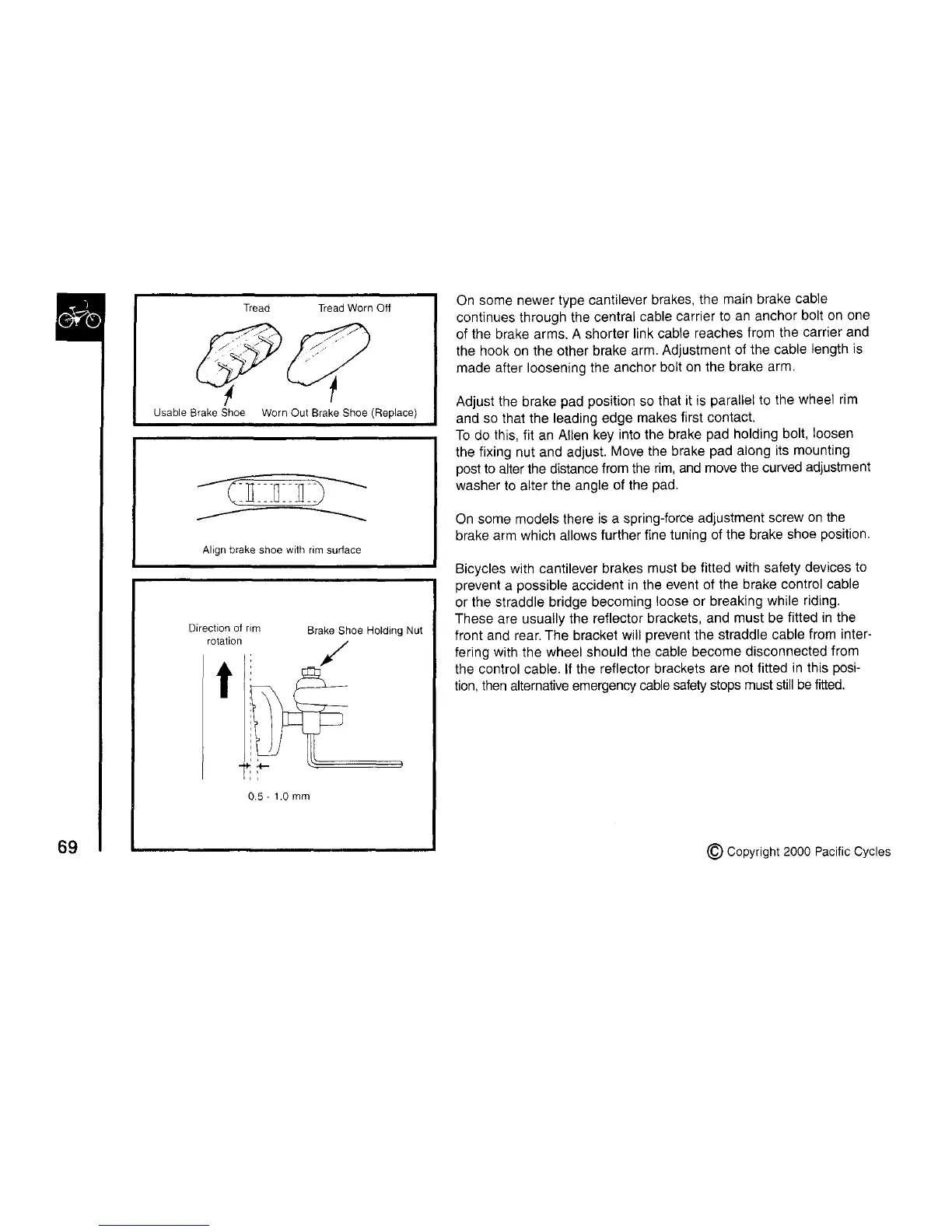
Tread
Usable Brake Shoe
Tread Worn Off
Worn Out Brake Shoe (Replace)
Align brake shoe with rim surface
Direction of rim
rotation
!
Brake Shoe Holding Nut
,/
0.5 - 1.0 mm
On some newer type cantilever brakes, the main brake cable
continues through the central cable carrier to an anchor bolt on one
of the brake arms, A shorter link cable reaches from the carrier and
the hook on the other brake arm. Adjustment of the cable length is
made after loosening the anchor bolt on the brake arm.
Adjust the brake pad position so that it is parallel to the wheel rim
and so that the leading edge makes first contact.
To do this, fit an Allen key into the brake pad holding bolt, loosen
the fixing nut and adjust. Move the brake pad along its mounting
post to alter the distance from the rim, and move the curved adjustment
washer to alter the angle of the pad.
On some models there is a spring-force adjustment screw on the
brake arm which allows further fine tuning of the brake shoe position.
Bicycles with cantilever brakes must be fitted with safety devices to
prevent a possible accident in the event of the brake control cable
or the straddle bridge becoming loose or breaking while riding.
These are usually the reflector brackets, and must be fitted in the
front and rear. The bracket will prevent the straddle cable from inter-
fering with the wheel should the cable become disconnected from
the control cable. If the reflector brackets are not fitted in this posi-
tion, then alternative emergency cable safety stops must still be fitted.
69 © Copyright 2000 Pacific Cycles



 To Next Page