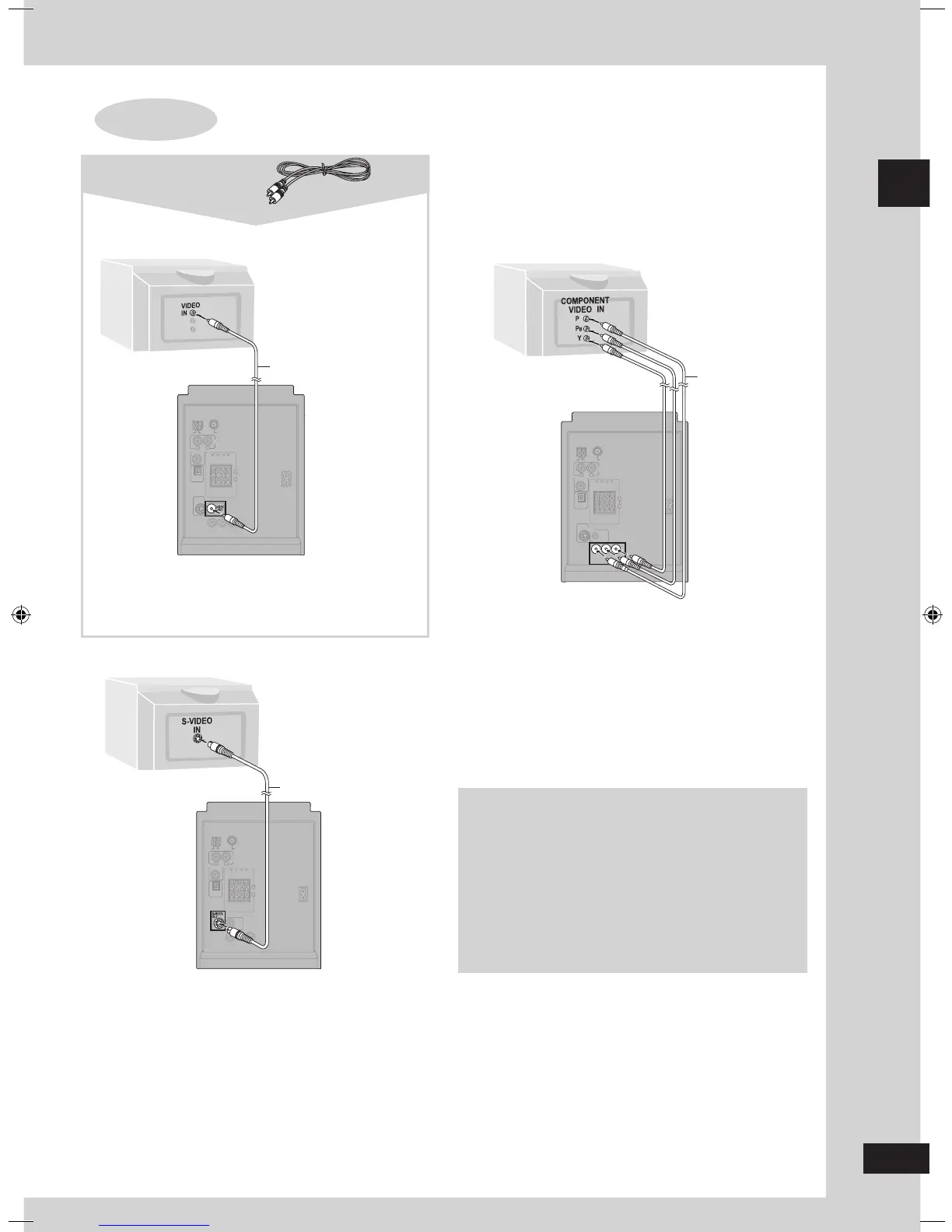
■ Connecting a television with a VIDEO IN terminal
VIDEO OUT terminal
Do not connect the unit through a video cassette recorder,
because the picture may not be played correctly due to the copy
guard.
Simple setup
Step 2: Television
Television
STEP 2
Video cable
■ Connecting a television with COMPONENT VIDEO IN
terminals
COMPONENT VIDEO OUT terminals
These terminals can be used for either interlace or progressive
output and provide a purer picture than the S-VIDEO OUT terminal.
Connection using these terminals outputs the color difference
signals (P
B
/P
R
) and luminance signal (Y) separately in order to
achieve high fidelity in reproducing colors. The description of the
component video input terminals depends on the television or
monitor (e.g. Y/P
B
/P
R
,Y/B-Y/R-Y, Y/C
B
/C
R
). Connect to terminals of
the same color.
• After making this connection, change the black level for a better
picture (“Video” tab - Black Level Control, ➡
page 21).
■ Connecting a television with an S-VIDEO IN terminal
S-VIDEO OUT terminal
The S-VIDEO terminal achieves a more vivid picture than the
VIDEO OUT terminal by separating the chrominance (C) and
luminance (Y) signals. (Actual results depend on the television.)
Video cables
To enjoy progressive video
1. Connect to the component video input terminals on a 480P
compatible television. (Video will not be displayed correctly if
connected to an incompatible television.)
2. Select “480p” for Video Output Mode (Picture Menu,
➡
page 19).
• All televisions manufactured by Panasonic and that have 480P
input connectors are compatible. Consult the manufacturer if
you have another brand of television.
• If the unit is connected to the television through VIDEO OUT
or S-VIDEO OUT, output will be interlace, irrespective of the
settings.
(included)


 To Next Page